
QJMotor SRV 300 Launched in India: Price, Specs & Features
QJMotor SRV 300 Makes Indian Debut at ₹3.29 LakhThe adventure motorcycle segment in India just got more interesting with the launch of QJMotor's SRV 300, priced at ₹3.29 lakh (ex-showroom). This marks an important expansion for the Chinese manufacturer in the Indian market, where adventure bikes hav...
Editorial Team
QJMotor SRV 300 Makes Indian Debut at ₹3.29 Lakh
The adventure motorcycle segment in India just got more interesting with the launch of QJMotor's SRV 300, priced at ₹3.29 lakh (ex-showroom). This marks an important expansion for the Chinese manufacturer in the Indian market, where adventure bikes have been gaining significant traction among enthusiasts.
What makes this launch particularly noteworthy is how it fills a specific gap in the entry-level ADV segment. At this price point, the SRV 300 positions itself as an accessible option for riders looking to enter the adventure touring space without breaking the bank.
From what I've observed, QJMotor seems to be targeting urban riders who occasionally venture to weekend getaways through varied Indian terrains. The timing is strategic too, as more Indians are exploring motorcycle tourism across the country's diverse landscapes - from the winding roads of the Western Ghats to weekend trips around metropolitan cities.
This launch also signals the growing competition in India's two-wheeler market, with more international brands recognizing the potential of our adventure-hungry riding community.
Engine Performance and Mechanical Specifications
At the heart of the SRV 300 sits a robust 292cc single-cylinder liquid-cooled engine, producing around 29 bhp of power and 27.5 Nm of torque. These figures position it competitively against rivals like the Royal Enfield Himalayan 411 and BMW G 310 GS in terms of raw output, though each has its distinct character.
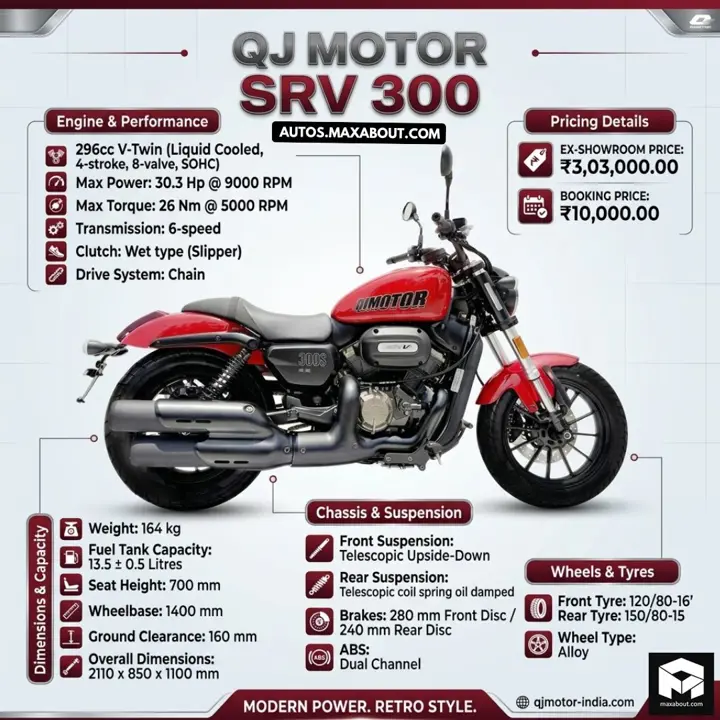 The engine comes paired with a 6-speed transmission that, based on early reviews, offers precise shifts - something crucial when navigating through unpredictable Indian road conditions. The liquid cooling system should prove particularly beneficial in our scorching summer traffic jams in cities like Delhi and Mumbai, where air-cooled engines often struggle.
From what I understand, the SRV 300 delivers a fuel efficiency of approximately 30-32 km/l under mixed riding conditions, which translates to a theoretical range of about 480-510 km from its 16-liter fuel tank. This makes it quite practical for those weekend rides to places like Lonavala from Mumbai or the Bangalore-Mysore stretch without frequent fuel stops.
The bike's power delivery appears to be tuned for mid-range performance rather than outright top-end, which I think is a sensible approach for Indian roads where overtaking capability and flexible power delivery matter more than absolute top speed. However, at ₹3.29 lakh, potential buyers will certainly be comparing its performance metrics carefully against more established competitors in this increasingly crowded adventure-touring segment.
Design and Ergonomics: Built for Indian Adventure Riding
The SRV 300 embraces a purposeful adventure styling with its tall stance, prominent beak-like front fender, and upright riding position. Standing at around 840mm, the seat height might be challenging for shorter Indian riders, but the narrow waist helps with foot placement. I appreciate how QJMotor has designed the bike with decent ground clearance—essential for navigating our notorious potholes and unmarked speed breakers.
The ergonomics appear well-thought-out for our conditions. The wide handlebars offer good leverage for maneuvering through city traffic, while the upright seating position reduces fatigue on those weekend rides to Lonavala or the Western Ghats. The windscreen provides reasonable protection from windblast on highways, though taller riders might experience some buffeting at speeds above 100 km/h.
Weight distribution feels balanced, which should make the bike manageable in slow-speed traffic situations in places like Bangalore or Delhi. The stock seat seems adequately padded for 2-3 hour stretches, but longer journeys might call for an aftermarket option—something adventure enthusiasts often modify anyway.
Luggage mounting points are thoughtfully integrated, with attachment points for panniers and a rear rack capable of supporting a top box—practical additions for overnight trips or carrying everyday essentials. For a motorcycle at this price point, the overall build quality and ergonomic package seems reasonably suited to the diverse riding conditions we face in India.
Features and Technology Package
The SRV 300 brings a respectable tech package to the table, centered around a modern full-digital instrument cluster that provides clear visibility even under bright Indian sunlight. I particularly like how the display shows all essential information at a glance—speed, RPM, gear position, fuel level, and trip data without feeling cluttered.
Lighting is comprehensive with full LED setup for headlight, tail lamp, and turn indicators, offering better visibility on poorly lit highways like those connecting smaller towns. There's a USB charging port conveniently placed near the handlebar—something I find essential for keeping navigation devices powered during long rides to places like Ladakh or the Western Ghats.
While the SRV 300 doesn't offer Bluetooth connectivity or riding modes found in pricier alternatives, I think this is a reasonable compromise at the ₹3.29 lakh price point. The RE Himalayan, priced slightly higher, includes the Tripper navigation system, whereas the Yezdi Adventure offers more connectivity features but at a premium.
For urban commuting in congested cities like Bangalore or Mumbai, the straightforward tech approach actually makes sense—fewer distractions and less to go wrong. That said, serious tourers might miss features like cruise control or adjustable ABS modes that would be useful on varied Indian terrain from highways to mountain passes.
Suspension, Brakes and Handling Characteristics
The QJMotor SRV 300 comes equipped with a reasonably sophisticated suspension setup for its segment. Up front, you'll find 41mm upside-down forks with 120mm travel, while the rear features a monoshock with preload adjustment. I think this combination strikes a good balance for Indian conditions—firm enough for highway stability but with sufficient travel for our notorious potholes.
Braking duties are handled by a 280mm front disc with a dual-piston caliper and a 240mm rear disc. The dual-channel ABS is a welcome safety feature, especially during monsoon seasons when road grip becomes unpredictable. The bike rolls on 17-inch alloys with 110/70 front and 160/60 rear tires, which appear well-suited for typical Indian road use.
From what I've gathered, the SRV 300 handles predictably on highways, offering decent stability at speeds of 80-100 km/h. The relatively light 165kg kerb weight should make it manageable in dense urban traffic situations like those in Delhi or Chennai. That said, the ground clearance of 175mm falls short of what you might want for tackling rough rural roads or light trails in places like Spiti Valley or the Western Ghats.
While not built for serious off-roading, the suspension setup should handle broken city roads and the occasional gravel path without complaint. However, riders looking for extensive adventure touring through challenging terrain might find the SRV 300's capabilities somewhat limited compared to purpose-built adventure motorcycles available in the Indian market.
Value Proposition: Price Analysis and Competition
At ₹3.29 lakh (ex-showroom), the QJMotor SRV 300 sits in an interesting price bracket in the Indian ADV market. I think this positions it as a mid-range option that attempts to balance features with affordability.
Comparing it with its competitors, the Royal Enfield Himalayan (₹2.16-2.28 lakh) offers better value with proven reliability and an extensive service network, despite having slightly less power. The KTM 250 Adventure (₹2.35 lakh) undercuts the SRV 300 significantly while offering comparable performance and better off-road capability.
The BMW G310GS (₹3.05 lakh) comes with premium brand value and better build quality for slightly less money. In my view, this makes the SRV 300's pricing somewhat ambitious for a relatively new brand in India.
What you're paying for with the SRV 300 is primarily:
Modern styling with LED lighting
Liquid-cooled engine with decent highway performance
Digital instrumentation
Comfortable touring ergonomics
Maintenance is another consideration - parts availability might be limited compared to established competitors, potentially leading to higher long-term costs. Service intervals and spare part pricing remain somewhat unknown quantities, making ownership costs difficult to predict for Indian riders, especially those from smaller cities where service networks may be sparse.
Overall, while the SRV 300 offers reasonable features, its value proposition is challenged by more established and often more affordable competitors in the Indian adventure motorcycle segment.
Service Network and Ownership Experience
QJMotor's service network in India is currently in its growth phase, with approximately 10 operational dealerships concentrated primarily in major metros. This limited footprint raises legitimate concerns for potential owners, especially those residing outside urban centers. The company has announced plans to expand to 25 dealerships by end-2024, which would improve accessibility but still trails established brands significantly.
Warranty coverage stands at 2 years or 30,000 km, which is competitive but not exceptional. The recommended service interval is every 3,000 km, which seems quite frequent compared to Japanese and European alternatives that typically offer 5,000-6,000 km intervals.
From what I understand, spare parts availability remains a question mark. While QJMotor promises adequate parts stocking at dealerships, the supply chain infrastructure is still developing. This could potentially mean longer wait times during repairs - something to consider if the SRV 300 would be your primary vehicle.
I believe early adopters should budget for potential inconveniences in service scheduling and factor in transportation costs to distant service centers if living in smaller towns. The ownership experience will likely improve as the network expands, but initial buyers should approach with realistic expectations about after-sales support.
Final Verdict: Who Should Consider the QJMotor SRV 300?
The QJMotor SRV 300 at ₹3.29 lakh represents an interesting proposition in India's adventure motorcycle segment. Based on my assessment, this motorcycle is best suited for urban riders seeking weekend adventure escapes rather than hardcore off-road enthusiasts.
The SRV 300 makes sense for:
Young professionals wanting an entry-level ADV with distinctive styling
Commuters in metro cities who occasionally venture to nearby hill stations
Riders upgrading from 150-200cc motorcycles seeking more highway capability
However, I wouldn't recommend it for serious long-distance tourers or those venturing far from service networks. The bike offers impressive specifications for its price point, especially compared to established players, but the developing service infrastructure remains its Achilles' heel.
Regarding resale value, Chinese motorcycle brands typically experience steeper depreciation in the Indian market than Japanese or European alternatives. Early adopters should view this as a 4-5 year ownership proposition rather than a short-term purchase.
In essence, if you value distinctive styling and adequate performance over established brand reputation and widespread service support, the SRV 300 deserves consideration. For others, waiting for the service network to mature might be prudent.
Explore the story
Related news
Share your view and join the discussion.
Earn reward points for every comment and get a chance to win ₹1,000 in our weekly lucky draw. Sign in with Google in one tap.
Start the conversation
No one has commented on this article yet. Be the first to share your view.
Want to read more automotive news?
Stay updated with the latest car launches, reviews, and industry insights.
Browse All News