
Piyush Goyal Backs Plug-In Hybrids for India EV Shift
Commerce Minister Piyush Goyal recently made a notable statement backing plug-in hybrid vehicles as a practical stepping stone in India's transition toward full electrification. For most people, ministerial statements about vehicle policy tend to blur into background noise. But this one is worth pay...
Editorial Team
Commerce Minister Piyush Goyal recently made a notable statement backing plug-in hybrid vehicles as a practical stepping stone in India's transition toward full electrification. For most people, ministerial statements about vehicle policy tend to blur into background noise. But this one is worth paying attention to — because it signals a possible shift in how India officially thinks about the road to cleaner mobility.
Right now, India's EV push faces some very real friction. Range anxiety is genuine, especially for anyone driving beyond city limits. Charging infrastructure, while improving in metros, remains patchy once you leave Delhi, Mumbai, Bengaluru, or Pune. And the upfront cost of a fully electric car still puts most options out of reach for the average buyer.
That's precisely where plug-in hybrids enter the conversation. A PHEV lets you run on electric power for shorter urban commutes, then switches to a petrol engine when you need the range. No charging station required for the longer stretch. It's not a perfect solution — nothing really is — but for a country with India's infrastructure realities, it looks like a honest compromise.
Whether this backing translates into concrete policy, reduced taxes, or manufacturer incentives remains to be seen. But the signal itself matters.
What Exactly Is a Plug-In Hybrid and How Is It Different from a Regular Hybrid?
This is where a lot of buyers get genuinely confused, and honestly, it's understandable. The terminology gets thrown around loosely, and not all hybrids are built the same way.
A regular strong hybrid — like the one in the Maruti Grand Vitara or Toyota Hyryder — uses a small electric motor alongside a petrol engine. The battery charges itself through regenerative braking and engine power. You never plug it in. The electric assist helps with fuel efficiency, but you're still fundamentally dependent on petrol.
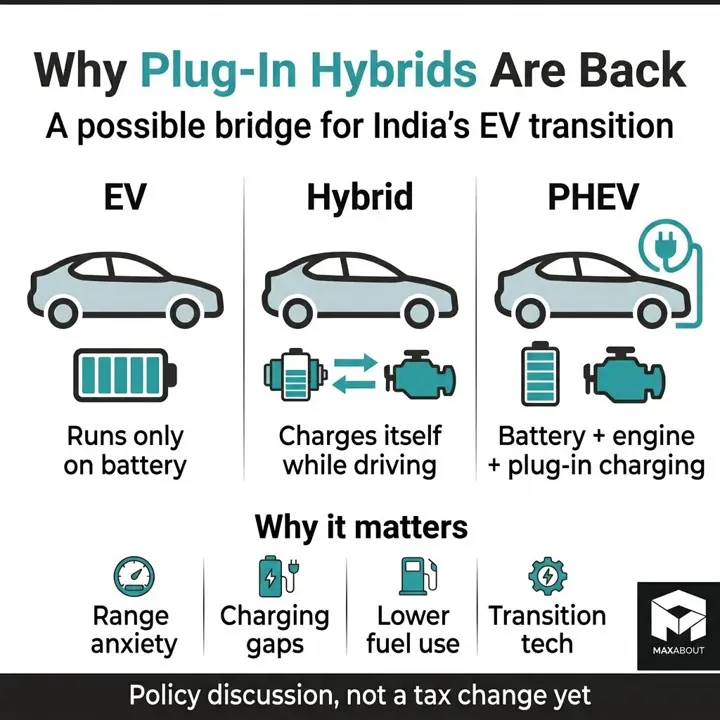 A plug-in hybrid (PHEV) is different in one critical way. It carries a significantly larger battery that you can charge externally — from a wall socket or a charging point. That larger battery gives it a real all-electric range, typically somewhere between 40 to 80 kilometres, before the petrol engine needs to step in at all.
Now think about daily urban commuting in cities like Bengaluru, Pune, or Delhi. Most people drive well under 50 kilometres on a regular workday. With a PHEV, that entire commute could run on electricity. Globally, brands like Jeep, Volvo, and BYD already offer PHEVs across various segments — the technology is proven and mature.
The mild hybrid, by comparison, is even more limited — it offers marginal electric assistance but no meaningful electric-only driving. It's the most basic form of electrification available today.
Why Goyal's Backing Matters: The Policy and Industry Angle
When a senior cabinet minister publicly endorses a technology, it rarely happens in a vacuum. Piyush Goyal's support for plug-in hybrids carries real weight — not just as an opinion, but as a potential signal of where policy could be heading.
Right now, India's tax structure treats PHEVs somewhat awkwardly. They attract 5% GST, which is better than the punishing 28% applied to conventional petrol and diesel vehicles. But that's where the clarity ends. Unlike pure battery electric vehicles, PHEVs don't benefit from the same level of structured government support under the FAME scheme. Subsidies, incentives, and infrastructure push have largely been directed at full EVs — leaving PHEVs in a grey zone that neither fully rewards nor penalises them.
Industry players have noticed. According to recent official announcements and industry reports, automakers like Toyota, Maruti Suzuki, and Hyundai have been quietly lobbying for a clearer PHEV policy framework for years. Toyota, with its strong hybrid expertise, has the most obvious stake in this conversation. A defined PHEV policy could unlock investment decisions that are currently on hold.
Goyal's statement, in that context, feels like more than casual commentary. It suggests the government may finally be willing to acknowledge that the road to electrification in India doesn't have to be a single straight line.
The Real-World Case for PHEVs on Indian Roads
Step back from the policy debate for a moment and think about how most Indians actually use their cars. A typical weekday in Bengaluru's Outer Ring Road or Delhi's ring roads isn't a smooth highway cruise — it's a grinding crawl, stop-and-go, engine idling for stretches that feel endless. That kind of driving, frustrating as it is, happens to be exactly where a PHEV powertrain earns its keep.
Low-speed urban traffic is where electric motors are most efficient. A PHEV charged overnight on a standard home socket — no fancy fast charger needed — could realistically cover a typical 30 to 40 kilometre daily commute almost entirely on electricity. The petrol engine just sits there quietly, ready if you need it for a weekend highway run or an unplanned long trip.
That last part matters more than people acknowledge. Range anxiety is real, and for many buyers it remains a genuine barrier to going fully electric. A PHEV removes that anxiety entirely.
Then there's the fuel cost reality. With petrol hovering above ₹100 per litre across most states, even partial electric running translates into meaningful monthly savings. For a middle-class family managing household expenses carefully, that arithmetic is hard to ignore.
PHEVs aren't a perfect solution. But on Indian roads, for Indian commuters, they may be the most practical one available right now.
The Challenges and Criticisms: PHEVs Are Not a Perfect Solution
That said, let's be honest. PHEVs come with real problems — not hypothetical ones.
The most legitimate criticism is what's called charge-depleting misuse. If an owner never plugs in — which happens more than you'd think — the vehicle lugs around a heavy battery pack while running purely on petrol. In that scenario, emissions can actually exceed those of a regular hybrid. The technology only delivers on its promise when the battery is regularly charged. That requires discipline, and frankly, charging infrastructure.
Then there's the cost. PHEVs are significantly more expensive than conventional hybrids and even some entry-level EVs entering the market. That price gap is hard to justify for buyers already stretching budgets.
Servicing is another genuine concern. A PHEV needs technicians who understand both electric motors and combustion engines simultaneously. India's service network is still developing that dual expertise. Outside major metros, finding a properly equipped workshop isn't straightforward.
Finally, the dual powertrain adds considerable weight. That affects handling — particularly noticeable on twisty roads or during quick city maneuvers. It's not dramatic, but it's there.
These aren't arguments to dismiss PHEVs entirely. But they're real trade-offs worth acknowledging before treating them as a straightforward solution.
Which PHEV Models Could Come to India — and What Might They Cost?
If policy support does materialise, the logical next question is: which vehicles actually arrive, and at what price? A few global nameplates seem like realistic candidates.
Toyota is the most obvious starting point. The brand already sells strong hybrid variants here, has an established service network, and offers PHEV versions of the Harrier and RAV4 in international markets. Bringing a PHEV Harrier to India feels plausible — though not imminent.
Jeep's Meridian PHEV exists in certain markets and would slot reasonably into India's premium SUV space. Volvo's XC40 Recharge PHEV is another contender, given the brand's growing presence here. BYD, which already operates in India, has multiple PHEV options in its global lineup that could theoretically transfer.
Pricing is where things get complicated. Globally, PHEVs typically cost ₹5–10 lakh more than equivalent non-plug-in hybrid models. In India's price-sensitive environment, that premium is genuinely difficult to absorb without meaningful subsidies or tax relief.
Realistically, a ₹20–35 lakh price band is probably where PHEVs would find reasonable mass-market interest — below that is tough to manufacture profitably, above that shrinks the audience considerably. Whether manufacturers can hit those numbers depends heavily on import duties and localisation decisions that remain unresolved for now.
How Should Indian Car Buyers Think About This Right Now?
If you're actively shopping for a car today, my honest advice is this: do not put your buying decision on hold waiting for PHEVs to arrive. Policy signals are encouraging, but the gap between a minister's endorsement and an affordable PHEV sitting in a showroom near you could easily be two to four years. Life doesn't pause for government timelines.
That said, your situation matters a great deal here. Think about what your daily life actually looks like before deciding.
If you live in an urban area with dedicated home parking — an independent house or a society with charging infrastructure — and your daily commute is under 50 kilometres, a PHEV genuinely makes sense for you. When they do arrive at reasonable prices, you'd get meaningful electric running costs without range anxiety. Worth waiting? Maybe, if your current car isn't urgent.
If you rely on street parking or a shared apartment complex, home charging is simply not realistic right now. A strong hybrid like the Maruti Grand Vitara or Honda City e:HEV gives you much of the fuel efficiency benefit without needing any plug. That's the practical sweet spot for most urban buyers today.
For buyers clocking serious highway kilometres — think regular intercity runs between cities like Pune and Mumbai, or Bengaluru and Chennai — petrol or diesel still holds a very real edge. Charging infrastructure on highways remains inconsistent, and PHEVs offer less advantage once the battery depletes on long stretches anyway.
The broader point is that good buying decisions are built on current realities, not pending announcements. Piyush Goyal's backing of PHEVs is a directional signal worth noting, not a shopping trigger.
The Bigger Picture: Can PHEVs Bridge India's EV Transition Gap?
Step back from the immediate debate and a genuinely interesting question emerges. Is India looking at PHEVs as a real solution — or a comfortable detour that lets policymakers avoid the harder work of building reliable charging networks and pushing pure EV prices down to mass-market levels?
The honest answer is probably both. And that tension is worth sitting with.
China and Europe offer useful reference points. In both markets, PHEVs had a meaningful phase — not a permanent home. They gave buyers a psychological bridge, kept range anxiety at bay, and bought time for charging infrastructure to mature. Eventually, pure EVs stepped in and took over the growth story. The PHEV chapter was real, but it was always a chapter — not the final destination.
India could follow a similar arc. Or it could get stuck in that chapter longer than necessary, particularly if tax incentives keep PHEVs artificially attractive while pure EV affordability lags behind.
In my view, Goyal's backing is pragmatic but carries risk. It acknowledges ground realities — inconsistent charging, range concerns, buyer hesitation — and that is genuinely sensible. But without parallel urgency on infrastructure investment and affordable pure EV development, PHEVs risk becoming a convenient excuse rather than a genuine bridge.
That said, the Indian auto market is moving faster than most people expected even three years ago. Buyers today have more genuinely interesting options than ever before — and more are coming. Whatever role PHEVs ultimately play, that part is exciting.
Explore the story
Related news
Share your view and join the discussion.
Earn reward points for every comment and get a chance to win ₹1,000 in our weekly lucky draw. Sign in with Google in one tap.
Start the conversation
No one has commented on this article yet. Be the first to share your view.
Want to read more automotive news?
Stay updated with the latest car launches, reviews, and industry insights.
Browse All News