
Petrol Dealers Urge Government To Review E20 Rollout Amid Customer Complaints
The debate around E20 petrol in India has moved from social-media complaints to the fuel-station counter. Petrol dealers in Odisha have urged the government to review the E20 rollout, saying pump operators are being blamed by customers for vehicle issues that customers believe are linked to the high...
Editorial Team
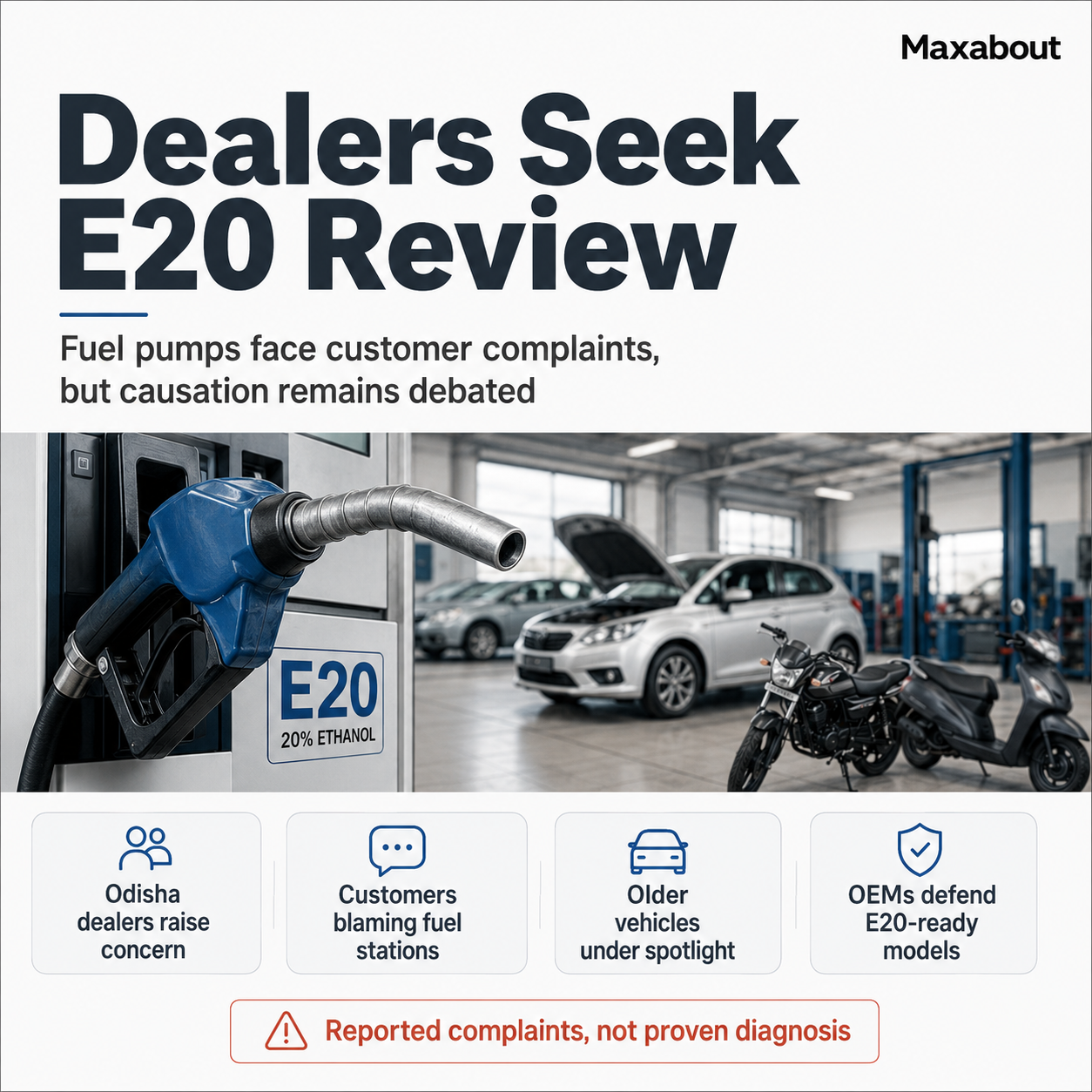
The debate around E20 petrol in India has moved from social-media complaints to the fuel-station counter. Petrol dealers in Odisha have urged the government to review the E20 rollout, saying pump operators are being blamed by customers for vehicle issues that customers believe are linked to the higher ethanol blend. The important distinction: these are dealer and customer complaints, not an independent technical finding that E20 has caused every reported fault.
What You Need To Know
Odisha Petroleum Dealers Association president Sasanka Sekhar Sahu has urged the government to reconsider the E20 rollout.
Dealers say customers are blaming petrol pumps for vehicle problems they believe are connected to E20 petrol.
Reported complaints include clogged carburettors and other mechanical failures, but causation has not been independently established in the report.
The comments come as automakers and industry experts continue to defend E20-compatible vehicles and their testing.
The issue matters most for owners of older petrol vehicles that may not have been designed with E20 use in mind.
Why Petrol Dealers Want An E20 Review
According to the reported comments, dealers say they are caught in the middle. The fuel blend is part of national policy, but the customer interaction happens at the pump. When a vehicle develops a running issue soon after refuelling, the dealer may become the first person blamed, even though the dealer does not decide the ethanol-blending level.
Sahu reportedly said dealers are facing significant difficulties under the current rollout and asked the government to reconsider the introduction of E20 fuel. He also claimed that many vehicles already on Indian roads were not originally designed for a 20 percent ethanol blend, which is why customers are raising concerns at fuel stations.
Confirmed Facts Vs Reported Claims
| Point | Status | What It Means |
|---|---|---|
| Dealers asked for a review | Reported statement | The association wants the government to revisit the rollout approach. |
| Customers are blaming pumps | Reported dealer concern | Fuel-station operators say they are facing customer anger directly. |
| Clogged carburettors and failures | Attributed claim | These issues were alleged by dealers/customers, not independently diagnosed in the report. |
| OEMs support E20-ready vehicles | Industry position | Automakers have maintained that E20-compatible vehicles have been tested for the blend. |
What This Means For Vehicle Owners
For Indian car and bike owners, the practical takeaway is not to jump straight to one conclusion. If a vehicle is officially E20 compatible and properly maintained, automakers say it should be ready for the higher ethanol blend. If a vehicle is older or was not designed for E20, owners should be more careful about service history, rubber components, fuel-system condition, and manufacturer guidance.
If a running issue appears after refuelling, the right next step is a proper workshop diagnosis rather than assuming the pump or the fuel blend is automatically at fault. Symptoms such as poor starting, hesitation, clogged jets, or fuel-system deposits can have multiple causes, including maintenance condition, contamination, age-related wear, or fuel compatibility.
Why The Debate Is Not Over
The dealer statement matters because it highlights a gap between national rollout confidence and ground-level customer experience. Automakers and experts may be confident about E20-ready models, but many Indian roads still have older vehicles, mixed service histories, and owners who may not know whether their specific model is compatible.
A clearer rollout could involve better consumer communication at pumps, vehicle-wise compatibility guidance, and a simple escalation process for complaints. That would help owners understand whether they are facing a policy issue, a vehicle-maintenance issue, or an unrelated mechanical fault.
FAQs
What is E20 petrol?
E20 petrol is a blend containing 20 percent ethanol and 80 percent petrol. India has been increasing ethanol blending as part of its fuel policy.
Did the report prove E20 caused vehicle failures?
No. The reported mechanical issues are dealer and customer claims. The report does not independently prove that E20 caused every alleged failure.
Are all vehicles compatible with E20 petrol?
No. Newer E20-compatible vehicles are designed and tested for the blend, but older vehicles may need manufacturer-specific guidance.
Should owners blame petrol pumps for E20 issues?
Not automatically. Dealers sell the fuel supplied under the policy, but they do not decide the national blending level. A workshop diagnosis is needed before assigning fault.
The E20 petrol rollout review demand shows that India’s ethanol-blending transition is not just a policy story. It is also a communication, compatibility, and customer-service challenge. Owners should check their vehicle’s compatibility, follow official service advice, and treat unverified failure claims carefully.
Explore the story
Related news



Share your view and join the discussion.
Earn reward points for every comment and get a chance to win ₹1,000 in our weekly lucky draw. Sign in with Google in one tap.
Start the conversation
No one has commented on this article yet. Be the first to share your view.
Want to read more automotive news?
Stay updated with the latest car launches, reviews, and industry insights.
Browse All News