
Ola Electric Invests ₹2000 Crore in EV and Cell Tech
There are moments in an industry's evolution that feel genuinely significant — not just as headlines, but as turning points. Ola Electric's decision to pump ₹2,000 crore into its EV manufacturing and cell technology arms feels like one of those moments. Whether it ultimately proves to be a masterstr...
Editorial Team
There are moments in an industry's evolution that feel genuinely significant — not just as headlines, but as turning points. Ola Electric's decision to pump ₹2,000 crore into its EV manufacturing and cell technology arms feels like one of those moments. Whether it ultimately proves to be a masterstroke or an overambitious gamble, the answer will matter to every Indian buyer quietly weighing whether now is the right time to go electric.
The investment is split across two fronts. A portion goes toward scaling up EV manufacturing operations, while a significant chunk is directed at Ola's cell technology division — the part of the business most people haven't paid close attention to, but arguably the most consequential.
Here's why that second piece matters so much. India currently depends heavily on imported lithium-ion cells for its electric vehicles. That dependency keeps costs high and supply unpredictable. Combine that with steadily rising fuel prices and a government that is clearly committed to pushing electric mobility forward, and suddenly building domestic cell technology stops sounding like corporate ambition — it starts sounding like practical necessity.
This is not a story about one company. It's a story about whether India can genuinely build an EV ecosystem from the ground up, rather than simply assembling imported components.
Breaking Down the Investment: EV Arm vs Cell Technology — Where Is the Money Going?
So where exactly does ₹2,000 crore go? The short answer is: two very different places, with two very different timelines for results.
The EV manufacturing arm gets the more immediate attention. Ola Electric has faced real, well-documented problems — delivery delays, quality complaints, after-sales service gaps that frustrated early adopters. Injecting capital here likely means expanding production capacity at their Krishnapatnam facility, tightening quality control processes, and building out a service network that can actually keep pace with sales volumes. There are also persistent industry whispers about Ola's ambitions beyond scooters — an electric car is reportedly in the pipeline. That kind of expansion needs serious infrastructure investment well before the first unit rolls out.
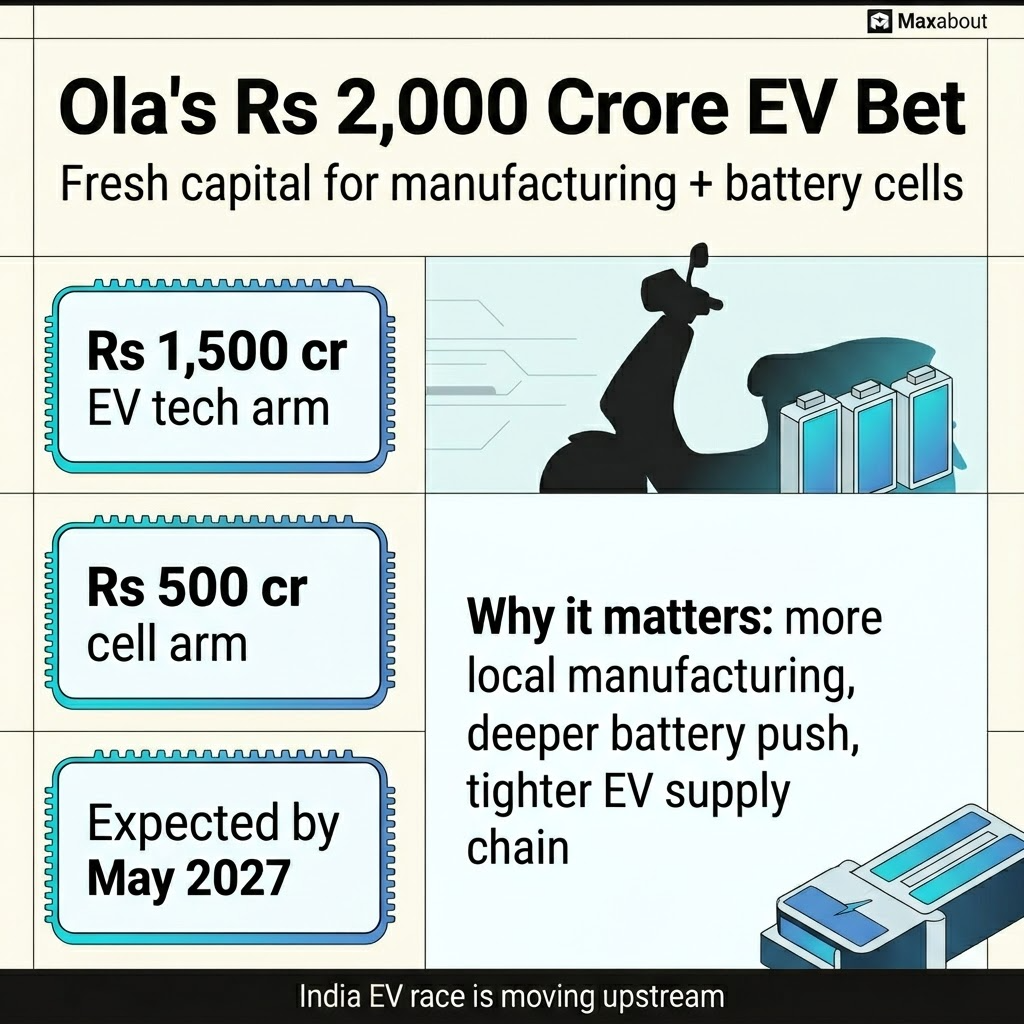 The cell technology division is the genuinely fascinating piece. India imports the overwhelming majority of its battery cells, primarily from China. This creates a double problem: cost vulnerability and supply chain fragility. When you build a vehicle around imported cells, you have limited control over your own pricing or production schedule.
Investing in domestic cell manufacturing is Ola's attempt to change that equation. In plain terms, it means developing the capability to produce the actual energy storage units locally — reducing import dependence over time and potentially bringing down battery costs as scale improves.
The important caveat: this takes years, not quarters. Global automakers like Tesla, Volkswagen, and several Korean manufacturers have spent the better part of a decade building viable cell production at scale. Ola is starting from a far earlier point. The investment signals intent — real commercial results are a longer journey.
Ola's Track Record So Far: Reason for Confidence or Caution?
That longer journey matters more when you look at where Ola actually stands today. And honestly, the picture is mixed — not catastrophically bad, but not the clean success story the brand's marketing would suggest either.
The genuine achievements deserve acknowledgment. Ola Electric grew its market share in the electric two-wheeler segment at a pace few expected. Their pricing was aggressive in a way that genuinely moved the needle — making electric scooters feel like a real option for middle-class buyers rather than a niche purchase. That accessibility matters in a country where most households are weighing every rupee carefully.
But the concerns are real too. Reports of service delays, software inconsistencies, and build quality complaints have surfaced consistently — not just as isolated noise, but as patterns that industry observers and actual buyers have flagged repeatedly. Trust in an EV brand, particularly in India where the service infrastructure is still catching up, is genuinely hard to earn and very easy to lose.
Which brings us to the honest question worth sitting with: does this ₹2,000 crore investment address the root issues, or does it fund the next chapter before the current one is fully written? Scaling cell production while service quality remains inconsistent is a real tension. Ambitious expansion and operational reliability don't always move at the same speed — and for a buyer or an industry observer watching this space, that gap is worth watching closely.
What Domestic Cell Manufacturing Could Actually Mean for Indian EV Buyers
Here is something most EV conversations in India quietly skip over: the battery cells inside almost every electric vehicle sold here today are imported, predominantly from China. The pack is assembled locally, the wiring is local, sometimes the casing is local — but the actual cells, the chemistry that stores and releases energy, travels a long way before it reaches your vehicle. That dependency has real consequences for cost and supply certainty.
Battery packs account for roughly 35 to 45 percent of an EV's total cost. That single fact explains why affordable electric cars remain difficult to deliver without compromising on range or build quality. If Ola's cell manufacturing arm can eventually produce competitive cells domestically at scale, the arithmetic starts shifting. Lower input costs could mean more accessible price points for middle-class families in cities like Pune, Lucknow, or Coimbatore who are genuinely interested in EVs but find current pricing just out of reach.
However, measured optimism matters here. Cell manufacturing is technically demanding and capital intensive in ways that are genuinely humbling — even established global players have faced significant setbacks scaling production. Results will not arrive quickly.
The broader opportunity, though, is worth acknowledging. Successful domestic cell production would not just benefit Ola. Other Indian manufacturers could potentially source locally, strengthening the entire ecosystem rather than one brand alone.
The Bigger Picture: India's EV Race and Where Ola Sits
Ola's ₹2,000 crore commitment doesn't exist in a vacuum. Step back and the broader landscape becomes genuinely interesting — and considerably more competitive than it might appear from the outside.
Tata Motors has been methodically building its EV presence, with the Nexon EV and Punch EV gaining real traction in the market. Mahindra is preparing a serious electric push of its own. Meanwhile, international players are watching India closely, recognising that this market is too large to ignore for long. Everyone is moving simultaneously, which means Ola cannot afford to stand still.
Government policy is actively shaping this race. PLI schemes and FAME incentives are designed specifically to reward local manufacturing — not just assembly, but genuine component-level production. Cell technology sits right at the heart of that policy intent. India's ambition to reduce dependence on imported battery cells is a national strategic priority, not simply a corporate talking point.
For someone considering an EV purchase over the next one to three years, this competitive intensity is actually encouraging news. More investment across multiple players typically accelerates price corrections and product improvements faster than any single company could manage alone. The race benefits buyers eventually, even when the short-term picture feels complicated.
Real Concerns That This Investment Does Not Automatically Fix
Let's be honest about something. Money solves funding problems. It does not automatically solve execution problems. And Ola Electric has some genuine execution challenges that ₹2,000 crore cannot simply write away overnight.
The service network issue is the most pressing one. Building a reliable, technically competent service presence across Tier 2 and Tier 3 cities is a slow, unglamorous process. It requires trained technicians, physical workshop space, spare parts availability, and consistent oversight — none of which scale quickly regardless of how large the investment is. Someone in Nagpur or Coimbatore dealing with a software fault or a battery concern today is not going to feel this funding announcement in any immediate, practical way.
Customer trust is the other variable that capital cannot fast-track. Early ownership experiences left a mark, and rebuilding that confidence requires consistent product quality and responsive after-sales support over an extended period — not a press release.
Cell manufacturing localisation is genuinely exciting as a long-term ambition, but it is a multi-year journey with real technical and supply chain complexity involved. Success is not guaranteed simply because investment exists.
In my view, anyone seriously considering an Ola EV purchase should watch patiently over the next 12 to 24 months. The real test is whether this investment visibly translates into better service experiences and software reliability on the ground. That is the only measure that truly matters.
Should This Investment Change How You Think About Buying an Ola EV?
Here is the honest answer: not directly, and not immediately. The ₹2,000 crore commitment is genuinely encouraging as a signal of long-term intent. It tells you the company is not planning to disappear quietly. For anyone worried about whether Ola Electric will still be around in five years to support your scooter with software updates and spare parts, this news does offer some reassurance.
But reassurance about the future is not the same as confidence in the present. And your buying decision happens today, not in 2027.
Before anything else, I would strongly suggest checking actual service centre availability in your specific city. The experience in Mumbai or Pune can be genuinely different from what someone in a smaller town like Nashik or Coimbatore encounters. Read real ownership reviews from people who have lived with the scooter through monsoons, software glitches, and routine servicing. Those ground-level accounts matter far more than any investment announcement.
The investment is worth factoring in as one positive data point — a signal that Ola is playing a longer game. But weigh it alongside current product quality and service reliability, not instead of them. A well-funded company with patchy service is still a patchy experience for you as an owner. Make the decision based on where things stand today.
Final Thoughts: A Defining Moment That Deserves Measured Optimism
₹2,000 crore is not a number any company throws around casually. This is a serious commitment — one that signals genuine confidence in India's EV trajectory, not just a headline-chasing exercise. The cell technology piece especially stands out. If Ola can crack locally manufactured, cost-competitive battery cells at scale, the ripple effects could benefit the entire Indian EV ecosystem, not just their own lineup.
That said, measured optimism is the right posture here. Investments are intentions. Products and service networks are outcomes. India's EV story is very much still being written, and moves like this are important chapters — not the conclusion.
For the average Indian thinking about making the switch to electric, here is what actually matters: the technology is improving, charging infrastructure is expanding, and investments of this scale suggest the industry is maturing past its experimental phase. That is genuinely encouraging.
But whether Ola specifically earns your trust as a buyer? That answer will come from their showrooms, their service centres, and real owner experiences — not from their press releases. Watch the money, then watch what it builds.
Explore the story
Related news

Share your view and join the discussion.
Earn reward points for every comment and get a chance to win ₹1,000 in our weekly lucky draw. Sign in with Google in one tap.
Start the conversation
No one has commented on this article yet. Be the first to share your view.
Want to read more automotive news?
Stay updated with the latest car launches, reviews, and industry insights.
Browse All News