
Ola Electric in Talks to Supply Battery Cells Globally
There's a headline making the rounds that deserves more attention than it's getting. Ola Electric is reportedly in talks to supply battery cells to global automakers. Not import them. Not license the technology. Supply them — as a vendor, as a manufacturer, as a serious player in the global EV compo...
Editorial Team
There's a headline making the rounds that deserves more attention than it's getting. Ola Electric is reportedly in talks to supply battery cells to global automakers. Not import them. Not license the technology. Supply them — as a vendor, as a manufacturer, as a serious player in the global EV components chain.
That's a genuinely different kind of story for an Indian automotive company.
Think about how India has traditionally fit into the global auto industry. We've been the market that global brands enter. We've been the destination for technology transfers, the recipient of platforms designed elsewhere. Even our most successful homegrown manufacturers have largely built their reputations domestically, with exports being a secondary chapter.
A battery cell supply deal flips that script entirely. It would position Ola Electric not as a local EV seller trying to survive in a competitive domestic market, but as a component source that global automakers actually depend on. That's a fundamentally different kind of industrial credibility.
From what industry observers are noting, this signals that Ola's investment in its Gigafactory and cell chemistry research may be reaching a point where the output is genuinely competitive. Whether the talks convert into contracts is another question. But the fact that these conversations are reportedly happening at all — that part matters.
Ola Electric's Battery Ambitions: From Scooters to Supply Chains
To understand why this development is significant, you need to appreciate how far Ola Electric has come — and how unusual their stated trajectory actually is for an Indian company.
Most Indian EV manufacturers, including several well-funded ones, assemble battery packs rather than manufacture the cells inside them. The cells — the fundamental electrochemical units that actually store energy — are almost universally sourced from established suppliers, predominantly in China, South Korea, and Japan. Assembling packs is genuinely valuable work, but it is not the same thing as controlling the core technology.
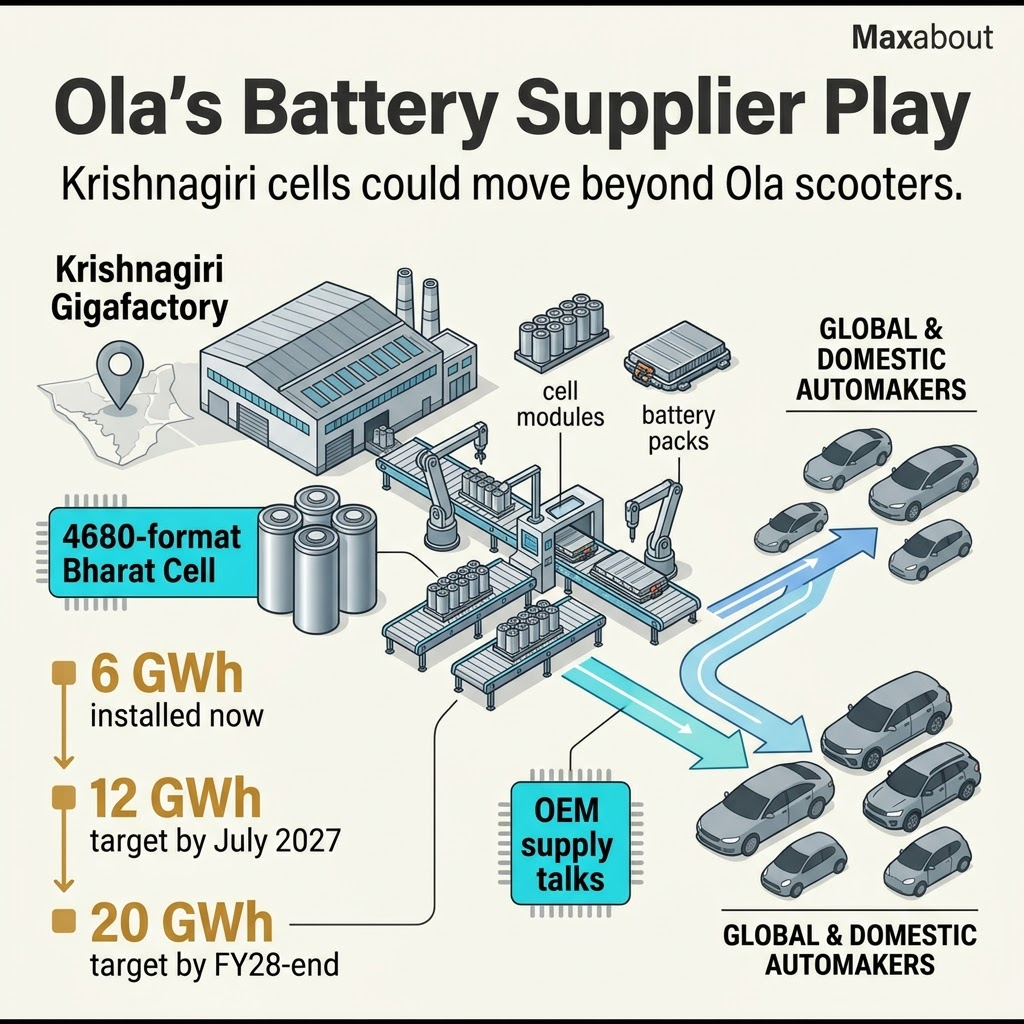 Ola's stated ambition goes further. Their Gigafactory in Tamil Nadu is positioned not just as a pack assembly facility but as an actual cell manufacturing operation. Publicly, the company has spoken about developing 4680-type cylindrical cells — a format that Tesla popularized and that the broader industry is now watching closely for its energy density and cost advantages.
Based on official announcements, Ola has also invested in cell chemistry research, which is where the real intellectual depth of battery manufacturing lives. Getting the chemistry right — the cathode materials, electrolyte formulations, thermal behaviour — is what separates a credible cell manufacturer from a company simply running an assembly line.
Where things stand honestly right now: ambition and early-stage capability are not the same as proven, scaled production. That gap still needs closing.
Which Global Automakers Could Be Interested — And Why
The timing of Ola Electric's reported supplier ambitions is not accidental. Right now, the global automotive industry is in the middle of a serious rethink about where its batteries come from.
For years, the answer was simple: China and South Korea. CATL, BYD, LG Energy Solution, Samsung SDI — these names dominated supply contracts. But that dependence has become uncomfortable. Geopolitical friction, export control concerns, and the hard lessons of pandemic-era supply chain collapses have pushed automakers in Europe, the United States, and Japan to actively scout alternatives.
The category of manufacturers most likely to explore a supplier like Ola Electric would logically include European automakers navigating strict local-content rules tied to EV subsidies, and American brands under pressure from legislation that incentivises non-Chinese battery sourcing. Japanese manufacturers, traditionally conservative but now accelerating EV transitions, are also reconsidering supply partnerships.
What does any serious global buyer actually look for? A few things matter enormously:
Cost competitiveness — India's manufacturing cost structure is genuinely attractive
Chemistry consistency — cell performance cannot vary batch to batch
Proven capacity at scale — sample cells are meaningless without volume capability
Geopolitical neutrality — an Indian supplier fits that profile well
India checks the strategic box. Whether Ola can check the technical ones is the real question.
India's Push to Become a Global EV Component Hub
Ola Electric's conversations with global automakers don't exist in a vacuum. They're happening because the Indian government has spent the last several years systematically building the conditions for exactly this kind of deal.
The Production Linked Incentive scheme for Advanced Chemistry Cell manufacturing is central to this. The government committed significant capital to attract serious battery manufacturers to set up on Indian soil — not just assemble packs, but actually produce cells domestically. The intent was always about moving up the value chain, not staying stuck as an assembly destination.
Then there's the broader strategic framing. Global automakers are genuinely anxious about their dependence on Chinese battery supply chains. India has positioned itself as the credible alternative — politically stable, English-speaking manufacturing base, growing technical workforce, and increasingly competitive labor costs.
The raw material angle matters too. India is actively pursuing lithium processing partnerships and has been part of international mineral security frameworks. Access to critical minerals, combined with domestic processing ambitions, could eventually give Indian battery manufacturers a more integrated supply chain story to tell.
From a policy direction standpoint, this is coherent industrial strategy. Whether execution keeps pace with ambition is a separate question — but the framework being built is one where Ola's international conversations are a feature, not a coincidence.
The Real Challenges Ola Electric Must Overcome
Here is where honesty matters. The policy framework is encouraging, the ambition is real — but there is a significant gap between where Ola Electric currently stands and what supplying cells to global automakers actually demands.
Start with the obvious. Ola's scooters have faced well-documented complaints — software glitches, service delays, quality inconsistencies that frustrated early buyers. These are not minor footnotes. Global OEMs evaluating a cell supplier will dig deep into that track record. A Toyota or Volkswagen cannot afford to have battery quality issues traced back to their supply chain. They will want years of consistent manufacturing data, not promises.
Cell manufacturing at scale is also an entirely different discipline from assembling scooters. Controlling cell chemistry, maintaining micron-level consistency across millions of units, managing thermal behaviour — this requires specialised expertise that takes years to develop and validate.
Financially, Ola Electric is still navigating a difficult path. Scaling a gigafactory to credible export volumes requires sustained capital investment over a long runway, while simultaneously managing domestic operations under close scrutiny from investors and regulators alike.
From what industry observers note, the conversations with global automakers are likely exploratory at this stage. Interest is not a contract. The distance between a promising discussion and a qualified, audited supply agreement is enormous — and Ola will need to close that gap through execution, not announcements.
What This Could Mean for Indian EV Buyers and the Domestic Market
So while the global ambitions play out in boardrooms, the more immediate question for most of us is simpler — does any of this actually help the Indian buyer? Possibly, yes. But not without some genuine risks worth thinking through.
If Ola Electric scales into a serious cell supplier, the most practical benefit for Indian consumers could be lower battery replacement and repair costs over time. Right now, battery pack servicing is one of the biggest pain points for EV owners across India — whether you're riding through Bengaluru's stop-start traffic or dealing with heat stress on highways in Rajasthan. Domestic cell availability at scale could gradually reduce that anxiety.
There's also the after-sales angle. A company supplying globally tends to invest more seriously in quality control and service infrastructure — because reputational stakes get higher. That could translate into better support for existing Ola scooter owners, who have had a mixed experience with service networks.
The risk, though, is real. If export contracts become more lucrative, domestic priorities can quietly slip. Indian customers could find themselves waiting longer for parts or software updates while production capacity serves overseas clients first.
For buyers currently evaluating two-wheelers or entry-level electric cars, this adds one more variable to an already complicated decision.
How This Stacks Up Against Global Battery Giants Like CATL and LG Energy
To understand what Ola Electric is potentially walking into, it helps to know who already owns this space.
CATL, LG Energy Solution, Panasonic, and Samsung SDI are not just large companies — they are deeply embedded into how global automakers think about electrification. CATL alone supplies Tesla, BMW, Volkswagen, and dozens of others. LG Energy Solution has partnerships stretching back decades. These relationships were built on something that cannot be rushed: consistent, proven performance at massive scale.
What makes these players dominant is not just technology. It is trust, built through years of zero-defect delivery, rigorous certification processes, and the ability to ramp production up or down without disrupting an automaker's assembly line. A global OEM signing a battery supply contract is essentially betting their vehicle program on that supplier.
Breaking into that world is genuinely difficult. Ola would need internationally recognised quality certifications, logistics infrastructure across continents, and the financial resilience to absorb early-stage contract demands.
That said, supply chains do shift. BYD was once an outsider too. The opportunity is real — but the climb is steep, and credibility at home would need to come first.
The Bigger Picture: Is India Ready to Export Automotive Technology?
There's something worth sitting with here. For decades, India has been on the receiving end of automotive technology — licensing it, assembling it, adapting global platforms for local conditions. The idea that an Indian company might one day supply critical EV components to automakers in Europe or North America represents a genuine shift in that story.
It wouldn't be the first time a country rewrote its industrial identity this way. South Korea's battery industry didn't emerge overnight. It was built through deliberate policy, patient capital, and companies willing to absorb losses for years before credibility arrived. China's dominance in EV supply chains today is the result of roughly two decades of strategic investment — not luck, not accident.
India hasn't yet shown that same systemic patience at a national level. But individual companies sometimes move faster than policy frameworks, and Ola's ambitions, however early-stage, suggest that someone is at least thinking in that direction.
Whether this particular bet pays off is genuinely uncertain. Ola Electric still has things to prove domestically. But the direction — India as a technology exporter rather than just a technology consumer — is worth watching. That journey will be long. The fact that it's beginning at all is the interesting part.
Explore the story
Related news

Share your view and join the discussion.
Earn reward points for every comment and get a chance to win ₹1,000 in our weekly lucky draw. Sign in with Google in one tap.
Start the conversation
No one has commented on this article yet. Be the first to share your view.
Want to read more automotive news?
Stay updated with the latest car launches, reviews, and industry insights.
Browse All News