
Oil Shock Speeds Up India EV Demand as Tata Sales Rise and Mahindra Eyes Faster Capacity Ramp-Up
India EV demand is getting a fresh push as fuel-price anxiety makes electric cars feel less like a distant alternative and more like a near-term buying option. The latest industry signals point to higher showroom interest, stronger electric car sales momentum, and possible production changes from ma...
Editorial Team
India EV demand is getting a fresh push as fuel-price anxiety makes electric cars feel less like a distant alternative and more like a near-term buying option. The latest industry signals point to higher showroom interest, stronger electric car sales momentum, and possible production changes from major Indian carmakers as buyers react to repeated petrol and diesel price increases linked to the Gulf/Iran oil shock.
What you need to know
Tata EV sales: The passenger vehicle business has reported EV sales up by as much as 30 percent since the Gulf conflict began.
Mahindra EV production: Mahindra may accelerate its planned EV capacity ramp from 8,000 cars per month to 12,000 cars per month within six months.
Market signal: IEA data cited for Q1 2026 shows Indian EV sales up 65 percent year on year to more than 55,000 units.
Reality check: EVs are still under 4 percent of total car sales, so charging access, pricing, and supply remain critical.
Why fuel prices are changing the EV conversation
India remains highly exposed to global crude-oil shocks, so a sharp fuel-price move quickly changes the running-cost calculation for daily commuters. When petrol and diesel prices rise repeatedly, EVs gain attention not only for lower emissions but also for predictable home-charging costs and reduced dependence on fuel stations.
That does not mean every interested buyer will immediately switch to an electric car. It does mean the conversation has moved from curiosity to comparison: buyers are now asking about monthly running cost, charger availability, battery warranty, resale value, and delivery timelines with more urgency.
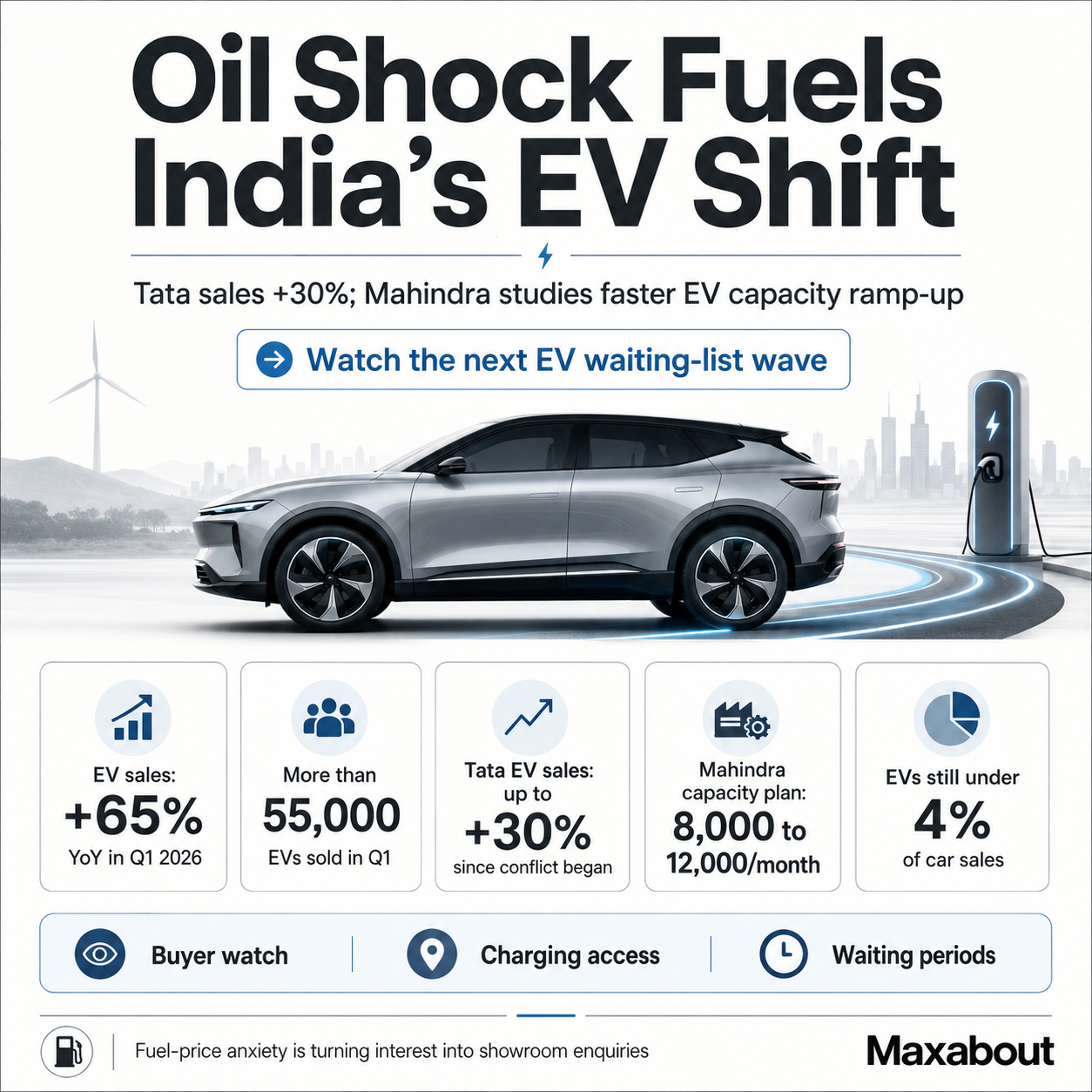
The key numbers behind India's EV demand story
| Signal | Reported figure | Why it matters |
|---|---|---|
| Tata EV sales | Up to 30 percent since the Gulf conflict began | Shows demand can react quickly when fuel costs rise. |
| Mahindra EV capacity | Possible move from 8,000 to 12,000 cars/month | Suggests carmakers may need more supply if enquiries convert. |
| Q1 2026 India EV sales | More than 55,000 units, up 65 percent year on year | Confirms the trend is not limited to one brand. |
| EV share of car sales | Still below 4 percent | Highlights how early the passenger-EV market remains. |
What it means for Indian buyers
For buyers considering an EV in 2026, this demand jump could have three practical effects. First, popular electric SUVs and hatchbacks may see stronger waiting periods if production does not keep pace. Second, brands may prioritise faster dealer allocation, charging tie-ups, and finance offers to convert fuel-price anxiety into bookings. Third, buyers may compare EV total ownership cost more seriously against petrol, diesel, hybrid, and CNG options.
The biggest constraint is still infrastructure. A buyer with reliable home or workplace charging will feel the EV advantage sooner than someone dependent on public chargers. Until charging density improves, demand growth may remain uneven across metros, highways, and smaller cities.
Could this speed up India's EV market?
The oil shock alone will not transform the market overnight. EVs still need better public charging, wider model availability, competitive pricing, and confidence around long-term battery health. But the latest numbers show that external fuel shocks can compress the adoption timeline. If higher enquiries turn into sustained bookings, brands such as Tata and Mahindra may have a stronger reason to scale EV supply sooner than planned.
For the broader India EV market 2026 outlook, the important signal is not just a sales spike. It is the shift in buyer psychology: EVs are increasingly being evaluated as a hedge against fuel-price volatility, not only as an environmental choice.
FAQs
Why is India EV demand rising now?
Demand is rising because higher petrol and diesel prices have made running costs a bigger concern for buyers. Recent company and market data also point to stronger EV enquiries and sales momentum.
How much have Tata EV sales increased?
Tata's passenger vehicle arm has reported EV sales up by as much as 30 percent since the Gulf conflict began, according to the source context used for this report.
Is Mahindra increasing EV production?
Mahindra may accelerate its planned EV capacity increase from 8,000 cars per month to 12,000 cars per month within six months. This should be treated as a reported production-capacity signal, not a final delivery guarantee for buyers.
Are EVs already mainstream in India?
Not yet. EVs are growing quickly, but they still account for less than 4 percent of total car sales. The next phase depends on pricing, charging access, supply, and buyer confidence.
Bottom line: India's latest fuel-price shock is giving EVs a stronger practical argument. If carmakers can scale supply and charging access improves, the current demand jump could become a meaningful step forward for India's electric car market.
Explore the story
Related news


Share your view and join the discussion.
Earn reward points for every comment and get a chance to win ₹1,000 in our weekly lucky draw. Sign in with Google in one tap.
Start the conversation
No one has commented on this article yet. Be the first to share your view.
Want to read more automotive news?
Stay updated with the latest car launches, reviews, and industry insights.
Browse All News