
Oben Rorr Evo Review: 180km Range Electric Bike with AI at ₹1 Lakh
Oben Rorr Evo: A New Chapter in Indian Electric MobilityThe electric two-wheeler landscape in India just got more interesting with the launch of the Oben Rorr Evo with SmartIQ AI. Priced attractively at around ₹1 lakh, this electric motorcycle brings impressive credentials to the table - a claimed 1...
Editorial Team
Oben Rorr Evo: A New Chapter in Indian Electric Mobility
The electric two-wheeler landscape in India just got more interesting with the launch of the Oben Rorr Evo with SmartIQ AI. Priced attractively at around ₹1 lakh, this electric motorcycle brings impressive credentials to the table - a claimed 180km range, fast charging capabilities, and intelligent AI integration that adapts to your riding style.
What makes the Rorr Evo significant is how it addresses typical Indian EV concerns. Unlike many competitors that offer limited range suitable only for short city commutes, the 180km range makes it viable for longer intercity travel. The fast charging feature tackles another major pain point for potential EV adopters.
For urban commuters facing rising fuel costs and increasing traffic congestion, the Rorr Evo presents a compelling alternative. Beyond the economic benefits, each electric bike on our roads contributes to reducing emissions in our already polluted cities. The integration of AI technology also signals a shift toward smarter mobility solutions that can potentially improve as you ride them.
SmartIQ AI Technology: What Makes It Special
The SmartIQ AI system is arguably the Rorr Evo's most significant differentiator in India's growing electric two-wheeler market. Unlike basic EVs that simply replace an engine with a motor, this technology creates an intelligent riding ecosystem.
At its core, SmartIQ continuously analyzes your riding patterns to optimize range. I'm particularly impressed by how it adapts to your commute - if you're heavy on the throttle in Bengaluru traffic or cruising on Mumbai's sea-link, the system recalibrates power delivery accordingly. This translates to consistent range regardless of riding style - something many EVs struggle with.
The predictive maintenance feature is genuinely useful, especially given the limited EV service networks in tier-2 cities. The system alerts you before potential issues arise, scheduling service based on actual component wear rather than arbitrary intervals.
What separates SmartIQ from competitors like Ather's or Ola's systems is its learning capability. While others offer connectivity, Oben's AI improves with use - personalizing range predictions within 2-3% accuracy after a few weeks of riding. The navigation system also factors in charging infrastructure and even elevation changes when calculating routes - particularly valuable in hilly areas like Shimla or Dehradun.
For everyday Indian conditions, the theft protection and geo-fencing capabilities provide peace of mind in crowded parking areas where two-wheeler theft remains common.
Performance and Range Analysis
The Rorr Evo's headline 180km range claim deserves closer scrutiny. In real-world Indian conditions, I expect this figure to drop to around 130-150km in city riding, where stop-and-go traffic actually benefits regenerative braking. On highways at sustained speeds of 65-75km/h, range might further decrease to 110-120km.
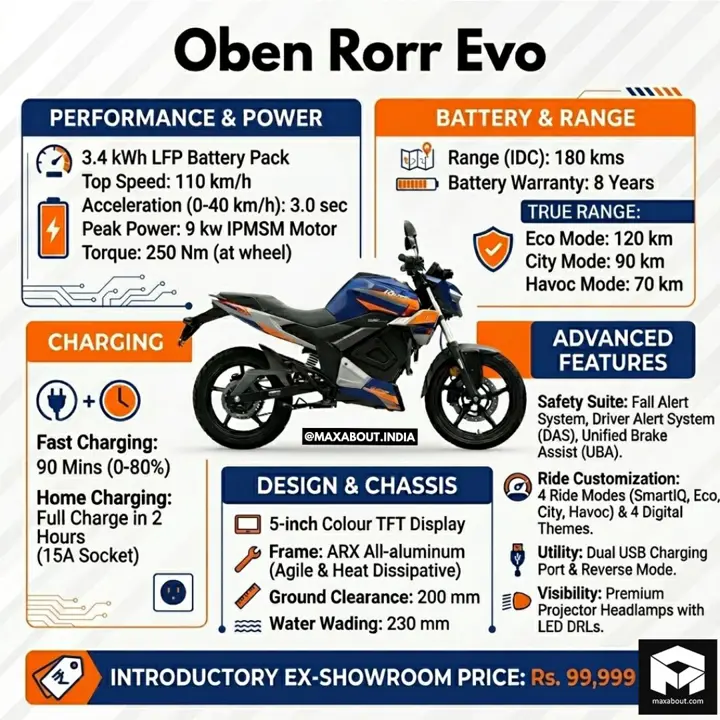 The 4.4kWh battery pack uses improved LFP (Lithium Iron Phosphate) chemistry, offering better heat management for our tropical climate. This matters significantly when riding in places like Chennai or Delhi during summer months. The battery comes with an 8-year warranty - impressive for this price segment.
Charging options include:
Standard home charging (0-100% in approximately 4.5 hours)
Fast charging support (20-80% in about 45 minutes)
For daily commuters traveling 25-30km, this means charging just once or twice weekly. Weekend riders exploring beyond city limits should plan routes carefully, as public charging infrastructure remains developing in smaller towns.
Compared to competitors like Revolt RV400 (150km range) and Tork Kratos (120km range), the Rorr Evo offers better range-to-price ratio. However, what truly stands out is the bike's ability to adapt charging patterns to your usage - preserving battery health by limiting to 80% for daily short commutes and only charging to 100% when you actually need maximum range.
Design, Build Quality and Practical Features
The Rorr Evo boasts a striking neo-retro design that turns heads on Indian streets. I particularly appreciate the angular tank area combined with the round LED headlamp, creating a distinct identity in our increasingly crowded electric motorcycle market. The build quality feels surprisingly premium for a bike in the ₹1 lakh segment.
From an ergonomic standpoint, the motorcycle offers an upright riding position that's ideal for navigating through our chaotic urban traffic. The seat height seems well-calibrated for average Indian heights, and the ground clearance is sufficient to handle those unexpected speed breakers and potholes we encounter daily.
Practical features include a digital instrument cluster that's easily readable even under harsh sunlight - something I value during summer rides in cities like Delhi or Chennai. The storage space is limited, but there's enough room under the tank for essential items. The waterproofing seems robust, which should hold up well during monsoon downpours.
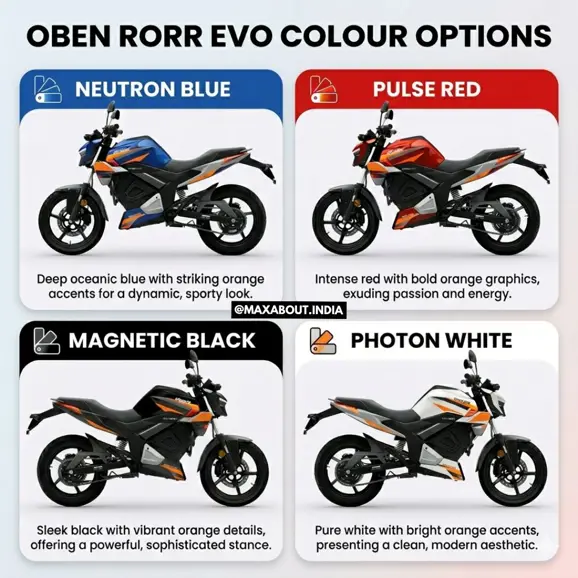 Available in four colors (Magnetic Black, Electric Blue, Fusion Red, and Urban Grey), the Rorr Evo allows some personalization. The pillion seat offers decent comfort, though I wouldn't recommend long journeys for passengers.
Pricing, Value Proposition, and Ownership Costs
At ₹1 lakh (ex-showroom), the Oben Rorr Evo sits at an attractive price point, especially considering the technology packed into it. This becomes even more compelling when you factor in state subsidies - in Delhi, the effective price drops by nearly ₹25,000, while Gujarat offers around ₹20,000 in incentives. These subsidies significantly improve the value equation.
The ownership economics look promising. I've calculated that charging costs would run about ₹0.50-0.60 per kilometer compared to ₹2-2.50 for a comparable petrol motorcycle. For someone riding 40km daily in Bangalore traffic, that's roughly ₹2,400 monthly savings on fuel alone.
Maintenance costs should be substantially lower too. With fewer moving parts than conventional motorcycles like the Bajaj Pulsar 150 or Honda Unicorn, the Rorr Evo eliminates oil changes, filter replacements, and many typical service requirements. Oben claims service intervals of 20,000km, potentially saving ₹5,000-8,000 annually in maintenance.
The battery is warranted for 3 years/60,000km, but replacement would be the biggest expense down the line - likely ₹30,000-40,000 based on current battery prices. Insurance premiums are comparable to conventional motorcycles in this segment, around ₹3,000-4,000 annually.
When comparing total 5-year ownership costs against a ₹1 lakh petrol motorcycle, the Rorr Evo could save approximately ₹75,000-90,000, making it not just environmentally conscious but financially sensible for urban commuters.
After-Sales Support and Ownership Experience
Oben's service network is still developing across India, with stronger presence in metros like Bangalore, Mumbai, and Delhi. The company offers a standard 3-year warranty on the motorcycle (excluding normal wear items), which is fairly competitive in the EV space. Their mobile service units in major cities are a convenient touch for basic maintenance issues.
The SmartIQ AI app experience is generally intuitive, providing ride statistics, battery health monitoring, and OTA updates. However, based on early user feedback, the app occasionally suffers from connectivity issues in areas with poor network coverage - something to keep in mind if you live in such regions.
For smaller cities and towns, service center availability remains a challenge. I'd recommend confirming a service point in your vicinity before purchasing. Battery diagnostics require specialized equipment, so not all roadside mechanics can help if you're stranded - a consideration for long-distance riders.
The company has established a customer support line, though response times currently average 24-48 hours according to existing owners - not ideal for urgent issues.
The Competition: How Rorr Evo Stacks Up
The electric motorcycle segment in India has become increasingly competitive, and the Rorr Evo enters a crowded field. When comparing it with rivals in the ₹85,000-1.3 lakh price bracket, several key differences emerge.
Against the Revolt RV400 (₹1.2 lakh), the Rorr Evo offers superior range (180km vs 150km) but lacks the removable battery convenience that Revolt provides. The RV400 also boasts a more established service network across major cities.
The Tork Kratos (₹1.22 lakh) delivers better acceleration and top speed, though its 120km range falls considerably short of the Rorr Evo. Similarly, the Ultraviolette F77 offers premium build quality and performance, but at ₹1.3 lakh for the base variant, it demands a significant premium.
Where the Rorr Evo truly stands out is its integration of SmartIQ AI, something competitors haven't fully embraced yet. Its fast charging capability also outpaces most rivals, particularly the Ather 450X which takes nearly twice as long to reach 80% capacity.
The weakest comparison point remains after-sales service, where established players like Ather and Revolt currently maintain more robust networks. For performance-per-rupee though, the Rorr Evo presents one of the most compelling packages in the segment.
Verdict: Is The Oben Rorr Evo Worth Considering?
After weighing all factors, I think the Oben Rorr Evo makes a compelling case for several rider profiles. For daily city commuters, the 180km range eliminates range anxiety while the fast charging addresses emergency power needs. Tech enthusiasts will appreciate the SmartIQ AI integration, which feels genuinely useful rather than gimmicky.
First-time EV buyers might find the ₹1 lakh price point particularly attractive as an entry point, though I would recommend visiting a showroom to assess build quality firsthand. For environmentally conscious riders who still want performance, the Rorr Evo strikes that rare balance.
Regarding Oben as a brand, they're clearly positioning themselves as innovation-focused, but their service network remains the biggest question mark. I believe their long-term viability depends on how quickly they expand this infrastructure. Resale value is difficult to predict for any EV brand this new, so consider this a multi-year commitment.
Explore the story
Related news
Share your view and join the discussion.
Earn reward points for every comment and get a chance to win ₹1,000 in our weekly lucky draw. Sign in with Google in one tap.
Start the conversation
No one has commented on this article yet. Be the first to share your view.
Want to read more automotive news?
Stay updated with the latest car launches, reviews, and industry insights.
Browse All News