
Nissan Terrano SUV Concept: Bold Return at Auto China 2026
Nissan's Bold Comeback: The Terrano SUV ConceptNissan just unveiled the Terrano SUV Concept at Auto China 2026, and I think this marks a significant turning point for the Japanese automaker. After maintaining a relatively quiet presence in the Indian market recently, this rugged PHEV concept signals...
Editorial Team
Nissan's Bold Comeback: The Terrano SUV Concept
Nissan just unveiled the Terrano SUV Concept at Auto China 2026, and I think this marks a significant turning point for the Japanese automaker. After maintaining a relatively quiet presence in the Indian market recently, this rugged PHEV concept signals what could be a serious comeback attempt.
The Terrano nameplate isn't new to Indian roads - many will remember it as the rebadged Duster that Nissan sold until a few years ago. But this new concept takes things in a dramatically different direction, showcasing bold design and advanced hybrid technology that the previous generation never had.
For Indian SUV enthusiasts, this unveiling matters because concept vehicles typically preview about 70-80% of what we'll eventually see in production models. With Nissan's current limited portfolio in India, the potential addition of a modern Terrano could significantly boost their standing against the likes of Hyundai, Kia and Mahindra in our competitive SUV market.
The timing feels right too - with Indian consumers increasingly demanding vehicles that combine rugged capability with improved efficiency.
Design Evolution: Rugged Meets Modern
The Terrano concept showcases a dramatic departure from the previous India-spec model, which was essentially a rebadged Duster with minimal differentiation. This new iteration presents a genuinely distinctive identity with a bold, squared-off silhouette that looks ready for adventure.
Standing taller with approximately 220mm ground clearance (versus the old model's 205mm), the concept appears far better suited to navigate our notorious urban potholes and rural back roads. The shorter overhangs would significantly improve approach and departure angles – something I've always found crucial when dealing with unexpected terrain changes on highways under construction.
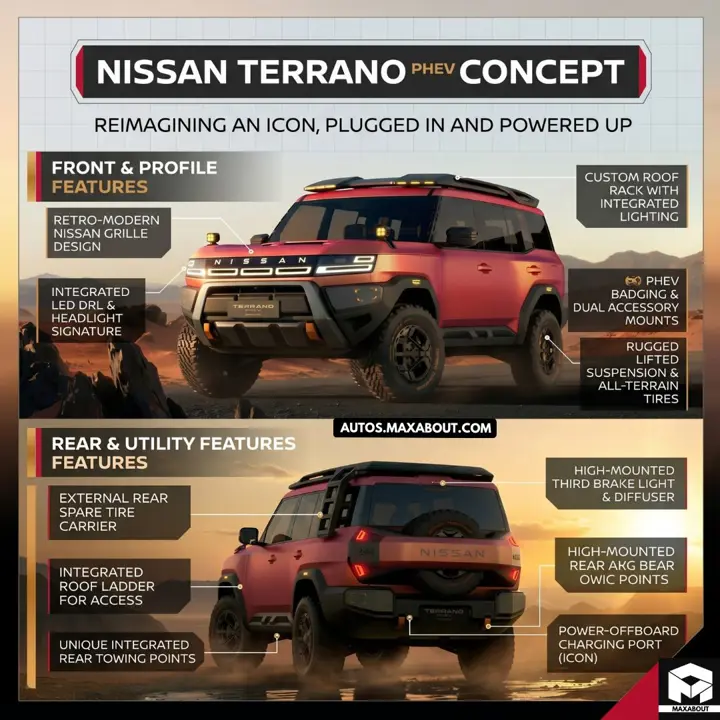 What particularly catches my attention is the integration of modern elements into this rugged framework. The slim LED lighting signature contrasts nicely with the muscular wheel arches and prominent skid plates. The designers have clearly focused on creating visual toughness while maintaining aerodynamic efficiency.
Inside, the cabin shows a welcome upgrade from the somewhat dated interior of the previous Terrano. The floating center console, configurable digital displays, and use of sustainable materials signal Nissan's focus on bringing premium features to this segment. The higher seating position and improved visibility would certainly be appreciated in India's dense traffic conditions.
At approximately 4.4 meters long, the concept sits in that sweet spot between compact urban maneuverability and sufficient interior space – a balance that has proven successful with Indian consumers. If the production version maintains these dimensions, it could offer a compelling alternative in the ₹12-18 lakh segment.
PHEV Technology: What It Means for Indian Drivers
The Terrano concept's PHEV (Plug-in Hybrid Electric Vehicle) system represents a middle ground in electrification that could be particularly relevant for Indian conditions. Unlike full EVs, PHEVs combine a traditional combustion engine with a battery that can be charged externally and provide electric-only driving for shorter distances.
This dual-powertrain approach makes a lot of sense for Indian drivers facing inconsistent charging infrastructure. I think the ability to run on pure electric for daily commutes (typically 30-40km in cities) while having the petrol engine for longer highway trips offers the best of both worlds.
With fuel prices hovering around ₹100/liter in many cities, the fuel savings could be substantial for urban drivers. Based on similar PHEV models, owners might save ₹3,000-4,000 monthly on fuel costs compared to equivalent petrol SUVs.
The PHEV system would likely offer multiple driving modes:
Pure EV mode - Perfect for short city commutes
Hybrid mode - Balancing both power sources for optimal efficiency
Engine mode - When battery is depleted or during highway driving
Unlike the MG Hector Hybrid or Toyota Urban Cruiser Hyryder, which are mild/full hybrids that can't be plugged in, the Terrano PHEV would offer meaningful electric-only range. This positions it as a practical stepping stone toward full electrification for customers who aren't ready to commit to vehicles like the Tata Nexon EV or MG ZS EV.
Potential Features and Technology for the Indian Market
For the Indian market, Nissan would likely need to balance premium features with competitive pricing. Based on current SUV trends, I think we'll see a 10-inch+ touchscreen infotainment system with wireless Android Auto and Apple CarPlay as standard across most variants. The higher trims might include a digital instrument cluster and 360-degree camera – features that have become increasingly important for urban Indian drivers navigating tight parking spaces.
Safety would be paramount with 6 airbags likely standard (especially with the new regulations), along with electronic stability control and hill-start assist. Advanced driver assistance systems (ADAS) like adaptive cruise control and lane-keeping assist might be reserved for top variants to maintain competitive pricing.
Comfort features that would make sense for our climate include:
Ventilated seats - Essential for our hot summers
Auto climate control - With rear AC vents
Air purifier - Becoming increasingly important in metro cities
Connected car technology - Remote start, geo-fencing, and climate pre-conditioning
If Nissan aims to price the Terrano between ₹15-20 lakh, they'll need to carefully curate these features to create a compelling package against established players like Hyundai Creta and Kia Seltos.
Market Positioning and Potential Pricing in India
Looking at Nissan's current lineup in India, the Terrano PHEV would likely sit above the Magnite, potentially filling that crucial ₹15-23 lakh segment where they currently lack presence. Based on its specifications and positioning, I think Nissan might price the base variant around ₹16 lakh, with the top PHEV variant stretching to ₹22 lakh.
This would position it directly against the Hyundai Creta, Kia Seltos, and Maruti Grand Vitara. The rugged styling combined with hybrid technology could be its main differentiator - something not many competitors offer together in this price band.
However, Nissan faces significant challenges in India. Their dealer network is considerably smaller than Maruti, Hyundai or Tata, with approximately 200 touchpoints compared to competitors' 1000+. I've noticed their after-sales reputation has been mixed, particularly in tier-2 cities where service center availability remains limited.
For the Terrano to succeed, Nissan needs to address these infrastructure issues while emphasizing the vehicle's unique blend of ruggedness and efficiency - qualities particularly valuable on Indian roads where both off-road capability and fuel economy matter tremendously.
Production Timeline and Indian Market Entry Possibilities
Looking at typical automotive development cycles, I expect we might see the production version of the Terrano globally by late 2027 or early 2028. Concept-to-production usually takes 18-24 months, but given the PHEV technology integration, Nissan might need additional time for testing and validation.
For the Indian market specifically, I think we're looking at a potential 2028 launch at the earliest. Nissan's manufacturing facility in Chennai could handle production, but that depends on whether they decide to allocate resources there or import from Thailand or Japan initially.
The production model will inevitably lose some of the concept's more dramatic design elements. Those massive off-road tires, exaggerated fender flares, and perhaps the roof-mounted light bar might be toned down. However, I expect the core design language and PHEV powertrain to remain intact, though possibly with lower power figures than the concept's ambitious claims.
Considering Nissan's current position in India, they might test the waters with a limited initial production run to gauge market response before committing to full-scale manufacturing.
The Broader Picture: Nissan's SUV Strategy for India
The Terrano concept represents a critical piece in Nissan's attempt to revitalize its presence in India's competitive SUV landscape. Looking at Nissan's current SUV portfolio in India, it's quite limited - essentially down to the Magnite compact SUV after the original Terrano and Kicks were discontinued.
The Magnite has been Nissan's saving grace in India, bringing reasonable sales numbers in the sub-4m segment. However, Nissan desperately needs a more comprehensive SUV lineup to remain relevant here. The Indian market has shifted dramatically toward SUVs, with even traditional sedan-focused brands now prioritizing their crossover offerings.
For the new Terrano to succeed, Nissan needs to address several challenges beyond just the product itself:
Expanding their service network - Currently too limited compared to Hyundai, Tata, or Maruti
Rebuilding consumer trust - After discontinuing multiple models in recent years
Competitive pricing - The ₹15-20 lakh segment is fiercely contested
If Nissan positions the new Terrano between the Magnite and premium offerings like the X-Trail (which remains a niche import), they might carve out a viable market position. However, they'll need to commit to the Indian market long-term rather than another short-lived product cycle.
No comments yet
Be the first to share your thoughts!
Want to read more automotive news?
Stay updated with the latest car launches, reviews, and industry insights.
Browse All News