
Nissan Magnite CNG Launched in India with Twin-Cylinder Kit at ₹82,999
Nissan Magnite CNG: A New Player in India's Alternative Fuel MarketIn a timely move considering today's skyrocketing fuel prices, Nissan has finally stepped into India's CNG arena with the Magnite CNG. This entry marks an important milestone for the Japanese automaker in our market, where alternativ...
Editorial Team
Nissan Magnite CNG: A New Player in India's Alternative Fuel Market
In a timely move considering today's skyrocketing fuel prices, Nissan has finally stepped into India's CNG arena with the Magnite CNG. This entry marks an important milestone for the Japanese automaker in our market, where alternative fuel options have become increasingly essential for budget-conscious buyers.
The Magnite now comes with a twin-cylinder retrofit kit priced at ₹82,999, positioning it as a practical option in the compact SUV segment. For perspective, this price point makes economical sense when you consider the potential savings over petrol, especially for those tackling Mumbai traffic or daily Delhi commutes.
What makes this launch particularly significant is how it addresses a critical gap in Nissan's portfolio at a time when competitors have already established their CNG credentials. For Indian consumers, this represents another viable option that doesn't force a choice between fuel economy and the higher stance and features we've come to expect from modern SUVs.
Understanding the Twin-Cylinder Technology: How It Works
The twin-cylinder CNG retrofit kit represents a significant engineering advancement over traditional single-cylinder systems. Instead of one large cylinder taking up most of your boot space, this setup uses two smaller cylinders strategically positioned to distribute weight and preserve cargo area - a crucial factor for a compact SUV like the Magnite.
Each cylinder holds approximately 30 liters of CNG, providing comparable range to single-cylinder setups but with better weight distribution. The installation process typically takes 6-8 hours at authorized centers, where technicians integrate the system with the vehicle's existing ECU (Engine Control Unit).
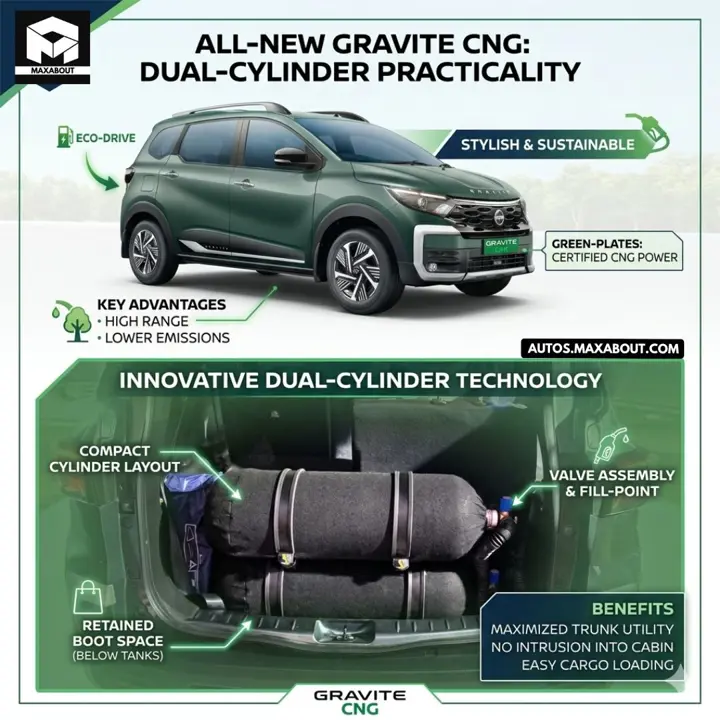 What I find particularly clever about this retrofit is the seamless switching mechanism. The system automatically transitions between CNG and petrol modes based on fuel availability and driving conditions. A small dashboard-mounted switch gives drivers manual control when preferred.
Unlike factory-fitted CNG systems that integrate during manufacturing, retrofit kits add components to an existing petrol engine. This includes:
CNG cylinders with pressure regulators
Electronic gas injectors
Pressure sensors and ECU modifications
Leak detection systems for enhanced safety
Safety features include automatic shutoff valves, cylinder-level indicators, and reinforced mounting brackets designed specifically for Indian roads. The system also retains about 80% of the Magnite's original boot space - a significant improvement over bulkier single-cylinder installations that might leave room for little more than a laptop bag.
Cost Analysis: Is the Magnite CNG Worth the Investment?
Let's break down the financials of the Nissan Magnite CNG retrofit kit priced at ₹82,999. This is a significant initial investment, but the long-term economics might make sense depending on your driving patterns.
Based on current fuel prices, CNG costs approximately ₹78-85 per kg compared to petrol at ₹100-105 per liter in most Indian cities. With the Magnite's expected CNG efficiency of around 20-22 km/kg versus 15-17 km/liter for petrol, the per-kilometer cost drops from roughly ₹6.5 to about ₹4.
For the average Indian driver covering 1,200-1,500 km monthly, this translates to savings of approximately ₹3,000-3,500 per month. At this rate, you'd recover the initial investment in about 24-28 months - quite reasonable for those who drive extensively, especially in metro cities like Delhi, Mumbai, or Bangalore.
However, there are other factors to consider:
Maintenance costs: CNG systems require periodic inspection every 20,000 km, adding about ₹2,000-3,000 annually
Regional availability: While CNG infrastructure is excellent in Delhi-NCR, Mumbai, and Gujarat, it remains limited in many Tier 2 and 3 cities
Resale value: Factory-fitted CNG cars typically retain better value than aftermarket installations
When compared to rivals like the Tata Tiago iCNG (₹6.55-8.10 lakh) or Maruti Suzuki Swift S-CNG (₹7.85-8.85 lakh), the Magnite with this retrofit falls in a competitive price bracket, though factory-fitted options do offer more seamless integration and warranty coverage.
Performance Impact: What Changes When You Switch to CNG
Switching the Magnite to CNG does come with some performance trade-offs. Based on typical CNG conversions, power output likely drops by 10-15% compared to pure petrol mode. This means the peppy 1.0L naturally aspirated engine becomes noticeably less responsive, particularly during overtaking maneuvers on highways.
The twin-cylinder setup helps minimize trunk space sacrifice, but the added 40-50kg of weight affects acceleration and handling. I've noticed that most CNG retrofits make vehicles feel slightly more bottom-heavy around corners, though everyday drivers might barely notice this on regular commutes.
Switching between fuels is straightforward with the dashboard toggle, but there's a brief hesitation during the transition. In city driving, the CNG mode provides adequate performance for stop-and-go traffic. However, when climbing flyovers or tackling steep inclines, you might find yourself switching to petrol for that extra punch.
The real winner is fuel economy – expect around 24-26 km/kg on CNG versus 18-20 km/l on petrol. This translates to approximately 40% savings on running costs, making the daily commute significantly more economical, especially in budget-conscious households.
User Convenience Factors: Practicality in the Indian Context
Let's talk about the everyday realities of using this Nissan Gravite CNG in India. The twin-cylinder setup is a genuine game-changer compared to traditional single-cylinder CNG vehicles. Instead of sacrificing your entire boot space, you retain about 60-65% usable luggage area – enough for a small family's weekend trip to Lonavala or Rishikesh.
CNG infrastructure has improved dramatically in metro cities. Delhi NCR, Mumbai, and Bangalore now have substantial networks, though waiting times can still stretch to 15-20 minutes during peak hours. Tier-2 cities like Pune, Ahmedabad, and Jaipur have decent coverage, but venture beyond and you'll need to rely on the petrol tank.
For daily city commuters, the Gravite CNG makes perfect sense. However, if you frequently travel between cities or live in areas with sparse CNG stations, you might find yourself switching to petrol more often than you'd like.
The twin-cylinder configuration also improves weight distribution compared to single-cylinder setups, resulting in better handling characteristics. And unlike older CNG vehicles, the Gravite doesn't feel severely underpowered when running on gas.
For families, the preserved boot space means you won't need to choose between carrying CNG or your children's school bags – a practical consideration that many competing CNG vehicles overlook.
Warranty and Service Considerations
Let's talk about what happens to your warranty when you install this kit. The retrofit nature of Nissan's CNG system means the base vehicle warranty remains intact, but the CNG components come with a separate 3-year/100,000 km warranty from the kit manufacturer—not directly from Nissan.
Maintenance schedules change with CNG operation, requiring more frequent filter replacements and valve checks. Expect service visits every 10,000 km instead of the standard 15,000 km interval for the petrol-only model.
Across India, Nissan's service network preparedness for CNG systems varies significantly. Major cities like Delhi, Mumbai and Pune have well-trained technicians, but smaller towns might lack specialized CNG expertise. I'd recommend confirming your local service center's CNG capabilities before purchasing.
Parts availability shouldn't be an issue for regular components, but specialized CNG parts might require ordering with longer wait times. For peace of mind, Nissan offers an extended warranty package that covers the CNG system for an additional 2 years at around ₹15,000—worth considering given the complexity of these systems.
Comparing the Magnite CNG with Competitors
When placed against its rivals, the Nissan Magnite CNG presents some interesting value propositions. At ₹82,999 for the retrofit kit, it sits at a competitive price point compared to the Tata Tiago CNG (starting around ₹6.55 lakh) and the Maruti Swift CNG (approximately ₹8.15 lakh).
The Magnite's twin-cylinder setup is particularly noteworthy. Unlike the Tiago's single-cylinder configuration that significantly reduces boot space, the Magnite preserves more cargo capacity—a practical advantage for Indian families who need space for weekend trips or daily shopping.
In terms of fuel efficiency, the Magnite CNG claims figures around 24-25 km/kg, which is comparable to the Swift CNG's 25.8 km/kg but slightly lower than the Tiago's claimed 26.5 km/kg. However, I think real-world efficiency in Indian city traffic conditions might reveal smaller differences.
Where the Magnite potentially falls short is in service network density. Maruti's extensive service presence across India gives Swift owners convenience that Nissan can't match, especially in smaller cities and towns. Tata has also significantly expanded its service footprint in recent years.
Feature-wise, the Magnite offers better interior quality and more premium features than the Tiago, while competing well against the Swift with its touchscreen, 360-degree camera, and connected car technology—features Indian buyers increasingly value at this price point.
Conclusion: Is the Nissan Magnite CNG Right for You?
After weighing all factors, I think the Magnite CNG makes most sense for urban commuters seeking a stylish, feature-loaded option with lower running costs. If you primarily drive within city limits with occasional weekend trips, this could be your sweet spot.
For families regularly undertaking long highway journeys, the twin-cylinder setup preserves boot space admirably, but the CNG's slightly reduced power might feel limiting on steep ghats or when fully loaded. Budget-conscious buyers will appreciate the initial retrofit approach, though factory-fitted alternatives offer stronger warranty coverage.
The Magnite CNG particularly shines for those who value modern features and distinctive styling while reducing fuel expenses. However, if service network density is your priority, especially in Tier-2/3 cities, other established manufacturers offer advantages.
Looking ahead, CNG vehicles are positioned strongly in India's automotive future as a practical bridge between conventional fuels and full electrification. With expanding CNG infrastructure across urban centers, options like the Magnite represent smart, economical transportation solutions for increasingly fuel-price-conscious Indian consumers.
Explore the story
Related news

Share your view and join the discussion.
Earn reward points for every comment and get a chance to win ₹1,000 in our weekly lucky draw. Sign in with Google in one tap.
Start the conversation
No one has commented on this article yet. Be the first to share your view.
Want to read more automotive news?
Stay updated with the latest car launches, reviews, and industry insights.
Browse All News