
Next-Gen Hyundai Tucson Interior Spied: Key Changes
Interior spy shots are rare. Manufacturers go to great lengths to hide cabin details — tape, camouflage covers, blacked-out windows. So when images of the next-generation Hyundai Tucson's interior surfaced recently, the automotive world paid attention. And honestly, so should Indian buyers.The Tucso...
Editorial Team
Interior spy shots are rare. Manufacturers go to great lengths to hide cabin details — tape, camouflage covers, blacked-out windows. So when images of the next-generation Hyundai Tucson's interior surfaced recently, the automotive world paid attention. And honestly, so should Indian buyers.
The Tucson has always occupied an interesting space in India's premium SUV segment. It sits above the crowd-pleasers like the Creta, yet undercuts the more aspirational European offerings. That middle ground is not easy to hold. But Hyundai has managed it — partly through competitive pricing, partly through a feature-rich cabin that punched above its price point.
Right now, the current-generation Tucson, priced around ₹29 to ₹35 lakh, competes in a segment that is getting sharper by the month. Rivals are updating quickly. Buyers in cities like Bengaluru, Pune, and Delhi are increasingly well-informed and harder to impress.
That is exactly why these spy shots matter. An interior reveal tells you far more about a vehicle's direction than exterior styling ever could. It speaks to the ownership experience — what you see, touch, and interact with every single day. And from what these leaked images suggest, Hyundai may be preparing something genuinely interesting for its next chapter.
Breaking Down the Spied Interior: Key Design Changes Spotted
So what do the images actually show? Let's be careful here — spy shots are rarely perfect, and lighting conditions, angles, and image quality can mislead. But from what can be made out, there are some genuinely interesting observations worth discussing.
The dashboard layout appears to show a more horizontal, layered design compared to the current Tucson's somewhat busier arrangement. The existing model has a distinctive integrated screen setup, but the next-gen version seems like it could be pushing toward a cleaner, more minimalist surface — something closer to what Hyundai has done with the Ioniq 5 and more recently the updated Santa Fe globally.
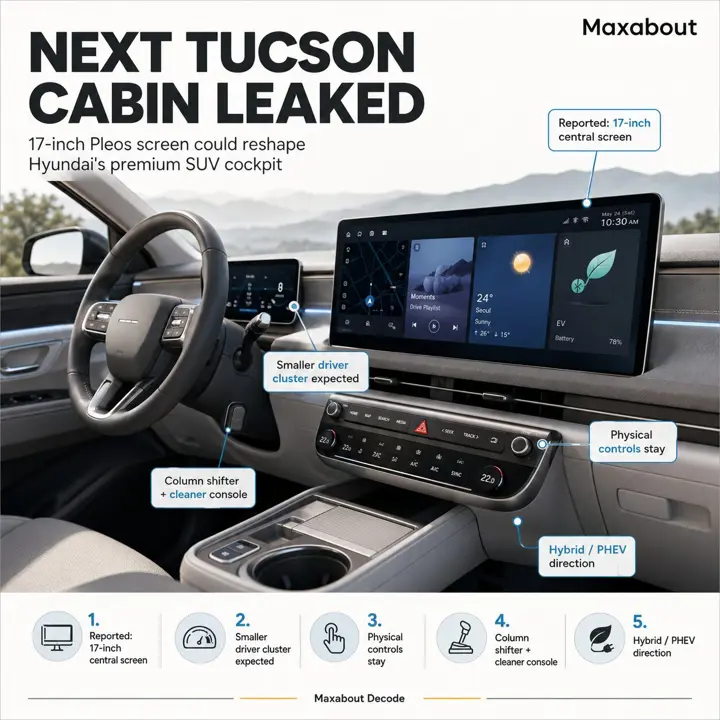 The screen situation looks promising. There appears to be a larger infotainment display, possibly floating or flush-mounted, paired with what seems like a fully digital instrument cluster. If that holds true, it would be a meaningful upgrade over the current setup, especially for buyers who feel the present layout is starting to show its age.
The steering wheel, from what can be made out in the images, looks more contemporary — flatter at the bottom, with revised control layouts. Hyundai has been gradually refining this across newer models, and it seems like the Tucson is following that same direction.
Material quality is harder to judge from spy images, but the surfaces visible suggest soft-touch elements on the upper dashboard. Ambient lighting strips also appear to be present, which would align with what Hyundai has been offering in its more premium global offerings.
How the New Interior Stacks Up Against Current Tucson and Rivals
The current Tucson already sits at a decent level inside. The panoramic sunroof, ventilated front seats, and that layered dashboard design genuinely feel premium for the segment. So the question isn't whether Hyundai is starting from a weak base — they aren't. It's whether the next generation moves the needle enough to stay competitive.
From what the spy images suggest, the cabin does feel more resolved. The screen arrangement looks cleaner, and the steering wheel revision brings it closer to what you'd see in the Ioniq 5 or the newer Creta facelift. That consistency matters to buyers who want a coherent, modern experience.
Against the Jeep Compass, the Tucson has historically had an edge in perceived refinement and feature count. The Compass cabin, while improved, still feels a generation behind in terms of screen integration. That gap looks likely to widen with the next Tucson.
The Volkswagen Tiguan is a tougher benchmark. Its interior build quality — the solidity of buttons, the weight of the door pulls — is genuinely excellent. The new Tucson may close the gap visually, but tactile quality is something spy shots simply cannot confirm.
The Skoda Kodiaq brings strong practicality and a well-organized layout, especially appreciated on longer highway runs. If Hyundai has genuinely improved rear space and ADAS integration in this update, that could be a meaningful advantage for family-focused buyers considering all three options.
Questions do remain, particularly around ADAS refinement for Indian conditions — something every brand still struggles with on chaotic city roads.
Technology and Features We Hope Make It to the India Spec
The spy shots, even partially obscured, hint at a noticeably more ambitious interior technology layout than the current generation. A larger central infotainment display appears to dominate the dashboard — looking wider and potentially curved at the edges, similar to what Hyundai has been doing with the Ioniq lineup globally. The instrument cluster also looks fully digital, possibly with higher resolution graphics and customizable layouts.
There are also hints of a heads-up display setup and what appears to be a more integrated ADAS control interface — cleaner buttons, fewer physical switches cluttering the steering wheel. Honestly, that alone would be a welcome change.
Now, the realistic part. Hyundai's India-spec vehicles have historically received most but not all global features. The current Tucson in India does reasonably well — it carries ADAS, a panoramic sunroof, and connected car tech. But features like the 12.3-inch fully digital cluster took time to arrive here, and some advanced driver assistance modes remain toned down compared to Korean or European variants.
For this next generation, I genuinely hope Hyundai resists the temptation to strip out the larger screen or downgrade the cluster to save costs. Those are the features buyers at this price point specifically notice and talk about.
Connected car features should be a given — Hyundai's BlueLink suite has matured well in India. What remains uncertain is whether the global model's more sophisticated ADAS camera and radar integration will survive the journey to Indian production. Given our road conditions, some calibration adjustments are expected, but outright removal would feel like a missed opportunity at this segment level.
Space, Practicality, and Real-World Usability for Indian Families
Technology is one thing. But for most Indian families actually spending ₹35–40 lakh on a Tucson, the real question is simpler: will everyone fit comfortably on that drive from Bengaluru to Coorg?
The current Tucson's rear seat has drawn mixed reactions from Indian owners. Headroom is acceptable but not generous, and taller passengers — anyone above six feet — occasionally report feeling slightly cramped on longer stretches. Whether the next generation addresses this through a longer wheelbase or revised roofline is something the spy shots don't yet fully reveal.
Boot space matters enormously here. Indian families pack seriously for weekend trips. The existing 540-litre boot is decent, but the shape and loading lip have been mild complaints — luggage stacking becomes awkward with a full family on board. A flatter, wider boot opening in the new model would genuinely move the needle for buyers.
Charging port placement is another practical concern. From what reviewers of the current model consistently mention, rear USB ports feel like an afterthought. With screens becoming central to family travel, the next-gen interior needs multiple accessible charging points — Type-C, ideally positioned at both front and rear without requiring awkward cable routing.
Storage compartments throughout the cabin — door pockets deep enough for a one-litre bottle, a centre console that actually organises rather than just swallows items — these small details define daily usability far more than any headline specification.
Expected India Launch Timeline and Pricing Outlook
Based on Hyundai's established pattern, the current Tucson generation reached India roughly two years after its global debut. If that rhythm holds, and given that spy shots of the next-gen model are already surfacing, a realistic India launch window would sit somewhere around late 2026 to mid-2027. That is genuinely a rough estimate — Hyundai occasionally surprises, but this timeframe feels reasonable based on how they have handled previous product cycles here.
Pricing is where things get interesting. The current Tucson starts close to ₹29 lakh and climbs well above ₹35 lakh for fully loaded variants. From what industry observers are suggesting, the premium interior upgrades — larger display architecture, improved material quality, enhanced ambient lighting systems — would almost certainly push the next generation's entry price toward the ₹32–38 lakh bracket. These are estimates, not confirmed figures.
At that pricing, the conversation immediately turns competitive. The Jeep Compass, Volkswagen Tiguan, and Skoda Kodiaq all occupy similar territory. Whether the Tucson's interior refinement alone justifies the premium over these established rivals remains an open question — one that Indian buyers will ultimately answer.
Should You Wait for the Next-Gen or Buy the Current Tucson Now?
This is genuinely the hardest question to answer right now. And honestly, it depends entirely on where you are in life.
The case for waiting is real. From what the spy shots suggest, the interior is a meaningful step forward — not just a cosmetic refresh. Better screens, refined materials, updated safety tech. If you're someone who can comfortably manage 12–18 months with your current vehicle, waiting could make sense. You'd also benefit from clearer pricing information and early ownership feedback before committing.
But buying now has its own logic. Dealers are currently offering solid discounts on the existing Tucson. Its reliability record is well-established, service costs are understood, and you won't be surprised by anything. That peace of mind has real value.
Consider your situation honestly:
Need a car urgently? Buy now. A proven product beats a promised one.
Can wait comfortably? Patience will likely reward you with meaningfully better technology.
Worried about resale? A next-gen launch typically softens current-gen resale values — worth factoring in.
In my view, there's no universally right answer here. The current Tucson is still a genuinely good vehicle. The next-gen simply looks like a better one.
Final Thoughts: Does the Next-Gen Tucson Look Like a Step Forward?
Honestly? From what these spy shots reveal, yes — this does look like a genuine step forward, not just a reskin with a fresh coat of paint.
The interior changes appear more than cosmetic. A cleaner layout, updated screen architecture, and what looks like a more premium overall feel suggest Hyundai is responding to real criticism, not just shuffling elements around. That matters.
For Indian buyers specifically, the details beyond the design will determine everything. Build quality that survives Mumbai humidity and Bengaluru traffic. A service network that doesn't make ownership stressful. Pricing that justifies the premium over strong competition in this segment.
Whether this becomes genuinely exciting depends on what sits beneath the surface — features, powertrain refinement, and how aggressively Hyundai prices it for this market.
Cautious optimism feels like the right position here. The early signs are encouraging. But spy shots only tell part of the story.
What do you think? Drop your thoughts below — what one feature would make you seriously consider the next-gen Tucson? A larger screen, ADAS improvements, better fuel efficiency? Would love to hear what actually matters to you.
No comments yet
Be the first to share your thoughts!
Want to read more automotive news?
Stay updated with the latest car launches, reviews, and industry insights.
Browse All News