
New 350cc KTM 390 Duke & 390 Adventure Launched: More Power, New Price at ₹2.77 Lakh
Something significant just happened in the Indian performance bike market. KTM has pulled the wraps off updated versions of both the 390 Duke and 390 Adventure, and the headline change is a reworked engine that demands serious attention from anyone shopping in this segment.Now, let me be upfront — o...
Editorial Team
Something significant just happened in the Indian performance bike market. KTM has pulled the wraps off updated versions of both the 390 Duke and 390 Adventure, and the headline change is a reworked engine that demands serious attention from anyone shopping in this segment.
Now, let me be upfront — official displacement specifics are worth reading directly from KTM's announcement, since early reports have carried slightly mixed figures. What matters is that KTM has made meaningful internal changes to the powerplant, extracting more output while launching both bikes simultaneously. That dual launch is deliberate. It signals KTM isn't just refreshing one model — they're repositioning an entire family.
And then there's the price. ₹2.77 lakh is a number that changes the conversation completely. From what I've seen across buyer discussions and segment analysis, this puts KTM in genuinely uncomfortable territory for its rivals. The Triumph Speed 400 and Royal Enfield Himalayan 450 both sit nearby, and buyers were already comparing them carefully.
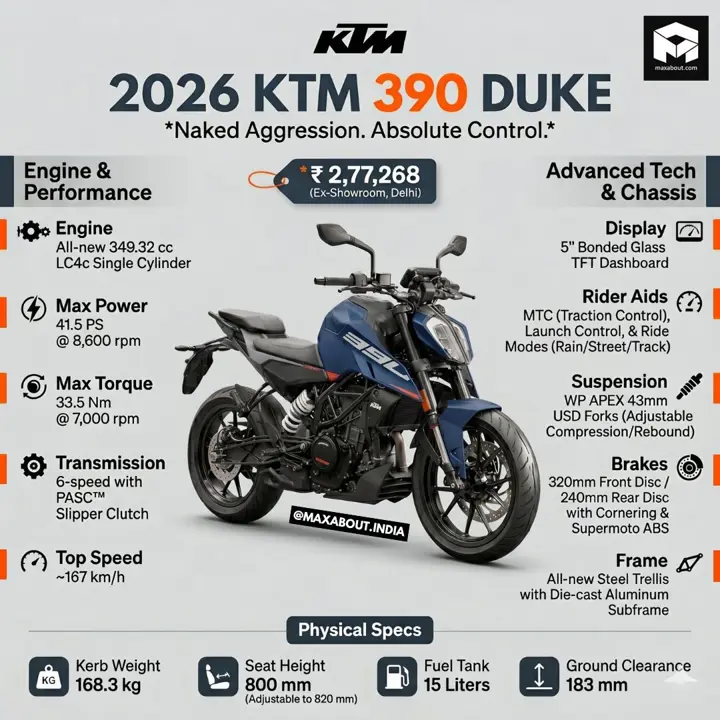 This feels like a proper shake-up. The mid-range performance segment in India — roughly ₹2.5 lakh to ₹3.5 lakh — is suddenly very interesting. More power, a sharper price, and two strong model options released together. That's not an accident. That's a strategy.
What's Actually New: Engine, Power, and Performance Upgrades Explained
The headline change is the displacement bump — from 373cc to 399cc. That might sound minor on paper, but the outcome is meaningful. Peak power climbs to around 46 bhp, with torque sitting at approximately 39 Nm. The outgoing 373cc unit produced roughly 43 bhp, so this isn't a dramatic leap. But the way that power is delivered is reportedly where the real difference lives.
From what early ride reviews have revealed, the new engine feels noticeably more relaxed at highway speeds. The previous motor had a slightly strained character above 120 km/h — not dangerous, just buzzy. This larger unit apparently breathes easier in that range, which matters considerably on long stretches like the Chandigarh-Manali corridor or the plains before Leh.
KTM has also revised the fueling and exhaust routing to meet updated emission standards, and the cooling system has been refined. The result, according to official announcements, is better thermal management — something riders on high-altitude routes through Rohtang or Baralacha La will genuinely appreciate.
In city traffic — think Bangalore's Outer Ring Road or Delhi's stop-start chaos — the low-end torque delivery is described as smooth rather than aggressive. That's a deliberate tuning choice. KTM appears to have softened the initial throttle response slightly, making daily commuting less tiring without dulling the excitement when you actually want it.
Overtaking on two-lane highways becomes more effortless with that extra headroom in the midrange. That's where this engine upgrade genuinely counts.
390 Duke vs 390 Adventure: Which One Makes More Sense for Indian Riders?
Same engine, completely different personalities. That's the honest summary here. Choosing between these two comes down to one simple question — where do you actually ride most of the time?
The 390 Duke is sharper, lighter, and thrives in urban chaos. If your daily reality involves Bengaluru's Silk Board junction or Mumbai's Western Express Highway crawl, the Duke's aggressive geometry and nimble handling feel like a genuine advantage. It cuts through gaps, responds instantly, and never feels oversized for tight city situations.
The 390 Adventure tells a different story. Taller windscreen, more upright seating, and a riding position designed for sustained comfort. Someone planning regular Pune-Goa runs or longer Coorg weekends will immediately appreciate that wind protection on open highways. The Adventure also carries luggage mounting points that the Duke simply doesn't offer, which matters enormously on overnight touring trips.
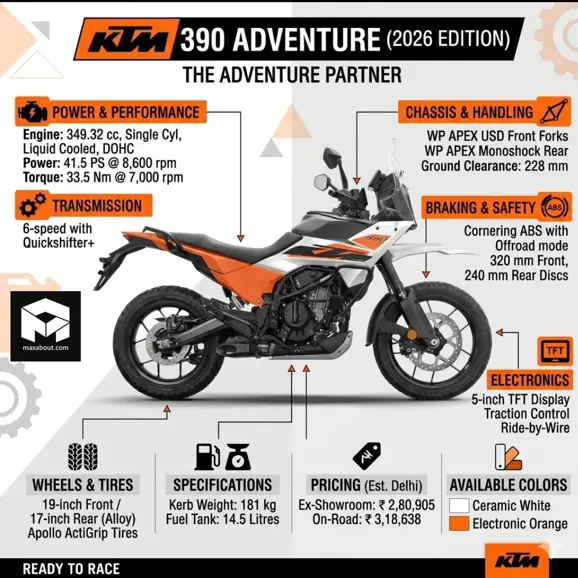 Seat height is worth mentioning — the Adventure sits noticeably taller, which could concern shorter riders in stop-and-go traffic. The Duke is more approachable there.
From a value perspective, both are priced close enough that the decision shouldn't be financial. It should be honest. If Spiti or Ladakh is genuinely on your riding calendar, choose the Adventure. If it isn't, the Duke's purity and directness arguably makes it the more rewarding everyday choice.
The ₹2.77 Lakh Price Tag: Is KTM Offering Real Value in 2025?
Let's talk money. The 390 Duke's ex-showroom price of ₹2.77 lakh sounds sharp on paper. But once you factor in registration, insurance, and dealer handling charges, expect on-road figures closer to ₹3.1–3.2 lakh in Delhi, nudging ₹3.3 lakh in Mumbai, and somewhere around ₹3.15 lakh in Hyderabad. That's real money for a 350cc motorcycle.
So how does it stack up against the competition? Honestly, it's a tight and interesting fight right now.
Triumph Speed 400 — sits around ₹2.33 lakh ex-showroom, offering strong brand prestige and refined character
Royal Enfield Guerrilla 450 — priced near ₹2.39 lakh, punching hard with smooth power and excellent build quality
Honda CB300R — more affordable but noticeably less equipped on the electronics front
Yamaha MT-03 — genuinely fun but priced higher, closer to ₹4.6 lakh, making it a different conversation entirely
Against the Speed 400 and Guerrilla 450 specifically, KTM is asking a meaningful premium. The justification? You're getting a proper electronics package — multiple riding modes, cornering ABS, traction control, and the much-appreciated QuickShifter as standard fitment. That last bit matters. Competitors either skip it entirely or charge extra.
From what industry observers are noting, the feature-to-price ratio does hold up reasonably well. But I won't pretend the gap against the Guerrilla 450 feels completely comfortable — Royal Enfield has genuinely raised the bar there.
For young working professionals in cities, the EMI angle is worth considering. At roughly ₹6,500–7,000 per month over 48 months with a standard down payment, it's manageable but not effortless. This is a stretch purchase for most, not an impulse one.
Is the price justified? Mostly yes — but only barely. KTM hasn't priced this aggressively enough to silence competitors. They've played it safe, banking on brand loyalty and the electronics list to carry the argument.
Living With a KTM 390: Service Costs, Reliability, and the Bajaj Network Reality
So you've stretched the budget and bought one. Now what? This is where ownership gets interesting — and occasionally frustrating.
The good news is that Bajaj's authorized service network genuinely helps here. With over 4,000+ service touchpoints across India, you're rarely stranded in a metro or Tier-1 city. Pune, Hyderabad, Bengaluru, Delhi — coverage is solid. The honest concern starts when you move to smaller towns. Tier-3 cities and rural areas can be genuinely challenging for parts availability, and waiting periods for specific components aren't uncommon.
On running costs, expect to spend roughly ₹8,000–12,000 annually on scheduled maintenance, depending on your riding intensity. Service intervals are set at every 5,000 km, and KTM recommends genuine oil and filters — costs that add up faster than on a Japanese machine.
The reliability conversation deserves honesty. Older 390 Duke owners have documented electrical gremlins and stator failures across enthusiast communities. These weren't isolated incidents. KTM has since revised the charging system architecture on newer generations, and industry observers note the current platform is meaningfully more stable. Has every concern been fully resolved? That remains to be seen over time with actual ownership data.
One practical suggestion — opt for the extended warranty if KTM offers it at launch. Given the electronics-heavy nature of this new model, that additional coverage makes clear financial sense for peace of mind.
New Features and Electronics: Does the 390 Finally Feel Premium Enough?
This is where the new 390 Duke genuinely starts making a strong case for itself. The feature list reads more like a ₹4-5 lakh motorcycle than something sitting at ₹2.77 lakh — and that honestly deserves some acknowledgment.
The TFT display is crisp, well-organized, and readable even under harsh afternoon sun — something that genuinely matters if you're navigating through Bengaluru traffic or riding out on a bright Rajasthan highway. Bluetooth connectivity pairs reasonably well with most Android and iOS devices, giving you turn-by-turn navigation prompts and call alerts directly on the cluster. In practice though, the pairing stability depends heavily on your phone model. From what reviewers have noted, it works consistently enough for daily use, but don't expect perfectly seamless behavior every single time.
Cornering ABS and traction control are genuinely useful additions — not just spec-sheet decoration. On broken road surfaces, sudden gravel patches, or mid-corner surprises that Indian roads constantly serve up, these systems add a real layer of confidence. Ride-by-wire enables the multiple riding modes, which adjust throttle response meaningfully between Street, Sport, and Rain settings.
Ergonomically, KTM appears to have softened the seat padding slightly and adjusted handlebar reach — previous complaints about aggressive positioning on longer rides seem partially addressed, though tall riders may still find the setup demanding beyond two hours.
Compared to rivals at similar pricing, the electronics suite here is genuinely class-leading. Few competitors offer cornering ABS at this price point.
Should You Buy It Now or Wait? Honest Buying Advice
Here is my straightforward take: if you have been riding for at least two years and currently own a KTM 200 Duke or a Royal Enfield Classic 350, this transition will feel surprisingly natural. The power jump is real, but the new electronics package genuinely helps manage it. First-time 390 owners should not feel intimidated — just respectful.
The ideal buyer is honestly someone between 24 and 35, comfortable with sporty ergonomics, riding regularly in urban traffic with occasional highway runs. If weekend tours to Lonavala, Coorg, or Spiti are on your list, the 390 Adventure variant makes more practical sense than the Duke.
On timing — waiting three to four months for early ownership feedback is reasonable advice. Launch variants sometimes carry minor software or hardware niggles that get addressed quietly. Expect dealership waiting periods of six to ten weeks in metro cities right now.
Upgraders from the Classic 350 should honestly assess maintenance expectations. KTM's service costs and intervals differ significantly from Royal Enfield's straightforward ownership experience.
At ₹2.77 lakh, this is genuinely hard to dismiss. The electronics, refinement, and performance represent strong value. But be honest with yourself — if your actual riding is mostly office commutes through congested traffic, this commitment may exceed your practical needs.
Explore the story
Related news
Share your view and join the discussion.
Earn reward points for every comment and get a chance to win ₹1,000 in our weekly lucky draw. Sign in with Google in one tap.
Start the conversation
No one has commented on this article yet. Be the first to share your view.
Want to read more automotive news?
Stay updated with the latest car launches, reviews, and industry insights.
Browse All News