
Musashi India Signs LOI With Kinetic Green for EV Powertrain Supply
Most EV news in India revolves around big-ticket announcements — new models, government subsidies, charging infrastructure. But sometimes, a quieter piece of news matters just as much. The recent Letter of Intent signed between Musashi India and Kinetic Green for electric two-wheeler powertrain supp...
Editorial Team
Most EV news in India revolves around big-ticket announcements — new models, government subsidies, charging infrastructure. But sometimes, a quieter piece of news matters just as much. The recent Letter of Intent signed between Musashi India and Kinetic Green for electric two-wheeler powertrain supply is exactly that kind of story.
So why does this deserve attention? Because it touches something fundamental — where the actual components come from.
Musashi India is the Indian arm of Japan's Musashi Seimitsu, a company with deep expertise in precision powertrain engineering. They've been supplying drivetrain components to the Indian automotive industry for years. Kinetic Green, on the other hand, is a well-established name in India's electric two-wheeler space, backed by the legacy Kinetic Group.
An LOI isn't a final contract — but it signals serious, documented intent between two parties to move toward one. Think of it as a firm handshake before the paperwork.
What makes this particularly relevant is the broader push to localize EV supply chains in India. Indian OEMs have been under real pressure to reduce import dependence, and partnerships like this one directly support that goal. From what industry observers are noting, this collaboration fits neatly into the Make in India framework that's reshaping how EVs get built here.
Who Is Musashi India and Why Their Entry Into EV Powertrains Matters
This is not a newcomer trying to find its footing. Musashi India is a subsidiary of Japan's Musashi Seimitsu Industry, a company with decades of experience manufacturing precision drivetrain and transmission components for some of the world's largest automotive groups. In India, they've been quietly operating as a Tier-1 supplier, delivering components that go into millions of two-wheelers and four-wheelers every year.
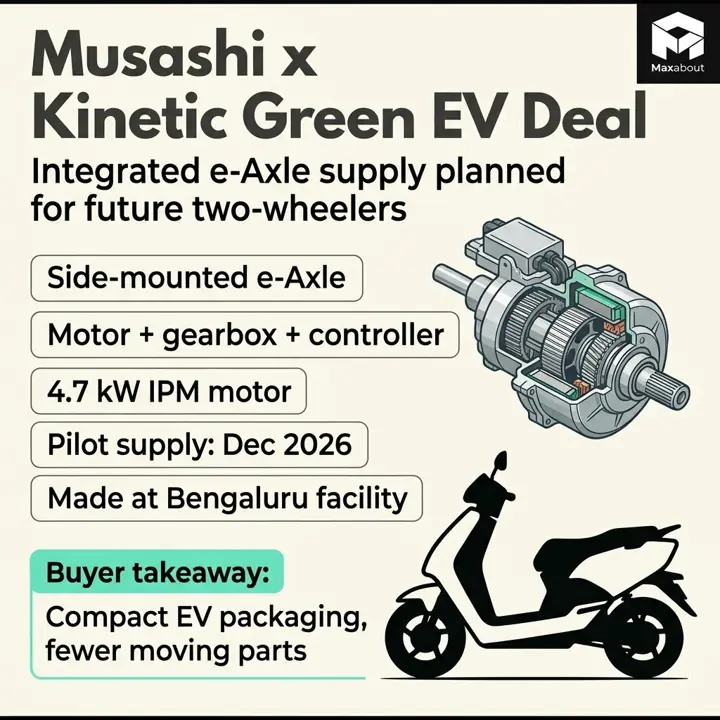 Their existing manufacturing presence here — with facilities geared toward high-tolerance, high-volume production — gives them a significant advantage. From what industry reports suggest, Musashi India has been supplying gear assemblies, differential components, and transmission parts to established ICE-based OEMs for years. That precision engineering background is exactly what EV powertrains demand.
The transition makes practical sense. EV drivetrains still rely heavily on gear reduction units and motor-integrated transmission assemblies — areas where Musashi's core competencies translate directly. From what industry reports suggest, their likely contribution to the Kinetic Green partnership involves these very components, potentially including motor housings and reduction gear systems.
What this signals, broadly, is that established Tier-1 suppliers are no longer watching the EV shift from the sidelines. They're actively repositioning their capabilities toward it — and that kind of institutional expertise entering the EV space could meaningfully raise the quality bar for Indian-made electric powertrains.
Kinetic Green's EV Ambitions and Why They Need a Powertrain Partner Like This
Kinetic Green isn't a newcomer trying to figure things out. The brand carries the weight of the broader Kinetic group's legacy — a name that genuinely meant something in Indian two-wheelers during the 1980s and 90s. That heritage gives Kinetic Green a certain credibility, but it also comes with expectations. And in the EV space, meeting those expectations requires more than brand recall.
Their current lineup focuses on low-speed electric scooters and urban commuter EVs, deliberately targeting segments that are often overlooked — women riders who prioritize ease of use, daily urban commuters who want affordable running costs, and fleet operators who need reliable, low-maintenance vehicles. It's a thoughtful positioning, honestly. These aren't glamorous buyers chasing performance numbers. They want something that works, day after day, without drama.
Scaling that promise is where things get genuinely difficult. Several Indian EV brands have stumbled badly on quality and after-sales reliability — issues that have made buyers cautious. From what industry observers have consistently noted, powertrain inconsistency remains one of the most common pain points. A partnership with a precision-focused supplier like Musashi directly addresses that vulnerability, giving Kinetic Green a more dependable foundation to build volume on without compromising the trust they're working hard to establish.
What This LOI Could Mean for the Indian Electric Two-Wheeler Supply Chain
Step back for a moment and look at where India's electric two-wheeler industry actually stands. Growth numbers look impressive on paper, but underneath that momentum lies a structural vulnerability that doesn't get discussed enough — heavy dependence on imported components, particularly from China. Motors, controllers, battery management systems — a significant portion of what goes into an Indian electric scooter today has traveled a long way before reaching the assembly line.
That's precisely why a deal like this LOI carries weight beyond just two companies signing an agreement. It represents a tangible step toward building something India genuinely needs right now: a reliable domestic EV supply chain.
The government has been pushing in this direction for a while. FAME II subsidies were deliberately structured to reward localization, and the PLI scheme for EV components offers meaningful incentives for manufacturers willing to invest in domestic production capacity. The policy intent is clear. What's been missing is enough industry momentum to match it — and partnerships like Musashi-Kinetic Green are exactly the kind of private-sector response those schemes were designed to encourage.
From a consumer standpoint, localization of powertrain components has a very direct impact. Lower logistics costs and reduced import dependency translate into more competitive pricing over time. But honestly, the even bigger benefit for everyday buyers is serviceability. In Tier 2 and Tier 3 cities today, sourcing spare parts for electric two-wheelers remains a genuine frustration. Locally manufactured components mean faster supply chains and more accessible replacements — which matters enormously when your vehicle is your daily commute.
What This Could Mean for Your Wallet and Your Ride
Let's get to the part that actually matters for someone standing in a showroom deciding whether to buy a Kinetic Green scooter. If this Musashi partnership moves from LOI to full-scale supply, the downstream effects on real-world ownership could be genuinely meaningful.
Scale is everything in component manufacturing. When Musashi India supplies powertrain parts at volume, per-unit costs drop — and at least some of that saving has a reasonable chance of flowing to the buyer through more competitive ex-showroom pricing or better-equipped base variants.
Beyond price, the more compelling story is powertrain quality and consistency. Indian summers are brutal on electric motors and battery thermal systems — anyone riding through Pune in May or sitting in Bangalore traffic in April knows exactly what that means. A well-engineered powertrain handles heat more predictably, which directly protects range consistency and long-term motor health.
Hill-climbing performance on city flyovers or ghat stretches also depends heavily on motor calibration and torque delivery — areas where established powertrain specialists like Musashi genuinely add value.
That said, an LOI is a statement of intent, not a finished product. Supply chain ramp-ups take time. Buyers shouldn't expect transformed scooters overnight. But as directional signals go, this one points somewhere worth watching.
The Competitive Landscape: Where Kinetic Green Stands Against Ola, Ather, and TVS
Let's be honest about where Kinetic Green sits right now. In a market where Ola Electric, Ather Energy, TVS iQube, Bajaj Chetak, and Hero Vida are all spending heavily on technology, retail experience, and brand building, Kinetic Green is not yet in the same conversation for most mainstream buyers.
Their current strength lies largely in the value and low-speed segment — practical, affordable options that work for last-mile delivery operators, tier-two city commuters, and buyers where price is the dominant factor. That is a legitimate market. But it is a different market from where Ather or TVS are competing.
The gap is visible in multiple ways. Retail network depth, after-sales reliability perception, software sophistication, and simply the aspirational pull of the brand — Kinetic Green trails on most of these counts compared to the top five players. From what industry observers consistently note, the brand has not yet built the kind of consumer trust that converts casual interest into a purchase decision.
That makes partnerships like this Musashi LOI genuinely meaningful. Building credible powertrain foundations before scaling is the right sequence. It suggests they are not cutting corners to chase volume quickly — and in India's EV market, where after-sales nightmares have damaged several brands, that measured approach actually matters.
Broader Implications: Japan-India Industrial Collaboration in the EV Era
There is a longer story here, one that stretches well beyond this single LOI. Japan and India have shared an extraordinarily deep automotive relationship for decades. Honda, Suzuki, Yamaha — these are not just foreign brands operating in India. They are practically woven into how India learned to manufacture vehicles at scale, with consistency and discipline.
That transfer of manufacturing culture matters enormously. Japanese precision engineering brought something beyond technology — it brought process thinking. The idea that quality is not inspected at the end of a line but built into every step along the way. Indian manufacturing has absorbed much of that philosophy, but inconsistency remains a genuine challenge, particularly in the emerging EV components space.
Musashi, as a Japanese precision parts specialist now pivoting toward EV drivetrains, carries that same cultural DNA. Globally, Japanese automotive suppliers are navigating a difficult transition — their expertise was built around internal combustion complexity, and electrification has forced a fundamental rethink. India is increasingly where that rethink finds practical, scalable application.
For Kinetic Green, this connection is quietly significant. Associating with a supplier that brings Japanese manufacturing rigour to EV powertrains could meaningfully address quality perception concerns that have troubled the broader Indian electric two-wheeler segment. That reputational dimension, understated as it appears, may prove just as valuable as the components themselves.
Final Thoughts: A Promising Signal for Indian EV Manufacturing, But Watch the Follow-Through
An LOI is exactly what it says — a letter of intent. It signals direction, not destination. The real test comes later, when production schedules tighten, supply chains face pressure, and cost targets get uncomfortably specific.
That said, this kind of supply chain groundwork is precisely what India's EV ecosystem needs more of. Not just bold launch events and headline numbers, but quiet, foundational work — credible suppliers, quality components, manufacturing discipline. Moves like this one rarely generate excitement, but they matter enormously.
Cautious optimism feels like the honest position here. If this partnership translates into consistent powertrain supply, it could genuinely strengthen Kinetic Green's product reliability — something Indian buyers have every right to demand after years of patchy experiences with early electric two-wheelers.
Keep watching both companies for official production timelines and model announcements. Those details will tell the real story.
Ultimately, what buyers in Pune, Hyderabad, or any Indian city actually need is straightforward: affordable, dependable electric scooters, backed by accessible service, that handle daily commuting without drama. Whether partnerships like this get us meaningfully closer to that reality — that is the only question worth tracking.
Explore the story
Related news

Share your view and join the discussion.
Earn reward points for every comment and get a chance to win ₹1,000 in our weekly lucky draw. Sign in with Google in one tap.
Start the conversation
No one has commented on this article yet. Be the first to share your view.
Want to read more automotive news?
Stay updated with the latest car launches, reviews, and industry insights.
Browse All News