
MG Windsor EV Commute Variant Launched at ₹13.49 Lakh
Something interesting happened in India's electric vehicle space recently. MG Motor quietly launched a new variant of the Windsor EV — called the Commute variant — priced at ₹13.49 lakh. And honestly, this feels like a more significant move than it might appear at first glance.Think about the timing...
Editorial Team
Something interesting happened in India's electric vehicle space recently. MG Motor quietly launched a new variant of the Windsor EV — called the Commute variant — priced at ₹13.49 lakh. And honestly, this feels like a more significant move than it might appear at first glance.
Think about the timing. Fuel prices remain stubbornly high. The government is actively pushing EV adoption through subsidies and policy support. And app-based cab platforms like Ola and Uber are expanding aggressively into tier-2 cities. Fleet operators are under real pressure to cut running costs, and a purpose-built electric option at this price point directly addresses that pain.
What makes this launch worth paying attention to is that MG isn't just discounting an existing model. From what official announcements suggest, the Commute variant is specifically configured for commercial use — built around durability, lower ownership costs, and the kind of everyday practicality that taxi operators genuinely need.
For fleet buyers in cities like Bengaluru, Hyderabad, or Pune — where traffic congestion makes electric running costs dramatically lower than petrol — this could be a compelling proposition. And for individual buyers curious about an affordable Windsor entry point, this variant raises some interesting questions too.
At ₹13.49 lakh, MG is also positioning itself firmly against budget EV competition. That conversation is worth having in detail.
What Is the Windsor EV Commute Variant and How Is It Different from the Standard Model
The Windsor EV Commute is essentially a stripped-back version of the regular Windsor EV lineup, purpose-built to serve fleet and taxi operators who need reliability and low running costs — not a panoramic sunroof or a premium sound system. MG has taken the same core platform and powertrain and trimmed the equipment list to bring the price down to a genuinely accessible ₹13.49 lakh.
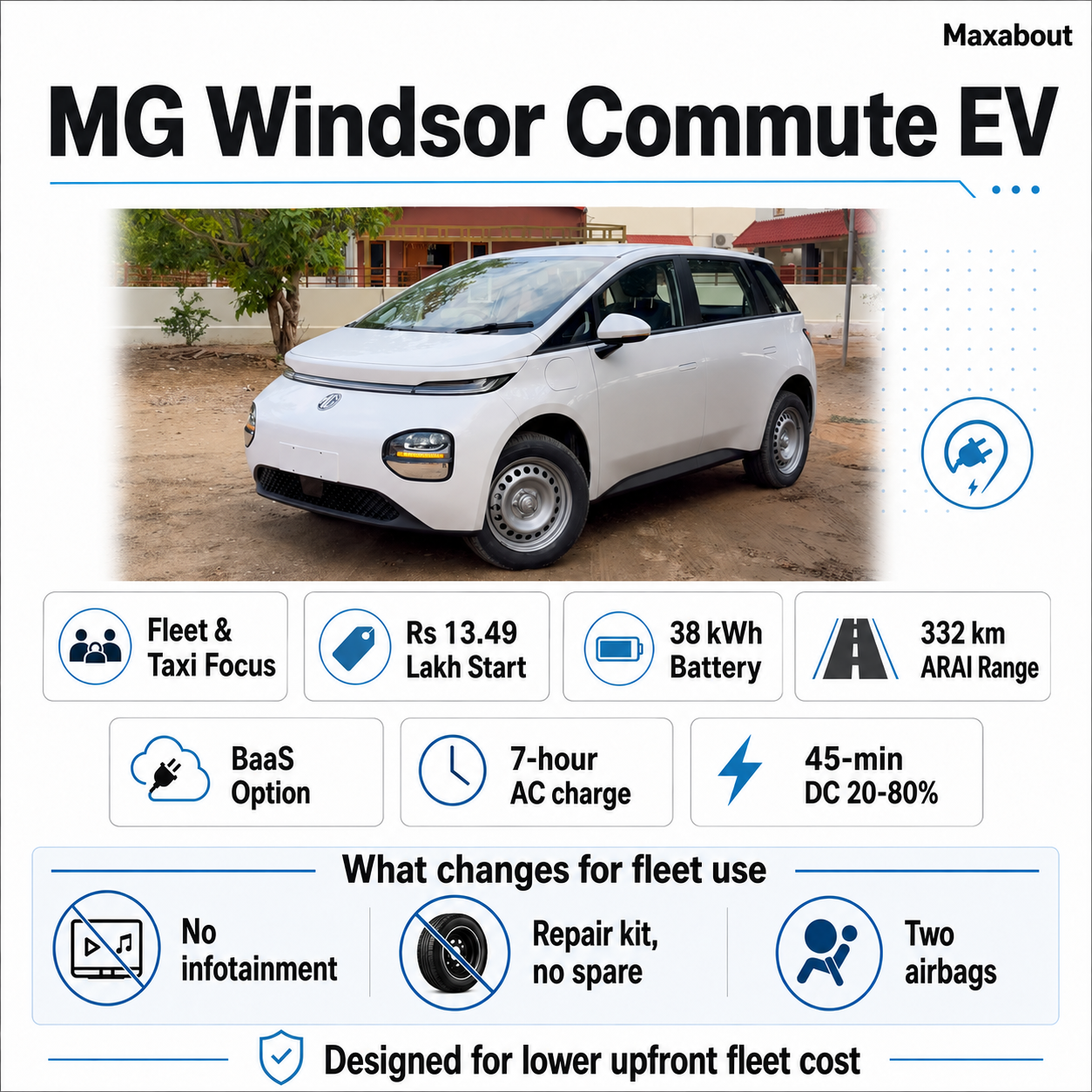 On the battery and range front, the Commute variant carries the 38 kWh battery pack, which MG quotes at roughly 331 km of range under standard test conditions. Real-world urban range — especially in stop-and-go city traffic — will likely sit closer to 220 to 250 km, which is still more than adequate for a daily taxi shift in most Indian cities.
What has been simplified? Quite a bit, actually. From what industry sources indicate, the Commute trim drops features like:
The panoramic glass roof
Ventilated front seats
Advanced ADAS driver assistance features
Higher-grade infotainment options
These are exactly the features a fleet operator would never prioritize. Running cost per kilometre matters. Passenger comfort basics matter. Everything else is secondary.
As for retail buyers — there is a case to be made. Someone wanting a straightforward, no-frills electric car for daily commuting could find genuine value here, provided they are comfortable with the reduced feature set.
The ₹13.49 Lakh Price Tag: Is It Actually Affordable for Fleet Operators in India?
Let's be honest — ₹13.49 lakh is not cheap for a taxi operator running thin margins. But the real question is never about the sticker price. It is about what the vehicle costs you per kilometre, month after month, year after year.
Compare this against something like the Tata Tigor CNG, which sits around ₹9–10 lakh. On paper, the Tigor wins easily. But CNG pricing, even at current rates, typically works out to roughly ₹2.5–3.5 per kilometre depending on the city. Electricity, charged smartly at off-peak rates, can bring that down to ₹1–1.5 per kilometre. For a cab running 150–200 kilometres daily, that difference compounds quickly.
Over a 12-month period, a high-mileage fleet vehicle could realistically save ₹60,000–₹80,000 in running costs alone. That starts to close the purchase price gap meaningfully.
Then there is the BaaS question. MG's Battery as a Service subscription significantly reduces the upfront cost on standard Windsor variants by removing the battery from the purchase price. Whether this applies to the Commute variant has not been officially confirmed with clarity yet. If it does, the effective entry cost drops considerably — and that changes everything for fleet economics.
GST also works differently here. Commercial buyers registered under GST can claim input tax credit, softening the actual outflow. Additionally, states like Delhi and Maharashtra still offer EV incentives that fleet operators can potentially leverage, making the real acquisition cost lower than the listed price suggests.
Real-World Suitability: Can the Windsor EV Handle India's Taxi Grind
Lower acquisition costs are one thing. Whether the car actually survives the daily punishment of commercial use is an entirely different question — and honestly, a more important one.
The Windsor EV carries a claimed range of around 331 km. In real-world city driving — think Hyderabad's heavy Old City traffic or Pune's perpetually congested Swargate junction — expect that figure to land somewhere between 220 and 260 km. For a driver doing 200-300 km daily, that is a tight margin. City-only operations are manageable. The moment intercity runs enter the picture, range anxiety becomes a genuine operational concern.
Fast charging support matters enormously here. The Windsor supports DC fast charging, which brings meaningful relief. But charging infrastructure outside major urban corridors remains patchy. A driver running Chennai to Pondicherry or Pune to Nashik repeatedly cannot always count on reliable fast chargers mid-route.
Cabin space is genuinely competitive. Rear seat room is generous for a car in this segment — passengers sitting behind taller drivers reportedly have decent legroom, which matters for longer rides. Comfort perception directly affects driver ratings and repeat bookings.
Build quality is where early observations warrant some caution. Test drive feedback suggests the interior materials feel acceptable but not robust. For a vehicle absorbing 80,000 to 100,000 km annually, long-term durability remains an open question that only sustained fleet usage will answer convincingly.
MG's After-Sales Network and Service Costs: The Make-or-Break Factor for Fleet Buyers
Purchase price gets the headlines, but any experienced fleet operator will tell you the real calculation happens after the sale. Service availability, turnaround time, and maintenance costs determine whether a vehicle actually makes money or quietly drains it.
MG currently operates around 650 sales and service touchpoints across India. That sounds reasonable until you map where taxi fleets actually concentrate. Tier 2 and Tier 3 cities — Nagpur, Coimbatore, Lucknow, Bhubaneswar, Rajkot — are seeing growing cab demand, yet MG's service density thins considerably once you move beyond major metros. A vehicle sitting idle waiting for a service appointment is lost revenue, full stop.
On the cost side, EVs do carry a structural advantage. Scheduled maintenance intervals are generally longer, and with fewer mechanical components — no oil changes, no clutch replacements, no exhaust work — routine servicing costs less over time. Industry estimates suggest EV maintenance can run 40 to 50 percent lower annually compared to equivalent petrol vehicles. For high-mileage fleet use, that gap compounds meaningfully.
Battery warranty is the critical clause here. MG offers an 8-year or 1.5 lakh km battery warranty, but fleet operators should read the fine print carefully regarding degradation thresholds. Heavy daily cycling in Indian heat could accelerate capacity loss, and battery replacement costs remain significant if coverage lapses or conditions aren't met.
Owner community feedback, based on wider MG EV discussions, points to mixed after-sales experiences — parts availability and service consistency vary noticeably by location. Fleet-specific service packages from MG exist in limited form currently, though formal structured offerings remain an area where competitors have moved faster.
Pros and Cons of the MG Windsor EV Commute Variant
No vehicle is perfect, and the Commute variant is no exception. Here is an honest breakdown of where it genuinely impresses and where it gives reason to pause.
The Genuine Strengths
Pricing is hard to ignore. At ₹13.49 lakh, this is one of the most accessible entry points into a proper electric sedan-SUV body style in India right now.
Running costs are compelling. For high-mileage operators in cities like Delhi, Pune, or Bengaluru, the per-kilometre cost advantage over petrol or CNG alternatives is real and measurable.
Cabin space punches above its price. The Windsor's interior room remains a genuine highlight even in this stripped trim.
Feature reputation holds up. MG tends to retain meaningful features even in base variants, which matters for driver comfort on long shifts.
The Legitimate Concerns
Resale uncertainty is real. EV resale values in India remain unpredictable, and fleet buyers eventually need an exit.
Chinese parentage perception. Some fleet operators and end-users still carry reservations, which can affect ride-hailing acceptance in certain markets.
Fast charging gaps outside metros. Beyond Tier-1 cities, the charging infrastructure thins out considerably.
Spec trade-offs feel noticeable. Buyers expecting a fully-loaded experience may find the Commute trim a little sparse.
Who Should Buy It — And Who Should Think Twice
So, given everything above, who does the Windsor EV Commute actually make sense for? Let me break it down plainly.
This variant is genuinely built for:
App-based cab operators in metros. If you're running a fleet on Ola, Uber, or Rapido in Bengaluru, Hyderabad, Pune, or Delhi-NCR, the math here is compelling. Lower per-kilometre running costs and reasonable upfront pricing can meaningfully improve margins over 3-4 years.
Individual owner-drivers on urban routes. Someone clocking 150-200 km daily within city limits, with overnight home charging access, will likely find this a practical, cost-efficient workhorse.
Corporate fleet managers. Companies looking to green their employee transport fleets without stretching budgets excessively should find this worth serious consideration.
However, think carefully before committing if:
You operate in a Tier-2 or Tier-3 city where public charging infrastructure remains unreliable.
You're planning to sell within two to three years — EV resale values in India are still unpredictable territory.
You expect a feature-rich cabin experience at this price point.
From what industry observers consistently note, the Commute variant rewards patience and urban discipline. It isn't for everyone — but for the right operator, it genuinely delivers.
Final Thoughts: Does the Windsor EV Commute Make Sense in India's Evolving EV Landscape
Something feels different about this launch. Not just the price — though ₹13.49 lakh is genuinely attention-grabbing — but the intent behind it. MG isn't simply offering a stripped-down version of an existing model. They're acknowledging, perhaps more directly than most manufacturers have, that commercial operators deserve purpose-built solutions rather than retail leftovers.
India's EV policy direction strongly supports this thinking. With government schemes actively pushing electric public transport and cab aggregators under pressure to green their fleets, a dedicated commercial variant arriving at this moment isn't accidental timing. It's calculated positioning.
Is ₹13.49 lakh genuinely disruptive? Marginally, yes — but not dramatically so. Competitors exist. The real disruption lies in the segment-specific approach rather than the number itself.
More broadly, this launch signals something worth noticing: Indian EV manufacturers are finally thinking beyond the aspirational retail buyer. That's a market maturity marker.
The question worth sitting with is this — if commercial EVs become genuinely viable and widespread, will India's charging infrastructure actually keep pace, or will operators be left solving that problem themselves? Would love to hear what you think.
Explore the story
Related news
Share your view and join the discussion.
Earn reward points for every comment and get a chance to win ₹1,000 in our weekly lucky draw. Sign in with Google in one tap.
Start the conversation
No one has commented on this article yet. Be the first to share your view.
Want to read more automotive news?
Stay updated with the latest car launches, reviews, and industry insights.
Browse All News