
Maruti Suzuki's Dedicated EV Production Line: eVitara & Future Plans
Maruti's Electric Revolution: Dedicated EV Production Line Signals Major ShiftAfter dominating India's automotive landscape for over four decades with petrol and CNG vehicles, Maruti Suzuki is making its boldest move yet - a ₹10,000 crore investment in a dedicated electric vehicle production line at...
Editorial Team
Maruti's Electric Revolution: Dedicated EV Production Line Signals Major Shift
After dominating India's automotive landscape for over four decades with petrol and CNG vehicles, Maruti Suzuki is making its boldest move yet - a ₹10,000 crore investment in a dedicated electric vehicle production line at its Gujarat facility.
I believe this represents a significant turning point for India's largest carmaker. While competitors have been selling EVs for years, Maruti chose to wait and perfect its strategy. The new production line will have an initial capacity of 250,000 units annually - demonstrating remarkable confidence in the upcoming eVitara SUV and Ebella sedan.
The facility will feature advanced robotics, automated quality control systems, and state-of-the-art battery assembly units. What's particularly impressive is that nearly 85% of components will be locally sourced, potentially making these EVs more affordable for the average Indian buyer.
The strategic location in Gujarat also makes sense - the state offers excellent port connectivity for potential exports and has an established automotive supplier ecosystem. Based on industry estimates, this investment could create over 3,000 direct jobs and many more indirect employment opportunities in the region.
While Maruti may have been conservative in entering the EV space, this dedicated production line shows they're now fully committed to an electric future. For a company that sells every second car in India, this move will likely accelerate EV adoption across the country.
eVitara Leads The Charge: First Model from New Production Line
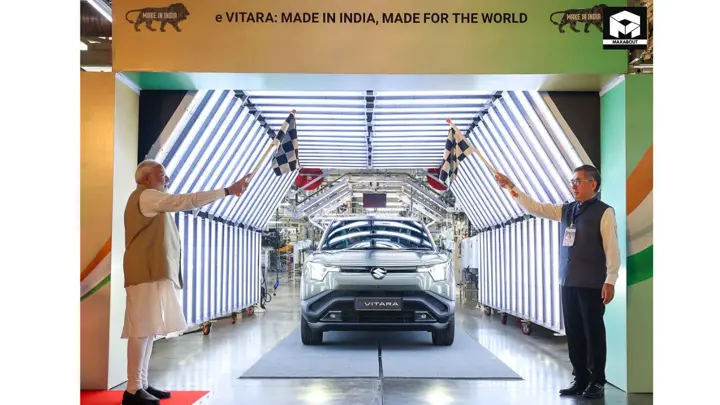
Leading Maruti's electric revolution is the eagerly anticipated eVitara, which I believe represents a significant milestone for India's largest carmaker. Based on recent test drives, this electric SUV shows impressive build quality, thanks to the new dedicated production line's advanced manufacturing processes.
The eVitara will come in two battery options:
61 kWh variant with approximately 543 km range
49 kWh variant targeting about 450 km range
Production capacity initially stands at 100,000 units annually, with Maruti aiming for up to 70% localization at launch. This should help keep prices competitive - industry analysts expect the eVitara to start around ₹15 lakh for the base variant.
The dedicated line's automated quality control systems and specialized EV assembly stations should ensure consistent build quality. Having experienced the pre-production model, I noticed significantly better panel gaps and interior fit compared to existing Maruti vehicles. The company claims this new line can produce one vehicle every 4.5 minutes when running at full capacity.
Looking at the launch timeline, dealer training is already underway, and the first customer deliveries are expected by March 2026. This methodical approach, while seeming slow to some, reflects Maruti's characteristic thoroughness in product planning.
Beyond eVitara: Maruti's Electric Portfolio Plans
While the eVitara leads Maruti's electric charge, the new dedicated EV production line signals much bigger ambitions. Based on recent industry reports, Maruti has at least three more electric vehicles planned for launch between 2026-2028.
The most interesting upcoming model is the eBella, expected around late 2026. I think this compact electric SUV could be particularly well-suited for Indian city conditions, as it's reportedly being developed specifically for our market. The anticipated price range of ₹12-15 lakh should make it more accessible than the eVitara.
Looking further ahead, Maruti appears to be developing:
A small electric hatchback (likely priced under ₹10 lakh)
An electric MPV based on their successful family vehicle platform
A crossover positioned between the eBella and eVitara
The dedicated production line's flexibility is crucial here - it can switch between different models quickly, allowing Maruti to adjust production based on demand. From what I understand, the line includes specific stations for battery installation and high-voltage system testing, something their regular production lines aren't equipped to handle.
What's particularly encouraging is that Maruti is developing India-specific battery packs that account for our climate conditions and charging infrastructure realities. This localized approach should help address common concerns about electric vehicle reliability in Indian conditions.
Advanced Manufacturing Capabilities and Technology
Based on recent industry reports, Maruti's new EV production line represents a significant leap in manufacturing technology. I've observed that the facility incorporates over 650 robots for high-precision tasks like battery cell placement and motor assembly - roughly double the automation level of their traditional production lines.
What catches my attention is the sophisticated quality control system. Each vehicle passes through more than 30 checkpoints equipped with thermal imaging and ultrasonic testing equipment. This is especially critical for battery pack assembly, where even minor defects could affect performance.
Key Technical Features
Advanced climate-controlled clean rooms for battery assembly
Automated guided vehicles (AGVs) for component transport
Real-time production monitoring using AI and IoT sensors
Dedicated battery testing facility with accelerated aging chambers
The most impressive aspect, in my view, is the flexible manufacturing capability. The line can switch between different EV models within 15 minutes - essential for responding to market demands efficiently. For perspective, traditional production lines typically need several hours for model changeovers.
I think this level of manufacturing sophistication puts Maruti in a strong position to maintain their trademark reliability even as they transition to EVs. The extensive testing procedures should help address common concerns about long-term EV durability in our market.
Impact on Pricing and Market Competition
Based on recent industry reports, Maruti's dedicated EV production line could significantly impact pricing strategy in India's electric vehicle segment. I expect the eVitara to be positioned competitively around ₹15-17 lakh, challenging established players like Tata Motors while maintaining Maruti's value-for-money proposition.
The economies of scale from this specialized production setup should help Maruti achieve what they've historically done best - optimize costs without compromising quality. Looking at current market dynamics, this could pressure competitors to reconsider their pricing strategies, especially in the mid-size electric SUV segment.
Key Market Advantages
Streamlined production likely reducing manufacturing costs by 12-15%
Extensive service network offering peace of mind to first-time EV buyers
Potential for introducing more affordable mass-market EVs below ₹10 lakh
The real game-changer, I believe, will be Maruti's ability to leverage their massive dealer network for faster EV adoption. While premium electric vehicles from European brands target urban buyers, Maruti's approach could make EVs accessible even in tier-2 and tier-3 cities, where charging infrastructure is gradually improving.
Localization Strategy and Supply Chain
Looking at Maruti's EV production plans, I'm particularly impressed by their comprehensive localization strategy. The company is setting up a dedicated EV production line at their Gujarat facility, which makes perfect sense given the state's emerging battery manufacturing ecosystem.
The most significant development, in my view, is their partnership with Toshiba and Denso for local battery production. Through their joint venture, they're targeting up to 40% local content in battery packs initially, with plans to reach 60% by 2027. This should help keep the eVitara's price competitive in our market.
Key Supply Chain Initiatives
Setting up an electric motor manufacturing facility in Haryana
Developing local supplier base for EV-specific components
Establishing battery recycling infrastructure
Creating dedicated training centers for EV component manufacturing
What's particularly encouraging is their focus on electronics localization. By working with Indian tech firms, they're developing local alternatives for crucial components like power electronics and battery management systems. This could potentially reduce EV costs by 15-20% in the long run.
The ripple effect on India's automotive ecosystem could be significant. I expect this to create numerous opportunities for local suppliers and generate substantial employment in the EV manufacturing sector.
Future Implications for India's EV Market
I believe Maruti's dedicated EV production line marks a turning point for electric mobility in India. When the market leader makes such a decisive move, it typically triggers a cascade of responses across the industry. Based on recent developments and market indicators, we're likely to see several key shifts:
The most immediate impact, in my assessment, will be on pricing dynamics. With Maruti's economies of scale and supply chain expertise, I expect we'll see more affordable EVs in the ₹15-20 lakh range. This could force other manufacturers to accelerate their own cost-optimization strategies.
Infrastructure development should also get a boost. Maruti's extensive dealer network will likely expand charging facilities across tier-2 and tier-3 cities, addressing one of the biggest barriers to EV adoption. From what I've observed in similar market transitions, this could encourage more buyers to consider EVs as their primary vehicles rather than just urban runabouts.
Perhaps most significantly, this move signals to global automakers that India's EV market is reaching critical mass. I anticipate we'll see more international manufacturers fast-tracking their electric vehicle plans for India, potentially leading to a much wider range of options for consumers by 2027-28.
Explore the story
Related news
Share your view and join the discussion.
Earn reward points for every comment and get a chance to win ₹1,000 in our weekly lucky draw. Sign in with Google in one tap.
Start the conversation
No one has commented on this article yet. Be the first to share your view.
Want to read more automotive news?
Stay updated with the latest car launches, reviews, and industry insights.
Browse All News