
Maruti Suzuki Kharkhoda Plant Unit 2 Now Operational
Maruti Suzuki has quietly done something significant. The second production unit at its Kharkhoda facility in Haryana has officially commenced operations — and if you've been waiting months for a new Maruti, this development is worth paying attention to.Kharkhoda isn't just another factory. It repre...
Editorial Team
Maruti Suzuki has quietly done something significant. The second production unit at its Kharkhoda facility in Haryana has officially commenced operations — and if you've been waiting months for a new Maruti, this development is worth paying attention to.
Kharkhoda isn't just another factory. It represents Maruti's most ambitious manufacturing bet in decades. The first unit was already a statement of intent. This second unit going live suggests the company is moving with real urgency — and that urgency is directly tied to demand that its existing plants in Gurugram and Manesar simply cannot absorb anymore.
Think about it practically. Waiting periods on models like the Brezza, Ertiga, and Jimny have frustrated buyers across cities for years. Production bottlenecks have been a persistent concern. Kharkhoda, with its significantly larger footprint, is clearly designed to address exactly that pressure.
From what industry reports suggest, this facility is central to Maruti's long-term India investment roadmap — a roadmap that involves scaling output, introducing new models, and staying ahead of intensifying competition. The second unit becoming operational is a notable milestone, not a routine announcement. It signals that the plan is actually executing on schedule.
What Is the Kharkhoda Facility and How Big Is This Really?
Located in Haryana's Sonipat district, the Kharkhoda plant sits roughly 60 kilometres from Delhi — close enough to connect with the existing supplier ecosystem around Manesar and Gurugram, yet far enough to allow serious room for expansion. That geography matters more than it sounds.
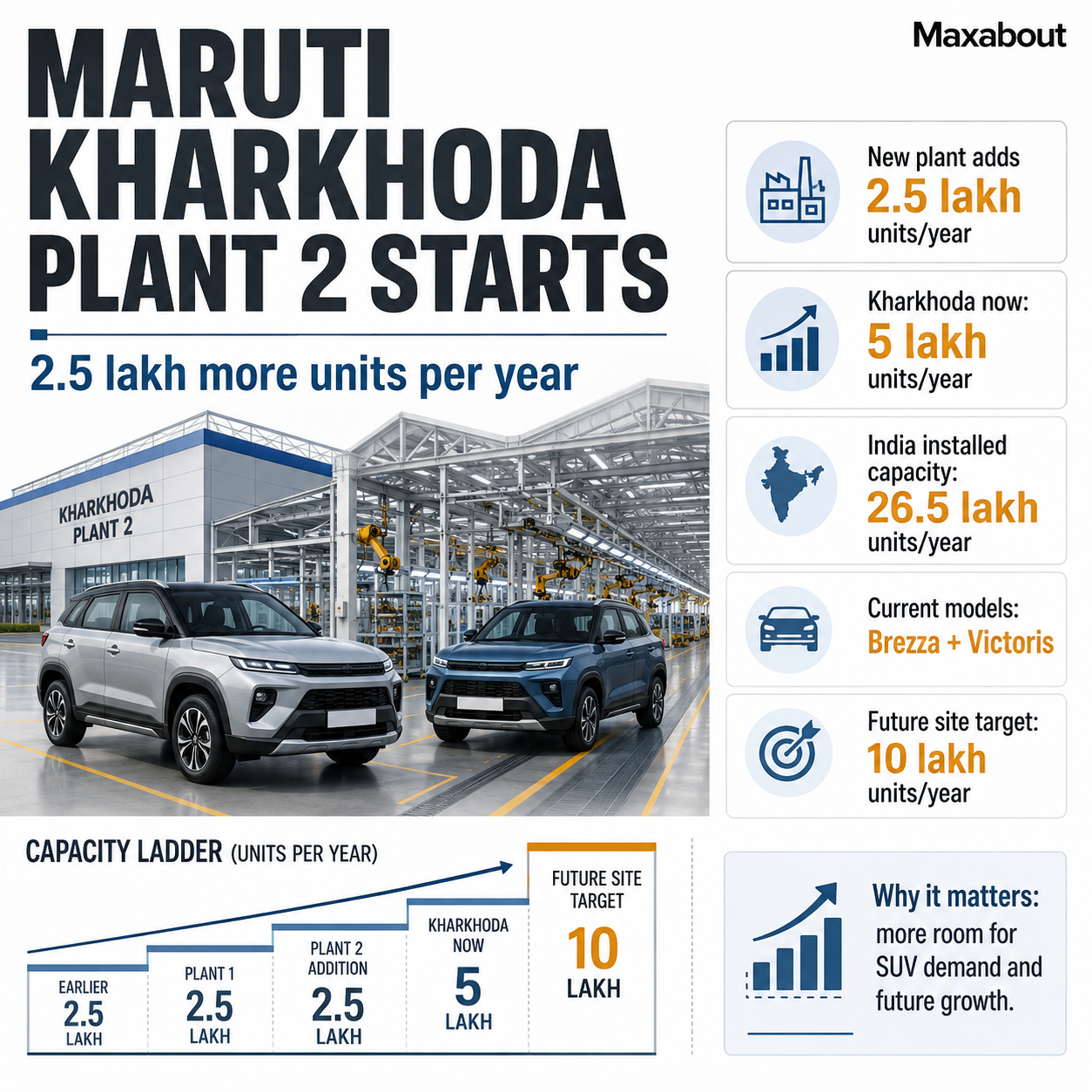
To put the scale in perspective: Maruti's Gurugram plant has an annual capacity of around 700,000 units, and Manesar handles roughly 900,000 units per year. Kharkhoda, once fully built out across all planned units, is expected to add up to 1 million additional units annually. The second unit alone is projected to contribute approximately 250,000 units per year to that total.
As for what "commencing production" actually means here — industry reports indicate this is a phased rollout, not an immediate full-scale operation. Trial runs and gradual ramp-ups are standard practice at this level. Full utilisation typically takes months, sometimes longer.
So while the announcement is significant, the realistic picture is one of steady progression — assembly lines coming online incrementally, quality benchmarks being validated before volumes scale up. That is the responsible way to launch a facility of this magnitude.
Which Maruti Models Could Benefit From This Expanded Output?
This is probably the question most buyers actually care about. Production milestones are interesting, but what does this mean for someone waiting on a Brezza or an Ertiga delivery in Delhi or Jaipur right now? Potentially, quite a bit.
Based on industry reports and what has been indicated through official channels, the Kharkhoda facility is positioned to support Maruti's higher-demand segments. The Brezza consistently sits at the top of waiting period complaints — certain variants have stretched to eight to twelve weeks in high-demand markets like Lucknow and the NCR region. More production capacity feeding into the supply chain should, over time, ease that pressure.
The Ertiga and XL6 are in a similar situation. Family buyers in tier-two cities have repeatedly flagged long waits. With Kharkhoda scaling up, there is reasonable expectation that allocation to dealerships improves gradually.
From what has been indicated officially, upcoming EV models are also central to this facility's purpose — which makes strategic sense given Maruti's stated push into electric mobility.
Realistically though, relief on waiting periods will not happen overnight. As production ramps up incrementally, the benefits will filter through slowly. If you are considering a purchase today, I would suggest checking with your dealer in about two to three months for a clearer picture.
Maruti's EV Ambitions and How Kharkhoda Fits Into the Picture
Maruti has been quite open about its electric vehicle roadmap, and Kharkhoda is clearly central to those plans. The e Vitara, which has been officially confirmed for the Indian market, is expected to be among the first electric models produced here. This is not incidental — building EV capability into a new facility from the ground up is far more practical than retrofitting older plants.
The timing makes some sense too. Government push for electrification is real, charging infrastructure in metros is gradually improving, and urban buyers — particularly in cities like Bengaluru, Pune, and Delhi — are showing genuine interest in EVs. Maruti entering this space with dedicated production capacity signals they are treating electrification seriously, not just ticking a box.
That said, I think it is worth being honest about the challenges. Range anxiety on longer highway stretches remains a genuine concern for many buyers. And outside major urban centres, EV adoption is still quite limited — charging access, awareness, and resale confidence are all works in progress.
Whether Maruti's EV timing is perfectly calibrated is debatable. They are arguably late compared to some rivals, but their distribution strength and brand trust in smaller cities could work in their favour once the product lineup matures. Kharkhoda gives them the production foundation — the harder work of building buyer confidence still lies ahead.
Jobs, Local Economy, and What This Means for Haryana's Industrial Belt
Step back from the product lineup and the production numbers for a moment. What Kharkhoda actually represents, at ground level, is a significant shift in economic gravity for this part of Haryana.
Large-scale automotive manufacturing doesn't arrive alone. It pulls an entire ecosystem behind it — ancillary suppliers, packaging units, logistics contractors, canteen operators, security firms, small tool shops. Manesar is the clearest local example of this effect. What was once relatively unremarkable land on the outskirts of Gurugram gradually became one of the most densely industrialised corridors in northern India. Entire townships, transport networks, and supplier clusters formed around that single anchor investment.
Kharkhoda could follow a similar trajectory — though these things take time and don't always go smoothly. The direct employment numbers are meaningful, but the indirect jobs often matter more to surrounding communities. A local welding contractor, a small logistics operator running inter-plant shuttles, a canteen supplying hundreds of daily workers — these are the businesses that quietly absorb the economic energy a facility like this generates.
Skill development is another real consideration. Formal automotive manufacturing tends to raise baseline technical training standards in a region over time.
How Does This Expansion Stack Up Against Maruti's Competitors?
Maruti still commands roughly 40-42% of India's passenger vehicle market — no other manufacturer comes close. But that dominance is being tested more seriously than it has been in years.
Tata Motors has been on an aggressive capacity push, particularly around its EV lineup. Hyundai and Kia together hold a formidable combined share in the SUV segment. Mahindra's upcoming facilities are clearly aimed at scaling production of its popular new SUV family. The competitive pressure is real, and it's accelerating.
Against that backdrop, Kharkhoda's second unit feels less like catch-up and more like deliberate consolidation. Maruti isn't scrambling — it's reinforcing a position it already holds. The phased approach here is strategic. Rather than announcing a massive greenfield project and struggling with execution timelines, Maruti has steadily built out Kharkhoda in stages.
That said, the honest concern remains: Maruti is still relatively late to EVs, and no amount of combustion-engine capacity solves that gap. Competitors have moved faster on electric models. Where Kharkhoda truly stacks up will depend on how quickly Maruti transitions this new capacity toward future-ready platforms — not just adding volume, but adding the right kind of volume.
What Indian Car Buyers Should Actually Take Away From This News
If you're currently waiting on a Maruti or planning to buy one in the next year or so, here's the honest picture: don't expect overnight changes at the showroom. Production ramp-ups take months to move through the supply chain, reach dealerships, and actually compress waiting periods. The second unit becoming operational is a meaningful step, but it's not a switch that flips availability tomorrow.
That said, the medium-term outlook is genuinely encouraging. More domestic production typically helps on two fronts — waiting periods on high-demand models should gradually ease, and parts availability tends to improve when manufacturing is closer to home. Maruti's service network is already one of India's strongest, and greater local output could quietly help keep maintenance costs from creeping upward.
On pricing, don't read this as a signal that cars will get cheaper. Input costs, currency movement, and demand all play a role. But stable domestic production does reduce exposure to supply shocks — which matters if you've watched prices jump unpredictably over the last few years.
The most grounded takeaway? If a Maruti fits your needs today, this expansion is a quiet confidence signal — not a reason to wait, but a reassurance that the brand is building for the longer run.
Final Thoughts: Kharkhoda Is a Long Game, and That's Exactly the Point
Plant expansions don't move markets overnight. They're quiet, deliberate bets — placed years before the payoff arrives. And that's precisely what makes Kharkhoda's second unit feel significant to me.
Maruti isn't reacting here. They're anticipating. Building capacity before demand peaks is the kind of discipline that separates brands with genuine long-term conviction from those just chasing quarterly numbers. Whether it's absorbing EV production lines, reducing waiting periods, or simply staying ahead of a growing middle-class buyer base — this facility seems designed to handle multiple futures at once.
Is this the right move at the right time? Honestly, yes. India's automotive appetite isn't slowing down, and Maruti knows this market better than almost anyone else.
So I'll leave you with this — are you currently waiting on a Maruti model? Maybe watching their EV roadmap with cautious interest? This expansion might matter more to your purchase timeline than you'd expect. Drop your thoughts below. I'm genuinely curious what's on your radar.
Explore the story
Related news


Share your view and join the discussion.
Earn reward points for every comment and get a chance to win ₹1,000 in our weekly lucky draw. Sign in with Google in one tap.
Start the conversation
No one has commented on this article yet. Be the first to share your view.
Want to read more automotive news?
Stay updated with the latest car launches, reviews, and industry insights.
Browse All News