
Maruti Electric YMC, Brezza Facelift & New Baleno Spotted Testing
Something big is brewing at Maruti Suzuki. And I mean that quite literally — three different models were recently caught testing simultaneously, and the location tells you everything you need to know about where this development process stands.Shimla is not a casual testing destination. You do not d...
Editorial Team
Something big is brewing at Maruti Suzuki. And I mean that quite literally — three different models were recently caught testing simultaneously, and the location tells you everything you need to know about where this development process stands.
Shimla is not a casual testing destination. You do not drive prototype vehicles up those winding mountain roads just for a scenic outing. The cold temperatures, high altitude, thin air, and relentless hairpin bends put powertrains, brakes, and suspension geometry through punishment that flat city roads simply cannot replicate. When a manufacturer sends vehicles there, the hardware is already fairly mature. This is serious validation work.
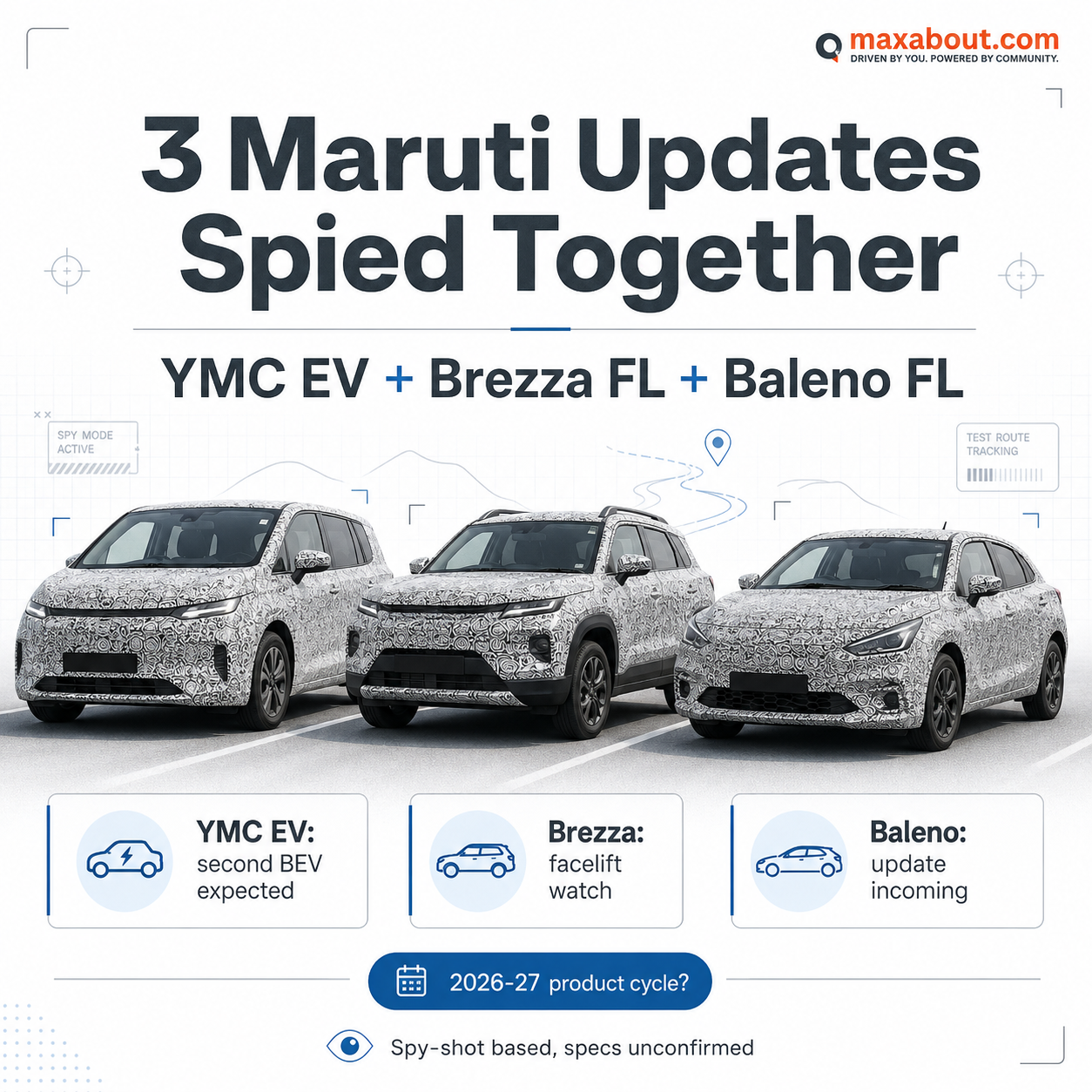
So the fact that Maruti had three distinct models running those hills simultaneously — the Electric YMC, a refreshed Brezza, and what appears to be a next-generation Baleno — feels genuinely significant. This is not a company tiptoeing into new territory. This looks like a coordinated product push.
From what the spy shots suggest, each vehicle represents a different strategic priority for Maruti. One is about entering electric territory. One is about protecting a segment stronghold. One hints at a much-needed reinvention. I have been thinking about these three ever since the images surfaced, and honestly, there is a lot worth unpacking here.
Maruti Electric YMC: India's Most Anticipated Affordable EV Finally Taking Shape
Let's start with the one that has genuinely captured attention — the Electric YMC. From what industry sources suggest, Maruti is targeting a price point somewhere between ₹10 lakh and ₹12 lakh, which would make it one of the most accessible electric cars in the country. That positioning matters enormously in a market where most EVs still feel like aspirational purchases rather than practical ones.
The Electric YMC is expected to be built on Maruti's Heartect-e platform — a dedicated EV architecture that has been developed keeping Indian road realities in mind. Broken roads, speed breakers that appear out of nowhere, waterlogging during monsoons — these are not edge cases here, they are everyday driving conditions. A platform designed specifically around these challenges rather than adapted from a global model could genuinely make a difference in long-term ownership experience.
Based on what has been reported, the expected range sits in the 400 to 500 kilometre bracket on a full charge. That would comfortably handle most urban commuting patterns and even reasonable intercity trips. Charging options are expected to include both AC home charging and DC fast charging compatibility, which covers the practical needs of apartment dwellers and highway travellers alike.
Now, the Shimla testing piece is particularly interesting. Cold weather is genuinely harsh on lithium-ion battery packs — it reduces range, affects charging speeds, and stresses thermal management systems. Maruti choosing to run tests in the hills suggests the company is not cutting corners here. They appear to be stress-testing the battery under real Indian seasonal extremes before committing to a launch.
And then there is the service network argument — which I think is actually Maruti's strongest card in the EV space. Most EV brands in India have concentrated their service presence in metros and large cities. Maruti, on the other hand, has service touchpoints in smaller towns and semi-urban areas that most competitors have never reached. For a family in a Tier 2 city considering their first EV, knowing that trained service support exists nearby changes the entire risk calculation.
That said, the genuine concern remains charging infrastructure outside major urban centres. A capable car with solid range still depends on a reliable charging network, and that network simply does not exist uniformly across India yet. Maruti's service reach helps with maintenance — but it does not automatically solve the public charging gap in smaller cities.
So the Electric YMC feels promising on multiple fronts — pricing, platform, range, and service accessibility. Whether the charging infrastructure catches up fast enough to support mass adoption beyond metros is the real question that no single manufacturer can answer alone.
Brezza Facelift: Does India's Favourite Compact SUV Need an Update?
Test mules of the Brezza facelift have been spotted recently, and the sightings tell an interesting story. The camouflaged units show a revised front fascia — sharper bumper lines, possibly a redesigned grille, and updated tail light clusters that look noticeably more contemporary. An interior refresh is also expected, likely borrowing some design cues from newer Maruti models.
Here is the thing though — the Brezza is already selling extremely well. It consistently sits near the top of compact SUV monthly sales charts. So why bother with a facelift at all?
Because the competition has not been standing still. The Nexon recently got a significant update, the Venue carries fresh styling, and Maruti's own Fronx is eating into the younger buyer segment with its coupe-SUV stance. Keeping the Brezza visually current is less about fixing problems and more about staying relevant.
From what owner communities widely report, the current Brezza handles Indian conditions very competently. The ground clearance is genuinely useful on broken city roads and on highway stretches heading toward hill stations. Boot space is adequate for weekend family trips, though not class-leading. And the K-series engine's long-term reliability is almost taken for granted at this point — that reputation is real and earned.
Mechanical changes seem unlikely with this facelift. Expect the updates to remain largely cosmetic with possibly some feature additions inside. Honestly, that is probably enough — the Brezza's fundamentals are already strong.
New Baleno Spied in Shimla: A Surprise Entry in the Premium Hatchback Race
Now here is something that caught my attention. Spy shots of a camouflaged Baleno testing in Shimla have been circulating recently, and the location itself tells an interesting story. Maruti does not typically haul test mules up mountain roads without reason. Hill testing suggests they are evaluating the car under specific stress conditions — gradient climbs, engine thermal management, braking on steep descents. That is more than a cosmetic update warrants.
So is this a proper next-generation Baleno, or a substantial mid-cycle refresh? From what the spy images reveal, the camouflage covers significant portions of the front fascia and rear. The overall silhouette appears familiar, but the wrapped sections suggest meaningful sheetmetal changes rather than a simple bumper swap. Interior details remain hidden, but expectations are running high given how competitive this segment has become.
The current Baleno already holds a strong position. It offers a refined driving experience, genuinely good fuel efficiency, and Maruti's unmatched service network — which matters enormously to practical Indian buyers. Its rivalry with the Hyundai i20 and Toyota Glanza keeps pressure on Maruti to stay sharp. The Glanza connection especially is worth noting, since any Baleno update almost certainly carries forward to its Toyota sibling.
Where the Baleno currently leaves room for improvement is ride quality on broken urban roads and the perceived premium feel inside the cabin. Buyers spending between ₹8 lakh and ₹11 lakh today increasingly expect connected tech, wireless charging, and a more upmarket dashboard experience. The i20 has pushed that bar noticeably. If the new Baleno addresses these gaps while retaining its efficiency and reliability, it could genuinely reclaim segment leadership.
Why Shimla? What High-Altitude Testing Tells Us About Maruti's Engineering Priorities
Most people see spy shots from Shimla and think little beyond "oh, it's being tested in the hills." But there is actually a very deliberate reason automotive manufacturers choose high-altitude locations, and understanding it tells you quite a lot about where these vehicles stand in their development cycle.
At elevations around 2,200 metres above sea level, air is noticeably thinner. For a petrol engine, that means less oxygen reaching the combustion chamber, which directly stresses the engine management system. Engineers need to confirm the ECU can compensate correctly, maintain smooth throttle response, and avoid rough idling or stalling. If a car handles Shimla's conditions confidently, it will handle the rest of India without issue.
For the electric YMC, the stakes are even higher. Cold temperatures and altitude together create a challenging environment for lithium-ion battery chemistry. Battery efficiency drops in the cold, and thermal management systems get a genuine workout. Testing here essentially stress-tests the battery's real-world range claims before Maruti commits to any official figures.
Then there are the roads themselves. Shimla's winding, uneven mountain routes are excellent for evaluating suspension calibration and chassis composure under continuous directional changes. Engineers can identify unwanted body roll, steering vagueness, or suspension harshness that flat urban testing simply would not reveal.
Seeing all three models tested simultaneously in such conditions is a meaningful signal. Companies typically reserve this kind of rigorous high-altitude validation for vehicles approaching their final development stages. It strongly suggests these are not early prototypes but near-production vehicles being fine-tuned before launch.
What These Launches Mean for Indian Car Buyers in 2025 and Beyond
Step back for a moment and consider what Maruti is actually doing here. Three distinct models, three different segments, all apparently nearing launch within a relatively compressed timeline. That is not coincidence. That is a deliberate strategy to defend market share from every direction simultaneously.
Rivals have been chipping away steadily. The compact SUV space has become fiercely competitive. The premium hatchback segment faces pressure. And the EV transition, however gradual in India, is real. Maruti's response appears to be: move on all fronts at once.
For buyers, this creates genuine opportunity but also real confusion. If you are currently shopping for a compact SUV, waiting a few months for the Brezza facelift seems reasonable. A refreshed design and likely updated features at a similar price point is worth some patience.
If you are EV-curious but nervous about range, the YMC's positioning matters enormously. An affordable entry point could finally make electric ownership a practical conversation rather than an aspirational one for mainstream Indian households.
And if you simply want a reliable, efficient hatchback, an updated Baleno with potentially better technology keeps that option competitive against newer challengers.
The practical advice here is straightforward: know your priority. Budget, segment, and powertrain preference should guide your decision, not launch excitement alone.
Expected Prices, Launch Timelines, and What to Watch Out For
Let's talk numbers, because that's ultimately what drives decisions in India's highly price-sensitive market.
The Electric YMC's sub-₹12 lakh target is ambitious, honestly. Current battery costs make that figure genuinely difficult to achieve without meaningful government subsidies or significant localisation of battery components. Industry speculation places a realistic starting price closer to ₹10–13 lakh, depending on variant structure. Whether Maruti can hold that floor is something to watch carefully.
For the Brezza facelift, expect a modest revision over the current ₹8.34–14.14 lakh range. A ₹20,000–40,000 hike across variants seems reasonable given the feature additions being anticipated.
The Baleno update could see marginal price movement if technology upgrades are substantial, though Maruti typically keeps hatchback pricing competitive.
On timelines, the Brezza facelift looks closest to production-ready. The Baleno likely follows. The Electric YMC probably arrives last, given the infrastructure groundwork still needed.
That said, everything here draws from available reports and spy shots. Specifications, pricing, and timelines can shift considerably before official announcements. Worth keeping an eye on rather than planning around just yet.
Final Thoughts: Is Maruti Playing It Smart or Spreading Too Thin?
Honestly? I think Maruti knows exactly what it's doing. Three products, three different segments, three different buyer profiles. That's not scrambling — that's covering ground before someone else does.
The Indian market is shifting faster than most legacy brands anticipated. Tata cracked the EV space early. Hyundai brought connected features to the mainstream. Maruti watched, learned, and is now responding with a broader push rather than a single bet. Whether that's confident strategy or cautious hedging depends on execution.
Of the three, the Electric YMC genuinely excites me most. Not because EVs are fashionable, but because if Maruti prices it right — and history suggests they will try — it could bring electric mobility to buyers who currently think EVs are out of reach. That would be meaningful, not just newsworthy.
The Brezza facelift matters for sales volume. The Baleno matters for brand image. But the Electric YMC could matter for the industry.
So — which of these three has caught your attention? Are you waiting for the electric option, hoping the Brezza refresh addresses real pain points, or is the new Baleno what's got you interested? Drop your thoughts below.
Explore the story
Related news
Share your view and join the discussion.
Earn reward points for every comment and get a chance to win ₹1,000 in our weekly lucky draw. Sign in with Google in one tap.
Start the conversation
No one has commented on this article yet. Be the first to share your view.
Want to read more automotive news?
Stay updated with the latest car launches, reviews, and industry insights.
Browse All News