
Mahindra Unveils Thar Roxx-Based Military ATV for Indian Army
Mahindra's Military Move: Introducing the Thar Roxx-Based ATV for the Indian ArmyMahindra has unveiled a new military-grade All-Terrain Vehicle (ATV) based on the Thar Roxx platform, specifically designed for the Indian Army. The announcement came during a special ceremony at Mahindra's research fac...
Editorial Team
Mahindra's Military Move: Introducing the Thar Roxx-Based ATV for the Indian Army
Mahindra has unveiled a new military-grade All-Terrain Vehicle (ATV) based on the Thar Roxx platform, specifically designed for the Indian Army. The announcement came during a special ceremony at Mahindra's research facility in Maharashtra, attended by senior military officials and Mahindra executives.
This development marks another chapter in Mahindra's storied 70-year relationship with India's defense forces. I think what makes this particularly significant is how Mahindra continues to leverage its civilian vehicle platforms for specialized military applications – a strategy that has served them well since the original Willys Jeep days.
The new ATV appears to feature enhanced ground clearance, specialized armor plating, and military-specific modifications while maintaining the Thar's legendary off-road capabilities. From what I've observed, these military collaborations often influence civilian models down the line, potentially previewing future rugged variants of the Thar Roxx.
Anish Shah, Managing Director of Mahindra Group, emphasized during the unveiling that the company remains committed to supporting India's defense requirements with vehicles specifically engineered for our unique terrain and operational needs.
Technical Specifications and Military Modifications
The military-spec Thar Roxx ATV represents a significant departure from its civilian counterpart. Based on the information available, the Army variant packs a more robust 2.2-liter mHawk diesel engine, reportedly producing around 150 bhp and 350 Nm of torque—figures optimized for tactical operations rather than highway cruising.
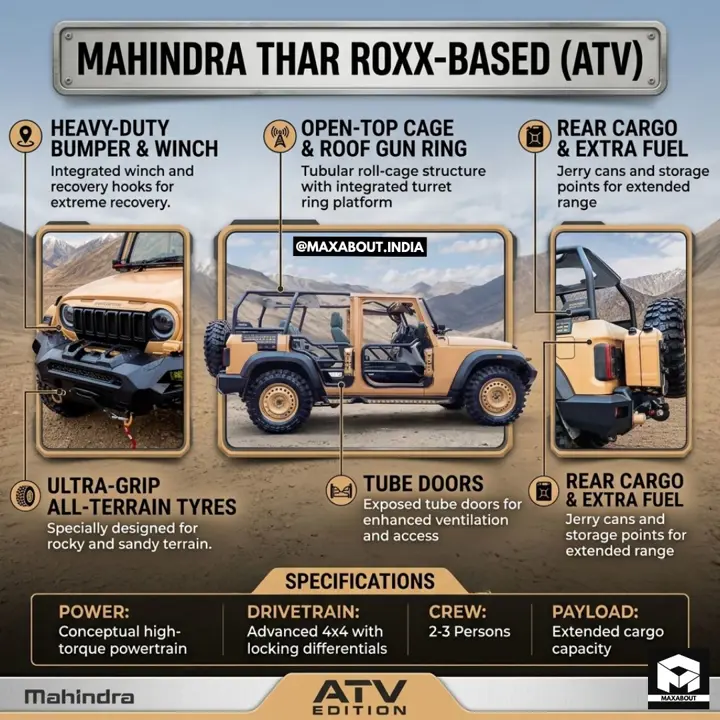 Ground clearance appears substantially increased to approximately 250mm (versus the civilian's 219mm), crucial for navigating the challenging terrain along our borders. The approach and departure angles have been enhanced, with specialized off-road tires that seem designed for everything from desert sand to mountain snow.
The military modifications are particularly interesting:
Reinforced chassis with additional underbody protection
Integrated weapon mounting points on the roll cage
Specialized communications equipment housing
Blackout lighting system for night operations
Enhanced wading depth (reportedly exceeding 700mm)
Unlike Mahindra's larger Armored Light Specialist Vehicle (ALSV), this Thar-based ATV prioritizes mobility and reconnaissance capabilities over heavy protection. It appears to be positioned as a versatile patrol and quick-response vehicle rather than a front-line combat asset.
The rear section has been modified to accommodate additional equipment or stretchers, showing clear consideration for both offensive operations and casualty evacuation scenarios. From what I can see, this continues Mahindra's evolution in military vehicle design, offering a more nimble alternative to their existing defense portfolio.
Strategic Importance for Indian Defense
The Indian Army's interest in Thar Roxx-based ATVs reflects the evolving security challenges along our diverse borders. Our forces operate across extreme terrains - from the high-altitude deserts of Ladakh to the marshy stretches in the Northeast. Traditional heavy vehicles often struggle in these environments, creating a tactical gap that these agile ATVs can fill.
These vehicles serve multiple strategic purposes. First, they enable rapid response capabilities in areas where conventional vehicles can't reach quickly. Second, they support India's push toward defense self-reliance. Rather than importing similar vehicles at premium prices, developing indigenous platforms helps build domestic expertise while ensuring maintenance and spare parts remain accessible.
The advantages extend beyond operational benefits. Having a domestic manufacturer like Mahindra means customizations for specific Indian requirements can be implemented quickly. This contrasts sharply with imported alternatives that often come with export restrictions or lengthy modification processes. Furthermore, these vehicles would likely cost significantly less than their foreign counterparts, allowing for broader deployment across challenging border regions.
The Thar Legacy: From Civilian Icon to Military Asset
The Mahindra Thar's journey from civilian favorite to military asset represents a natural evolution of its capabilities. Born with off-road DNA inspired by the original Willys Jeep, the Thar has always maintained the rugged reliability that makes it perfect for defense applications.
Mahindra's relationship with the Indian military dates back decades. The company previously supplied vehicles like the MM550 and Axe, establishing a track record of creating platforms that can withstand extreme conditions. What makes the Thar platform special is its modular architecture - designed to be adaptable while maintaining core strengths.
I think what's particularly impressive is how the civilian Thar's popularity created a feedback loop of improvements. Each generation became more capable off-road while simultaneously becoming more refined, with Mahindra's engineers gaining valuable real-world data from countless vehicles tackling India's diverse terrains.
The new ATV variant leverages this experience while stripping away civilian comforts for military functionality. From what I've observed, this military-focused development actually benefits civilian models too - innovations in suspension, drivetrain durability, and water fording often filter down to showroom vehicles.
This military adaptation further cements the Thar's iconic status in India. Already symbol of adventure and freedom, it now adds "defender of borders" to its resume.
Production Plans and Potential Timeline
From what I understand, Mahindra will manufacture these military ATVs at their Chakan facility near Pune, where the civilian Thar is already produced. This makes logistical sense, allowing them to leverage existing supply chains while maintaining the necessary security protocols for defense production.
The production timeline appears quite aggressive. Initial reports suggest Mahindra aims to deliver the first batch by mid-2024, following a rigorous testing phase that likely includes high-altitude trials in Ladakh and desert testing in Rajasthan.
Before full deployment, these vehicles must clear stringent military certification standards - particularly for reliability in -40°C to +50°C conditions. The Indian Army typically conducts extensive field trials lasting 6-8 months.
While the exact order size remains undisclosed, defense analysts estimate an initial requirement of approximately 500-700 units valued at roughly ₹150-200 crore. If successful, follow-up orders could potentially triple this number over the next five years.
Civilian Market Implications
Mahindra's military ATV development could have fascinating ripple effects for their civilian lineup. I think we'll likely see some of the extreme-condition durability improvements eventually make their way into the standard Thar Roxx, especially enhanced cooling systems and reinforced chassis components.
This military connection might also spawn a special "Expedition" or "Commander" edition Thar with rugged styling elements and some functional upgrades borrowed from the Army variant. These limited editions typically command a premium of ₹1-2 lakh over standard models while strengthening the vehicle's tough-as-nails image.
From a brand perspective, this military contract reinforces Mahindra's position as India's homegrown off-road specialist. In the increasingly competitive SUV market where newcomers like Maruti Jimny are challenging Mahindra's territory, this defense credibility provides valuable differentiation that resonates with adventure-seeking buyers seeking authentic capability rather than merely styled crossovers.
Comparison with Global Military ATVs
When stacked against global military ATVs, Mahindra's Thar Roxx-based offering brings some interesting perspectives to the table. The American forces typically deploy modified Polaris MRZR or Jeep-based platforms that excel in rapid deployment but come with hefty maintenance requirements and price tags often exceeding ₹1 crore per unit.
What stands out about the Mahindra solution is its serviceability advantage. With parts manufacturing and service networks already established across India, the military can expect faster turnaround times and lower operational costs compared to imported alternatives that might require specialized components from overseas.
In terms of performance, while the Russian GAZ Tigr or British Supacat vehicles might offer superior ballistic protection, they often struggle in high-altitude environments like Ladakh where the Mahindra's indigenous engineering shows its worth. The Thar platform's proven reliability in temperatures ranging from -20°C to 50°C gives it a practical edge for India's diverse deployment needs.
However, I think the Mahindra ATV faces limitations in terms of integrated weapons systems and electronic warfare capabilities that more specialized international military vehicles offer. But this is balanced by its significantly lower acquisition cost, estimated at 30-40% less than comparable imported options, making it an economically sound choice for large-scale deployment.
Conclusion: What This Means for Mahindra and Indian Defense Manufacturing
This development represents a significant milestone for Mahindra's defense portfolio. By leveraging their civilian platform expertise into military applications, they've created a cost-effective force multiplier that serves national security while boosting domestic manufacturing capabilities.
For India's defense ecosystem, this ATV demonstrates our growing ability to develop tactical vehicles domestically instead of relying on imports. It aligns perfectly with the self-reliant India vision for defense manufacturing, potentially saving foreign exchange while creating specialized jobs and technical expertise within the country.
Looking ahead, I believe this positions Mahindra strategically at the intersection of military and civilian markets. The technological cross-pollination will likely benefit their consumer vehicles too - improvements in durability, all-terrain capability, and extreme weather performance could eventually enhance their civilian Thar lineup, creating a virtuous development cycle that strengthens both segments.
Explore the story
Related news




Share your view and join the discussion.
Earn reward points for every comment and get a chance to win ₹1,000 in our weekly lucky draw. Sign in with Google in one tap.
Start the conversation
No one has commented on this article yet. Be the first to share your view.
Want to read more automotive news?
Stay updated with the latest car launches, reviews, and industry insights.
Browse All News