
Made in India Norton Atlas Spied: TVS to Manufacture 585cc ADV at Hosur Plant
Something interesting is happening on Indian roads. Spy shots of the Norton Atlas have been doing the rounds recently, and if you're even remotely passionate about motorcycles, this is genuinely exciting news. A British icon, quietly rolling through Indian test routes — that's not something you see ...
Editorial Team
Something interesting is happening on Indian roads. Spy shots of the Norton Atlas have been doing the rounds recently, and if you're even remotely passionate about motorcycles, this is genuinely exciting news. A British icon, quietly rolling through Indian test routes — that's not something you see every day.
For the uninitiated, the Norton Atlas has serious heritage. The name traces back to Norton's classic lineup from the 1960s, and its revival carries that same spirit into a modern, premium package. We're talking about a motorcycle that blends old-school British character with contemporary engineering — the kind of bike that turns heads without trying too hard.
Now here's where it gets interesting for the Indian market. TVS Motor Company acquired Norton in 2020, and since then, the brand has been quietly rebuilding itself. Testing a motorcycle on Indian roads is rarely accidental. It signals serious intent — homologation runs, understanding local conditions, figuring out how a bike handles the chaos of real Indian traffic.
India's appetite for premium motorcycles has grown significantly. Riders here are now genuinely considering options above the ₹5 lakh mark. The timing feels right. From what industry observers are noting, Norton appears to be positioning the Atlas as its entry point into this market — and that, honestly, is worth paying attention to.
Norton's Revival Story and the TVS Connection
To understand why this testing matters, you need to go back a few years. Norton Motorcycles — one of Britain's most storied names — had fallen into serious trouble. By 2020, the company had collapsed under financial mismanagement, leaving creditors unpaid and a legendary brand in ruins. It was a genuinely sad moment for anyone who cares about motorcycle history.
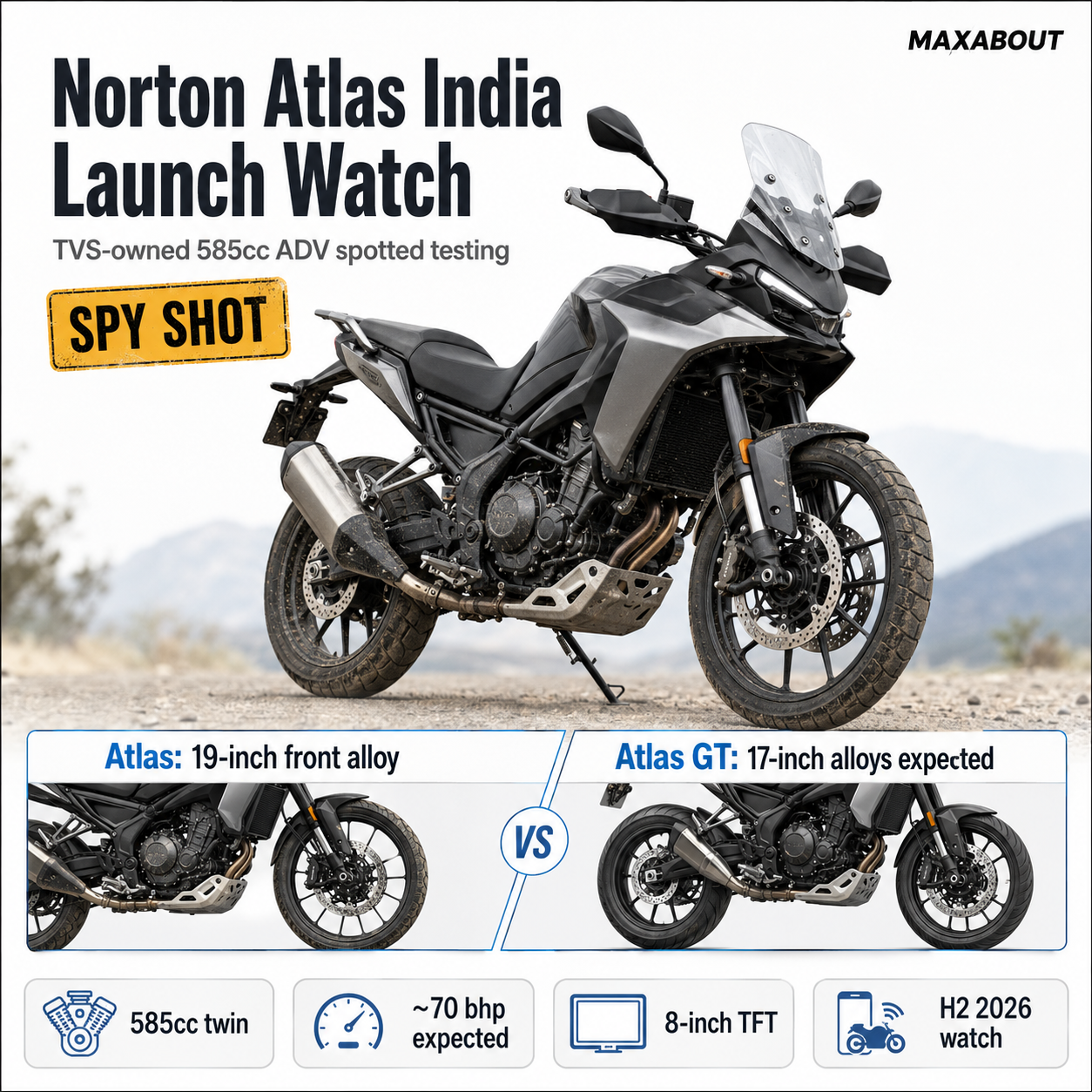 Then TVS Motor Company stepped in. The acquisition in 2020 was, frankly, a smart move. TVS brought something Norton desperately needed — financial stability, manufacturing discipline, and a global supply chain that actually works. What Norton brought in return was heritage, engineering DNA, and a name that still commands serious respect among premium motorcycle enthusiasts worldwide.
The partnership has already produced results. Norton's Commando and Dominator models have received strong reviews internationally since the revival, with industry reports noting marked improvements in build quality and reliability — areas where the old Norton had struggled considerably toward the end.
For Indian buyers, the TVS connection is particularly meaningful. TVS operates one of the country's most extensive service networks, which addresses a real concern with premium imported motorcycles — the anxiety of finding competent servicing outside major cities. That problem largely disappears when TVS is backing the brand.
India as a next step makes complete sense strategically. TVS understands this market deeply, and according to official announcements from the company, expanding Norton's footprint into Asia remains a clear priority within their broader growth strategy.
What Is the Norton Atlas? Breaking Down the Motorcycle
Before getting into what a potential India launch might look like, it helps to understand what the Norton Atlas actually is — because it is not a single motorcycle. Norton offers two distinct variants under the Atlas name: the Atlas Ranger and the Atlas Nomad. Same platform, meaningfully different intentions.
Both motorcycles share a 650cc parallel-twin engine producing around 84 horsepower. That figure is competitive but not overwhelming — Norton clearly tuned this motor for long-distance pulling power and smooth mid-range delivery rather than aggressive peak numbers. The engine has a relaxed, refined character to it, which suits both variants well.
The Atlas Ranger leans toward genuine adventure touring. It gets longer suspension travel, a more upright ergonomic stance, and wire-spoke wheels designed to handle unpaved surfaces. Think weekend escapes into rougher terrain. The Atlas Nomad, by contrast, is the road-focused sibling — cast wheels, sportier geometry, and a riding position built more for sweeping highways than broken trails.
From what reviewers internationally have noted, the chassis feels composed and confidence-inspiring without being overly stiff. The electronics package includes traction control, multiple riding modes, and ABS — reasonable for the segment.
Compared to what Indian enthusiasts already ride, the Atlas sits closest in spirit to something like the Royal Enfield Himalayan 650 or the Triumph Tiger Sport 660 — but with noticeably more premium fit and finish throughout.
Testing on Indian Roads: What the Sightings Tell Us
Spotting a test mule on Indian roads is never accidental. Manufacturers plan these runs deliberately, choosing specific conditions to stress-test things that controlled environments simply cannot replicate.
The Norton Atlas was recently observed on stretches that appear to include highway corridors and semi-urban routes — the kind of mixed-condition riding that genuinely exposes a motorcycle's weaknesses. India's roads are uniquely punishing in this regard. A broken patch outside Pune, dense stop-and-go traffic through Bengaluru, or summer tarmac in Rajasthan — these are real-world filters that no European test track can substitute.
What are engineers likely evaluating here? A few things stand out:
Heat management — Indian summers are brutal, and engine thermals behave very differently at 42°C compared to a mild English afternoon
Vibration tolerance on broken surfaces, which affects rider fatigue and component longevity
Low-speed traffic handling, where clutch feel and engine temperament matter enormously
Other international brands have learned this the hard way. Triumph and BMW both required calibration adjustments for Indian fuel quality and heat cycles before local launches felt truly polished.
Norton, being thorough, appears to be taking this seriously.
Expected Price and Who Will Actually Buy the Norton Atlas
Pricing will make or break this motorcycle in India. Based on Norton's international positioning and how TVS has priced other premium partnerships, a rough estimate of ₹5 lakh to ₹8 lakh seems reasonable — but that is purely speculative at this point. Official numbers could surprise us either way.
If Norton and TVS land it closer to ₹5-6 lakh, the Atlas becomes a genuinely compelling proposition. Push it toward ₹8 lakh or beyond, and the conversation changes significantly. At that level, buyers start comparing it against established names with stronger service networks and proven long-distance reliability.
So who actually buys this? From what industry observers suggest, the likely buyer profile looks something like this:
Riders graduating from 250-400cc machines looking for their first serious premium motorcycle
Weekend touring enthusiasts who want character and heritage alongside performance
Brand loyalists drawn specifically to the Norton name and its history
The adventure and touring segment already has strong competition. Pricing will be the critical factor. A compelling number could genuinely carve out space for the Atlas. An ambitious one risks pushing buyers toward more familiar alternatives.
How Does It Stack Up Against the Competition in India?
The segment Norton is entering is genuinely crowded. The Royal Enfield Himalayan 450, Triumph Speed 400, and BMW G 310 GS already fight hard for attention in this space. Each brings something distinct — proven reliability, established service networks, and years of real-world feedback from Indian owners.
Against these names, the Norton Atlas faces an interesting challenge. The brand heritage is undeniable, but heritage alone does not fix a puncture on the Manali-Leh highway or get you a replacement part in Coimbatore on a Tuesday morning.
That said, the emotional pull of the Norton name is real. There is something genuinely different about owning a motorcycle with that level of history behind it. Triumph has demonstrated that British brand premium pricing can work in India — buyers responded. Norton could follow a similar path, provided the product quality and after-sales support actually deliver.
From a performance and specification standpoint, the Atlas looks competitive on paper. Whether it rides better than a Speed 400 or offers more touring capability than the Himalayan 450 is something only extended real-world use will confirm. Based on reviews from international markets, the Atlas rides well, but Indian roads present a different set of demands entirely.
The honest picture is this — established rivals offer something Norton currently cannot: certainty. Buyers know what they are getting. With Norton, there is excitement mixed with a reasonable degree of caution, and that balance will define its success here.
Service Network and Ownership Realities in India
This is where the conversation gets genuinely important — perhaps more than performance numbers or pricing ever could. Because in India, after-sales support can make or break a premium motorcycle brand, no matter how impressive the machine itself is.
Norton currently operates through a limited number of dealerships in India, concentrated largely in metros like Mumbai, Bangalore, Delhi, and Pune. If you live in Coimbatore, Nagpur, or Lucknow, the nearest authorised service point could be a significant distance away. That is a real concern, not a minor inconvenience.
The TVS backing does offer some reassurance here. TVS has one of the most extensive dealership and service networks in the country, and there is genuine expectation that this infrastructure will gradually support Norton ownership. Whether that means dedicated Norton service bays within TVS premium outlets or standalone Norton dealerships expanding beyond tier-one cities remains to be seen officially.
From what industry observers have noted, other premium brands like Triumph and BMW Motorrad faced similar early criticism before slowly building credible service presence in larger cities. Norton will likely follow a comparable path — but the initial years could be uncomfortable for buyers outside major urban centres.
Spare parts availability is another honest concern worth flagging.
Final Thoughts: Should Indian Riders Be Excited About the Norton Atlas?
Honestly? Yes — but with measured expectations. Seeing a revived Norton testing on Indian roads genuinely signals something meaningful. It suggests India's premium motorcycle market has matured enough to attract heritage brands that once seemed completely out of reach for most enthusiasts here.
That said, testing sightings are not launch confirmations. There is a considerable distance between prototype evaluation and showroom availability. Pricing, compliance, homologation, and dealer network readiness all need to align before any real conversation begins.
In my view, the Norton Atlas will likely remain a very niche product — appealing to a small, financially committed audience in cities like Mumbai, Bangalore, and Delhi. That is not necessarily a criticism. Every premium segment starts somewhere.
What should you watch for? Keep an eye on official Norton India announcements, confirmed launch timelines, and most importantly, actual pricing reveals. If Norton positions the Atlas competitively against established rivals, the conversation gets genuinely interesting. If pricing feels disconnected from the value equation, enthusiasm will fade quickly.
For now, stay curious — but stay patient.
Explore the story
Related news
Share your view and join the discussion.
Earn reward points for every comment and get a chance to win ₹1,000 in our weekly lucky draw. Sign in with Google in one tap.
Start the conversation
No one has commented on this article yet. Be the first to share your view.
Want to read more automotive news?
Stay updated with the latest car launches, reviews, and industry insights.
Browse All News