
Lexus LM 350h: India's First WLTP-Certified Vehicle
Anyone who has bought a car in India knows the drill. You see a fuel efficiency figure on the brochure, get excited, and then reality hits you somewhere between a Bengaluru signal and a Delhi flyover. The number never quite matches. It never has. And for years, Indian buyers just accepted this as th...
Editorial Team
Anyone who has bought a car in India knows the drill. You see a fuel efficiency figure on the brochure, get excited, and then reality hits you somewhere between a Bengaluru signal and a Delhi flyover. The number never quite matches. It never has. And for years, Indian buyers just accepted this as the way things work.
That frustration has a reason. India has traditionally relied on ARAI (Automotive Research Association of India) testing, conducted under controlled laboratory conditions that bear little resemblance to actual roads. Low speeds, no traffic, ideal temperatures — the kind of driving that exists nowhere outside a test facility.
WLTP changes that equation. The Worldwide Harmonised Light Vehicle Test Procedure uses more realistic speed ranges, varied driving cycles, and accounts for real-world variables. It is the global standard that Europe adopted years ago, and it consistently produces figures that are meaningfully closer to what drivers actually experience.
Now, the Lexus LM 350h has become the first vehicle in India to carry official WLTP certification. That is not a small footnote. It is a genuine first — and depending on how the industry responds, it could be the moment Indian fuel efficiency testing finally started growing up.
What Is WLTP and How Is It Different From the Old ARAI Testing?
Let me start with the basics. WLTP stands for Worldwide Harmonised Light Vehicle Test Procedure. The name sounds bureaucratic, but the idea behind it is straightforward — test a vehicle in conditions that actually resemble how people drive, rather than in conditions that make efficiency numbers look as flattering as possible.
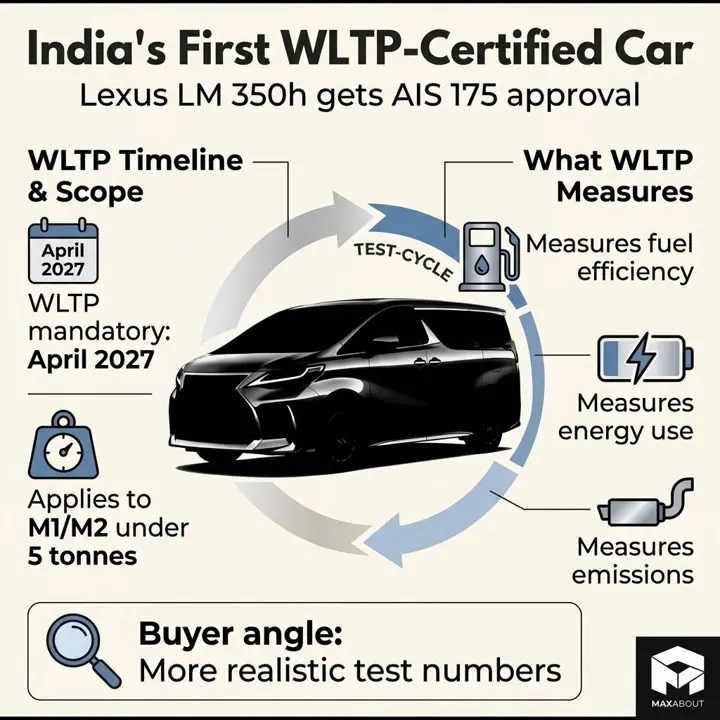 The older standard that WLTP replaced was called NEDC — the New European Driving Cycle. Despite the word "new" in its name, NEDC dated back decades and involved gentle, almost leisurely acceleration patterns on a laboratory dynamometer. No real traffic. No air conditioning load. No cold morning starts in January. The result was efficiency figures that looked great on a brochure and meant very little on an actual road.
WLTP changed that approach significantly. It tests vehicles across four distinct speed phases — low, medium, high, and extra high — covering around 23 kilometres at speeds up to 131 km/h. Crucially, it accounts for accessory loads like air conditioning, factors in different vehicle configurations, and runs longer test cycles. Europe made it mandatory in 2017, and it has since become the global benchmark for credible efficiency measurement.
India's ARAI testing — conducted by the Automotive Research Association of India — has followed a different path. The methodology has historically produced figures that are, to put it politely, optimistic. If you have ever bought a car rated at 18 km/l under ARAI certification and then driven it through Bengaluru's Outer Ring Road or Delhi's evening rush hour, you already know the gap I am talking about. Real-world returns of 11 to 13 km/l from that same vehicle are entirely common. That is not driver error. That is a testing standard that was never designed to reflect actual Indian driving conditions.
The core difference comes down to one word: realism. Think of ARAI testing like a fitness assessment done on a perfectly flat treadmill at a constant walking pace. WLTP is closer to timing someone on an actual run that includes hills, traffic signals, and a backpack. Neither is perfect, but one is clearly more honest about what you will experience.
WLTP figures still come from a controlled lab environment — no test standard is a perfect replica of real life. But independent data from European markets consistently shows WLTP numbers landing 10 to 20 percent closer to real-world performance than NEDC figures ever did. For Indian buyers, who have spent years mentally discounting whatever efficiency claim a manufacturer makes, that kind of credibility is genuinely valuable.
The Lexus LM 350h: A Quick Look at What You Are Actually Buying
Before getting into what the WLTP certification means in practice, it helps to understand exactly what kind of vehicle we are talking about here. The Lexus LM 350h is not a mainstream luxury car. It sits at a level where most buyers arrive with a chauffeur, not a driving licence in hand.
Priced well above ₹2 crore, this is a premium MPV built around the experience of being driven rather than driving. The four-seat VIP cabin configuration — which reviewers consistently describe as genuinely aircraft-business-class in its proportions and finish — is the central attraction. Industry observers have noted that the rear cabin quality feels unlike anything else currently available in the Indian market at this price point.
Under the hood, Lexus deploys its familiar self-charging hybrid architecture. A 2.5-litre four-cylinder petrol engine works alongside electric motors, producing a combined system output that prioritises refinement and smoothness over outright performance. There are no plugs required, no charging anxiety — the system manages itself entirely.
In spirit, it competes with something like the Mercedes-Benz V-Class, but the pricing and positioning operate in a different universe entirely. For senior executives and business leaders in cities like Mumbai, Delhi, and Bengaluru, where being productive during commutes matters as much as comfort, the LM 350h addresses a very specific and well-defined need.
Real-World Fuel Efficiency: Does the WLTP Number Actually Hold Up in Indian Conditions?
This is where things get genuinely interesting. The WLTP certification — the very milestone that makes the LM 350h historically significant in India — uses a more rigorous testing cycle than the older NEDC method. It accounts for varied speeds, real acceleration patterns, and accessory loads. So the efficiency figure it produces is meaningfully closer to real-world outcomes than what Indian buyers were used to seeing on paper.
Here is an honest observation though: Lexus has not published a specific kilometers-per-litre claim for Indian conditions. What the WLTP certification does tell you is that the number you see was earned under a harder standard. That matters.
Now, here is something that might actually surprise people. A self-charging hybrid performs better in Indian city traffic, not worse. Stop-and-go conditions in Mumbai or Hyderabad — the kind that punish petrol engines — are precisely where regenerative braking recovers energy and keeps the battery topped up. The electric motor carries more of the load at low speeds. This is a structural advantage of hybrid architecture in urban India.
Extreme heat is a legitimate concern for battery performance, particularly during peak summers in Rajasthan or interior Maharashtra. Long highway stretches at sustained speeds also reduce the hybrid advantage somewhat, since regeneration opportunities thin out.
But here is the practical reality: at this price point, most LM 350h buyers are not personally behind the wheel. Fuel efficiency is not a primary purchase decision. What it reflects, however, is engineering discipline and reduced running costs at fleet or operational scale — and that does matter to the people signing the cheques.
Why This WLTP Certification Is a Bigger Deal for the Indian Market Than It Looks
Step back from the Lexus LM 350h for a moment. Because what just happened here is genuinely significant — and it goes well beyond one luxury van and its fuel efficiency numbers.
India has come a long way on emissions and testing standards. The jump from BS4 to BS6 was enormous, and the industry adapted faster than many expected. But fuel efficiency and range testing protocols have remained relatively opaque compared to global benchmarks. Manufacturers have operated under ARAI testing conditions that, frankly, do not reflect how most Indians actually drive. The numbers looked good on paper. Real-world experience told a different story.
Lexus voluntarily pursuing WLTP certification for an India-sold vehicle signals something important — that premium manufacturers are beginning to treat Indian buyers as globally informed consumers who deserve the same transparency as buyers in Europe or North America. That is a meaningful shift in attitude.
And it creates pressure. When one manufacturer sets a higher standard of transparency, others eventually have to respond — particularly in the premium and near-premium segments where informed buyers do their research thoroughly.
The EV angle here is especially worth noting. WLTP is the global benchmark for electric vehicle range claims. As India's EV adoption accelerates, credible and standardised range testing becomes critical to consumer trust. Range anxiety is already a real concern among potential EV buyers in cities like Bengaluru and Pune. A recognisable, internationally respected testing standard could meaningfully reduce that uncertainty.
In my view, this is genuinely a step in the right direction — small, but pointed exactly where it needs to be.
Lexus in India: The Service Network and Ownership Reality
Buying a Lexus in India is a different kind of decision. You are not just choosing a car — you are choosing how much convenience you are willing to trade for a certain kind of prestige and reliability. That trade-off is real, and any honest conversation about the LM 350h has to acknowledge it.
Lexus currently operates through a relatively modest dealership footprint. The major metros — Delhi, Mumbai, Bengaluru, Chennai, and Hyderabad — are reasonably covered. But if you live in Jaipur, Coimbatore, or Lucknow, the nearest authorised service centre could be several hours away. For a vehicle sitting well above ₹2 crore, that is a genuine concern, not a minor inconvenience.
Where Lexus does earn its reputation is in the ownership experience at those established touchpoints. Industry observers and existing owners have consistently noted that the brand's customer service culture feels noticeably different — more attentive, less transactional. That counts for something, especially at this price point.
Spare parts availability remains a practical consideration. Insurance premiums for a vehicle in this segment run significantly higher, and service intervals, while infrequent given the hybrid drivetrain's engineering, can carry meaningful costs when they do arrive.
Globally, Lexus has one of the strongest reliability records in the luxury segment. In a market where service access is limited, that reputation becomes less of a selling point and more of a survival strategy.
Should Indian Luxury Buyers Care About WLTP?
My honest answer is yes. Unambiguously yes.
At this price point, buyers are not simply purchasing a vehicle. They are making a statement about their expectations — of engineering quality, of manufacturer accountability, of transparency. WLTP certification signals all three. It tells you that a manufacturer submitted their product to a rigorous, internationally recognised testing framework rather than hiding behind loosely defined numbers.
Indian luxury buyers today are more globally informed than ever. Many compare notes with peers in Singapore, the UAE, or the UK before signing anything. WLTP gives them a common reference point — a standard that travels across borders without needing translation or qualification.
A practical suggestion: when evaluating any premium vehicle going forward, simply ask for real-world efficiency data or WLTP-equivalent figures. If a manufacturer hesitates or deflects, that itself tells you something worth knowing.
The broader significance of the LM 350h's certification milestone, though, extends well beyond luxury buyers. If this is the beginning of a genuine shift toward greater transparency in Indian automotive certification, that matters for every buyer at every price point. Cautious optimism feels appropriate here — one vehicle, one standard, but perhaps the start of something that raises the bar for the entire market.
Explore the story
Related news


Share your view and join the discussion.
Earn reward points for every comment and get a chance to win ₹1,000 in our weekly lucky draw. Sign in with Google in one tap.
Start the conversation
No one has commented on this article yet. Be the first to share your view.
Want to read more automotive news?
Stay updated with the latest car launches, reviews, and industry insights.
Browse All News