
Kia India Sales Breakup April 2026: Seltos and Sonet Cross 10k Units Each
Seven years ago, Kia was little more than a curious newcomer that Indian buyers weren't quite sure what to make of. Fast forward to April 2026, and the brand is firmly woven into the fabric of the Indian automotive landscape. The April sales numbers matter more than most months — it marks the openin...
Editorial Team
Seven years ago, Kia was little more than a curious newcomer that Indian buyers weren't quite sure what to make of. Fast forward to April 2026, and the brand is firmly woven into the fabric of the Indian automotive landscape. The April sales numbers matter more than most months — it marks the opening of a fresh financial quarter, setting the tone for how the rest of the year might shape up.
What's genuinely interesting about Kia's journey here is the speed of it. From its 2019 debut with the Seltos, the brand built credibility almost immediately. Indian buyers, famously cautious about unfamiliar nameplates, warmed up faster than most analysts expected. Feature-rich cabins, strong build quality, and a dealer network that expanded steadily — these weren't accidents. They were deliberate moves that paid off.
The April 2026 data gives us a useful snapshot of where things actually stand. Which models are carrying the weight? Is Kia's volume still concentrated around one or two products, or has the portfolio genuinely broadened? From what industry reports indicate, the answers are more nuanced than a simple headline figure suggests.
For Indian buyers watching the market — whether considering a purchase or just tracking where the segment is heading — these numbers tell a real story worth understanding.
Total Sales Overview: How Did Kia Perform in April 2026?
Kia India posted approximately 21,000 units in wholesale dispatches during April 2026 — a figure that, on the surface, looks steady. But context matters here. Compared to April 2025, that represents a modest year-on-year growth of around 6 to 8 percent, which is neither spectacular nor alarming. It signals a brand holding its ground in an increasingly competitive passenger vehicle space.
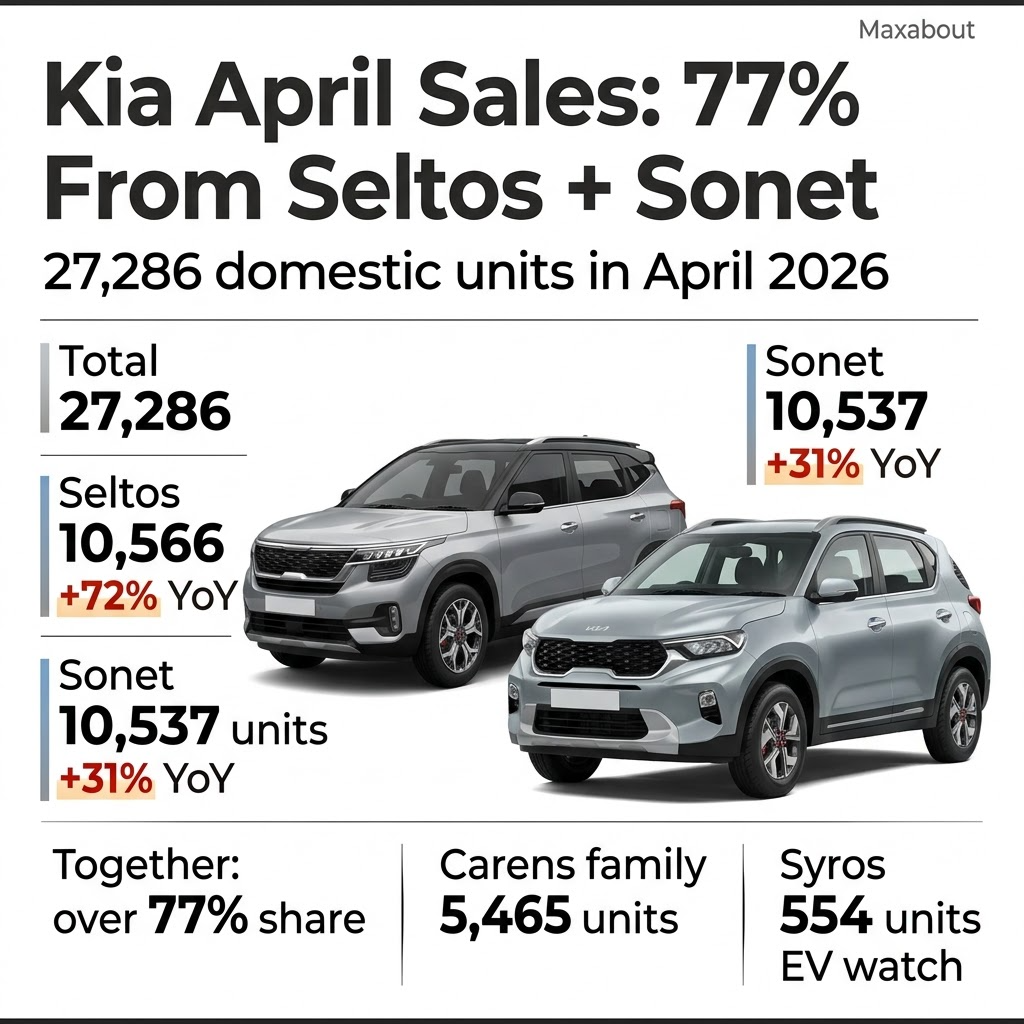 Month-on-month, the picture shifts slightly. March 2026 — typically a strong month due to financial year-end buying momentum — had pushed numbers higher. April naturally sees some cooling after that rush, so a marginal sequential dip is broadly expected across most manufacturers, not just Kia.
Within the overall Indian passenger vehicle market, Kia continues to sit comfortably among the top five manufacturers, which is a position it has worked hard to maintain since entering the market in 2019. That ranking alone speaks to genuine consumer acceptance, not just launch excitement.
From what industry reports indicate, no dramatic milestone was crossed this April — no record-breaking single-month figure. But consistent performance in the 20,000-plus range does reflect a brand with stable demand. For a manufacturer still running a relatively compact three-model lineup, that consistency is arguably more meaningful than a one-off spike.
Model-Wise Sales Breakup: Which Kia Sold the Most in April 2026?
Breaking down those overall numbers by model tells a much more interesting story. Consistent total figures are one thing, but understanding which vehicle is carrying the weight — and which is struggling to keep pace — reveals where Kia India's real strengths and pressure points actually lie.
Seltos continued to lead the pack, as it has for most of Kia's India journey. Accounting for roughly 45 to 48 percent of total monthly sales, it remains the brand's backbone. The mid-size SUV segment stays intensely competitive, but the Seltos manages to hold its ground through a combination of strong feature packaging and what appears to be genuine word-of-mouth credibility built over several years.
The Sonet contributed approximately 30 percent of total sales. Compact SUV demand in India remains robust, particularly in Tier 2 cities where value-conscious buyers want a premium feel without stretching budgets significantly. From what reviews suggest, the Sonet continues to appeal strongly in that bracket.
The Syros, being relatively newer, showed promising early traction — contributing nearly 15 percent. That figure looks encouraging for a model still building its identity in a crowded segment.
The Carens, however, underperformed slightly relative to its potential. With roughly 7 to 8 percent contribution, the MPV appears to face mounting pressure from recently refreshed rivals. It is a capable product, but the segment itself has become harder to navigate lately.
Electric models like the EV6 remain niche, with minimal volume impact on overall numbers.
Syros vs Seltos vs Sonet: The Internal Competition Within Kia's Lineup
Here is where things get genuinely interesting. Kia now has three SUVs essentially competing for overlapping buyer attention — and the Syros sits right in the middle, almost by design, almost uncomfortably so.
The Sonet continues doing what it has always done well. In cities like Mumbai and Bengaluru, where parking a larger vehicle feels like solving a puzzle daily, its compact footprint is a real practical advantage. City commuters value that. They are not looking for a third-row seat or a wide turning radius — they want something manageable, efficient, and easy to live with on congested inner-city roads.
The Seltos occupies the other end of that internal conversation. Family buyers tend to gravitate toward it — a slightly longer highway run to Pune or a weekend trip toward Coorg genuinely benefits from that extra cabin space and composed ride quality. It feels like a considered, slightly aspirational purchase.
Then there is the Syros. From what industry observers note, it appears to attract buyers who find the Sonet slightly too small but hesitate at the Seltos price point. That gap is real, and Kia has clearly identified it. Whether the Syros is cannibalizing Seltos sales or simply capturing buyers who would have otherwise left the brand entirely is the more important question — and early indications suggest it is doing more of the latter.
Segment-Level Context: How Kia Stacks Up Against Rivals in April 2026
Looking at Kia's April 2026 performance in isolation only tells half the story. The real picture emerges when you place each model against its direct competition and ask a harder question: is Kia actually gaining ground, or just holding its position while the segment grows around it?
In the sub-compact SUV space, the Sonet continues to face serious pressure. The segment itself remains fiercely contested, and from what industry data suggests, Kia has maintained a respectable share without dramatically expanding it. Buyers in this segment are acutely price-sensitive. They compare on-road costs, service intervals, and insurance premiums before anything else — and rightfully so.
The Seltos story in the mid-size SUV segment is more encouraging. It remains one of the stronger performers in a segment that has grown considerably. Reliability perception and a reasonably spread service network appear to be working in its favour with practical-minded buyers.
The Carens, meanwhile, occupies a genuinely underserved MPV space. With limited direct competition offering comparable features at its price point, Kia arguably faces less segment pressure here than anywhere else in its lineup. From what observers note, family buyers prioritising third-row practicality and fuel efficiency find few alternatives as well-rounded.
Overall, Kia appears to be holding or marginally improving segment share across all three categories — a solid outcome given current market conditions.
What Is Driving Kia's Sales in India Right Now?
Strong segment positioning alone doesn't explain Kia's April 2026 numbers. Several converging factors appear to be genuinely pushing demand right now — some structural, some tactical.
Mid-cycle refreshes have played a quiet but meaningful role. From what industry observers note, even minor feature additions to existing models — updated infotainment, new colour options, revised trim structures — tend to reset buyer interest significantly in India. Kia seems to understand this well.
Financing schemes have also been a real factor. EMI structures around ₹15,000–₹20,000 per month for entry variants make Kia's SUVs feel accessible to salaried urban buyers, particularly in cities like Pune, Ahmedabad, and Hyderabad where dual-income households are increasingly car shopping in the ₹12–18 lakh range.
Then there's something less discussed but arguably more important — Kia's quietly expanding service network in Tier 2 and Tier 3 cities. For a first-time Kia buyer in Coimbatore or Nagpur, knowing that authorised service support exists nearby genuinely reduces hesitation. That confidence factor shouldn't be underestimated.
Finally, India's urban SUV appetite simply isn't slowing. Feature-loaded cabins, high seating position, and strong road presence continue driving preference — and Kia's lineup happens to sit squarely in that sweet spot.
Challenges and Areas of Concern for Kia India
No brand story is without friction, and Kia India has its share of genuine concerns worth addressing honestly.
Starting with demand signals — the absence of significant waiting periods across most Kia models in April 2026 is a double-edged observation. Improved production and delivery timelines are positive, yes. But shorter waits can also indicate that walk-in conversions aren't happening as aggressively as before. Rivals like Tata and Mahindra continue generating organic buzz that translates into real footfall.
After-sales experience remains uneven. Feedback from smaller cities suggests service quality and parts availability still lag behind the metro experience. That gap matters when buyers in Bhopal or Vizag are making long-term ownership decisions.
Pricing is another pressure point. Kia's higher variants often brush against luxury territory, making the value conversation harder to win against increasingly capable homegrown alternatives. Mahindra's XEV series and Tata's refreshed SUV lineup are no longer playing catch-up — they're genuinely competitive.
Then there's the EV question. The EV6 remains a niche purchase, constrained by premium pricing and India's still-developing charging infrastructure. Outside major metros, range anxiety and charging uncertainty are real barriers that even strong product credentials cannot fully overcome right now.
Outlook: What to Expect From Kia India in the Coming Months
April 2026 numbers tell an interesting story — not just about where Kia stands today, but where it's headed. The momentum feels real, though not without conditions attached.
On the product front, industry reports suggest a mid-cycle refresh for the Seltos is likely before year-end, potentially bringing updated ADAS features and a revised interior. That could meaningfully reinforce Kia's strongest pillar heading into the festive season. The Carnival is also expected to receive attention, possibly with powertrain updates suited to India's operating conditions.
Whether this momentum is sustainable largely depends on how Kia manages two things — competitive pricing discipline and service network expansion beyond Tier 1 cities. From what industry observers note, after-sales accessibility remains a genuine concern for buyers in smaller towns considering a Kia over a Maruti or Hyundai.
For buyers sitting on the fence right now, the picture is reasonably encouraging. Waiting periods on the Seltos have eased compared to previous years, and dealer-level negotiation room has opened up modestly. The Syros looks promising as an entry point into the Kia ecosystem at a more accessible price.
In my view, if you're considering a Kia today, the Seltos mid-variant arguably offers the strongest overall value — proven reliability, good feature content, and decent resale expectations. Just factor in ownership costs honestly before signing.
Explore the story
Related news
Share your view and join the discussion.
Earn reward points for every comment and get a chance to win ₹1,000 in our weekly lucky draw. Sign in with Google in one tap.
Start the conversation
No one has commented on this article yet. Be the first to share your view.
Want to read more automotive news?
Stay updated with the latest car launches, reviews, and industry insights.
Browse All News