
Kia BaaS Plan for Carens Clavis EV Explained
Electric vehicles are getting smarter, sleeker, and genuinely exciting. But the price tags? Still a wall that stops most Indian families cold. And the uncomfortable truth is that a huge chunk of that cost — sometimes 40 to 50 percent of the vehicle's price — is sitting quietly inside the battery pac...
Editorial Team
Electric vehicles are getting smarter, sleeker, and genuinely exciting. But the price tags? Still a wall that stops most Indian families cold. And the uncomfortable truth is that a huge chunk of that cost — sometimes 40 to 50 percent of the vehicle's price — is sitting quietly inside the battery pack. You are essentially paying a premium upfront for something you cannot see, touch, or easily replace.
This is exactly the hesitation Kia seems to be targeting with its newly introduced BaaS (Battery as a Service) plan for the Carens Clavis EV. The concept is straightforward once you break it down. Instead of buying the car with the battery included, you purchase the vehicle without the battery at a lower upfront price, and then pay a separate monthly subscription fee to lease the battery. The car is yours. The battery comes on a usage plan.
From what industry observers are noting, this is a genuinely thoughtful approach for the Indian market — not just a gimmick. The Carens Clavis EV sits in the family MPV space, a segment where buyers are particularly value-conscious. These are not impulse purchases. Families in cities like Pune, Hyderabad, or Lucknow are making careful, long-term financial decisions here. Affordability is not just a preference in this segment — it is practically a requirement.
Whether BaaS actually delivers on that promise is worth examining closely.
How the BaaS Plan Actually Works for the Carens Clavis EV
The structure is straightforward in concept. Instead of buying the car complete with its battery pack, you purchase the vehicle body, motor, and electronics at a reduced upfront price. The battery — typically the single most expensive component in any electric vehicle — is not yours. You pay a separate monthly subscription fee to use it.
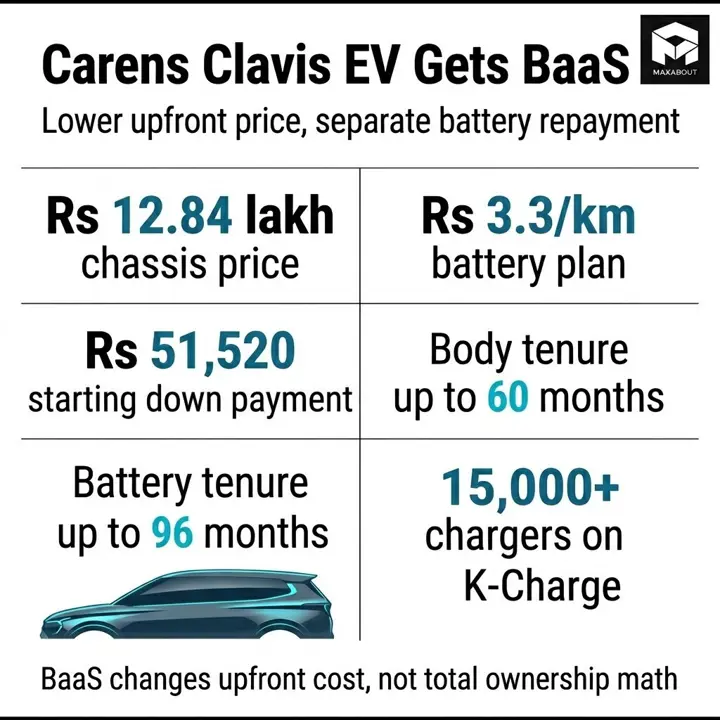 Think of it like leasing the most critical part of the car indefinitely. The vehicle cost drops significantly because you are essentially removing ₹3–5 lakh or more from the sticker price, depending on battery size. That monthly fee then covers your right to use that battery and, importantly, comes with certain guarantees attached.
What the subscription typically covers includes:
Guaranteed battery health above a stated threshold — usually around 70–80% capacity retention
Battery replacement if degradation falls below that threshold
Some level of roadside support related to battery faults
This model is not entirely new. Brands like NIO in China and some European operators have already tested BaaS arrangements, with mixed but generally positive reception among urban buyers.
That said, the fine print matters enormously here. Before committing, readers should verify the exact subscription terms, exit clauses, and replacement conditions directly through official Kia India announcements. What sounds reassuring in a press release can look quite different in an actual contract.
The Real Cost Comparison: BaaS vs Standard Purchase
This is where things get genuinely interesting — and where you need to do some honest math rather than just read the brochure.
Based on industry estimates and available information, the Carens Clavis EV is expected to be priced somewhere in the ₹18–22 lakh range for the standard purchase. With BaaS, the upfront cost could potentially drop by ₹4–6 lakh, bringing entry closer to ₹14–16 lakh. That sounds compelling. But then the monthly battery subscription kicks in — likely somewhere between ₹3,500 and ₹6,000 per month based on comparable BaaS models globally. These are illustrative figures; official Kia India pricing should be confirmed directly.
Run that across different ownership timelines and the picture shifts considerably:
3 years: BaaS likely remains cheaper in total outgo — you've paid roughly ₹1.5–2 lakh in subscriptions, still below the price gap saved upfront.
5 years: This is roughly the break-even zone. Total subscription costs start approaching or matching the initial saving.
8 years: Standard purchase almost certainly wins. You've paid significantly more through subscriptions than you ever saved upfront.
So the critical question is simple — how long do you actually keep your cars? If you upgrade every four to five years, BaaS makes financial sense. If you're the type who drives a vehicle into the ground over a decade, the standard purchase is mathematically sounder.
There's also the resale angle. A BaaS vehicle without battery ownership could fetch a lower resale price, which further complicates the long-term calculation for buyers planning to sell eventually.
Who Actually Benefits from the BaaS Model in India?
Not every buyer is the right fit for this scheme. Let me be honest about that.
First-time EV buyers are probably the most natural candidates here. Battery degradation anxiety is real, and BaaS directly addresses it. If you're nervous about owning a large battery pack outright — wondering what happens at year six or seven — this model transfers that worry to Kia. That peace of mind has genuine value.
Metro commuters in Bengaluru, Pune, or Delhi with predictable daily routes also benefit considerably. Shorter upfront costs, consistent monthly charges, and covered battery health checks fit neatly into structured urban lifestyles. Families considering the Carens Clavis as a second household car — used primarily for school runs and weekend outings — similarly find the lower entry price more palatable.
But BaaS is honestly not ideal for everyone. Buyers in smaller cities where Kia's service network is thinner may face practical difficulties with battery-related servicing commitments. High-mileage drivers — people clocking 40,000 to 50,000 kilometres annually — could find subscription costs accumulating uncomfortably fast.
And then there's the psychological dimension. Some buyers simply dislike ongoing financial obligations. A monthly subscription layered on top of loan EMIs feels like too many moving parts. That discomfort is completely valid, and no amount of clever structuring changes it.
Battery Anxiety in India: Does BaaS Actually Solve the Problem?
Let's be honest — battery anxiety is probably the single biggest reason Indian buyers hesitate before committing to an electric vehicle. And it isn't irrational fear. It's rooted in real questions. What happens when the battery degrades? What does replacement actually cost? Who's responsible five years from now?
This is precisely where BaaS makes its strongest argument. By keeping battery ownership with Kia, the financial risk of degradation shifts away from the buyer entirely. From what official announcements indicate, the subscription includes guaranteed battery health minimums — meaning if capacity drops below a specified threshold, Kia carries the responsibility to address it. That's a meaningful structural protection.
But Indian conditions deserve honest scrutiny here. Extreme summer heat across cities like Delhi, Nagpur, and Chennai accelerates cell degradation faster than moderate climates. Stop-and-go traffic causes thermal stress. And frequent fast charging — which many urban owners rely on — compounds long-term wear. Whether the subscription terms adequately account for these realities remains worth examining carefully before signing.
There's also a counterpoint worth raising. Battery technology is evolving rapidly, with newer, more efficient chemistries becoming commercially viable. A buyer locked into a long-term subscription could theoretically end up paying for yesterday's technology while significantly cheaper batteries enter the market. That's not a trivial concern.
The Carens Clavis EV Itself: Is It Worth Considering Beyond the BaaS Plan?
Set the battery subscription question aside for a moment. The more fundamental question is whether the Carens Clavis EV stands on its own as a genuinely good vehicle. Because no financial structure should carry a car that doesn't deserve to be bought in the first place.
From what reviews and official specifications suggest, there's quite a bit to like here. The claimed range sits in a bracket that makes genuine daily family use feasible without constant range anxiety. For a household running school runs, weekend outings, and the occasional inter-city trip, that's meaningful. The seven-seat configuration is practical in a way that most electric offerings in India simply haven't addressed yet — most EVs at this price point are either sedans or compact SUVs built for four adults comfortably, not a family of six or seven.
Space and practicality appear to be real strengths. The Carens platform already has a solid reputation for interior roominess, and the Clavis EV carries that forward. Third-row passengers reportedly get adequate legroom — not luxury, but genuinely usable for shorter trips.
Where things get more nuanced is real-world performance on Indian roads. Speed breakers, broken surfaces, and stop-start city traffic are the actual test. The BaaS plan is interesting. The car, though, needs to earn its place on its own terms first.
Kia's Service Network and BaaS Support: Can India Handle This?
The BaaS model sounds compelling on paper. But here's a practical question worth asking: is Kia India's service infrastructure actually ready to support it? Battery-related servicing isn't the same as routine maintenance. It requires trained technicians, specialized equipment, and dealerships that are specifically configured to handle battery diagnostics and replacements.
Kia has been expanding steadily. Their network has grown noticeably over the past few years, and that's genuinely encouraging. But expansion and readiness aren't always the same thing.
If you're in Mumbai, Bangalore, or Delhi, you're probably fine. The concern is elsewhere. Buyers in cities like Coimbatore, Nagpur, or Lucknow should specifically verify whether their nearest Kia dealership is BaaS-equipped before committing. Don't assume. Call the dealership directly, ask pointed questions, and get clarity in writing if possible.
From what industry observers have noted, EV service infrastructure across Tier 2 and Tier 3 cities remains inconsistent — not just for Kia, but broadly. A breakdown in a smaller city with limited support options is a genuinely stressful scenario.
That said, this is an evolving situation. Kia has shown willingness to invest in its network. Whether that investment keeps pace with BaaS rollout is something worth monitoring closely before you sign on the dotted line.
Final Thoughts: Is the Kia BaaS Plan a Smart Move for Indian EV Buyers?
Honestly? The BaaS plan is one of the more genuinely interesting ideas to come out of the Indian EV market in a while. Lowering the upfront cost of the Carens Clavis EV by separating the battery from the vehicle price is a real attempt to solve a real problem. For middle-class families sitting on the fence about EVs, that reduced sticker price matters.
But interesting ideas and good deals are not always the same thing. The smarter move here is to treat the lower entry price as a starting point for your calculations, not the conclusion. Add up the subscription costs over five years. Compare that total honestly against a conventional purchase. Only then does the picture become clear.
Your city and daily usage pattern matter enormously here. If you're in Bengaluru, Pune, or Delhi with a predictable daily commute and a Kia service centre nearby, the BaaS structure could work very well for you. If you're further out, with longer unplanned trips and limited service access, the risk calculus shifts considerably.
Read the fine print carefully — particularly around mileage caps, subscription flexibility, and what happens if you exit the plan early. These details will define whether BaaS feels like freedom or a financial trap three years in.
My suggestion: visit a Kia dealership, ask for the full BaaS terms in writing, take the Carens Clavis EV for a proper test drive, and then decide with numbers in front of you — not just the attractive headline price.
Explore the story
Related news


Share your view and join the discussion.
Earn reward points for every comment and get a chance to win ₹1,000 in our weekly lucky draw. Sign in with Google in one tap.
Start the conversation
No one has commented on this article yet. Be the first to share your view.
Want to read more automotive news?
Stay updated with the latest car launches, reviews, and industry insights.
Browse All News