
JSW Motors' Chery iCar V23-Based SUV Spotted Testing in India
JSW Motors Enters India with Chery iCar V23-Based SUVThe Indian automotive landscape is about to get more interesting as JSW Motors, a new venture from the industrial giant JSW Group, has been spotted testing their upcoming SUV based on China's Chery iCar V23 platform. This marks a significant move ...
Editorial Team
JSW Motors Enters India with Chery iCar V23-Based SUV
The Indian automotive landscape is about to get more interesting as JSW Motors, a new venture from the industrial giant JSW Group, has been spotted testing their upcoming SUV based on China's Chery iCar V23 platform. This marks a significant move for the steel-to-energy conglomerate as they diversify into the competitive automotive sector.
The test vehicle was recently spied on Indian roads wearing heavy camouflage, but industry experts could identify its Chery origins. This strategic partnership with the established Chinese automaker Chery gives JSW a solid foundation to build upon rather than starting from scratch.
From what I can tell, the upcoming SUV appears to target the mid-size segment, potentially competing with vehicles like the Hyundai Creta, Kia Seltos, and Maruti Grand Vitara. Given JSW Group's manufacturing expertise and deep pockets, this entry could shake up the market that's currently dominated by established players.
The timing seems particularly strategic, with Indian consumers increasingly gravitating toward SUVs across price points. Expected to launch sometime in 2024, this vehicle will likely be priced in the ₹10-18 lakh range, depending on variant configurations.
Spied Testing Details: What We Know So Far
The recently captured spy images of JSW Motors's upcoming SUV reveal quite a bit despite the heavy camouflage. Spotted testing on the outskirts of Pune last week, the test mule maintains the overall silhouette of the Chery iCar V23, but with some notable modifications. I was particularly struck by the squared-off wheel arches and the relatively upright stance – design elements that typically appeal to Indian SUV buyers.
The front fascia, though disguised, appears to feature split LED headlamps and a wide grille – slightly redesigned from the original Chery model. The test vehicle was riding on dual-tone alloy wheels, approximately 17-inches in diameter, which complemented its substantial ground clearance – something essential for tackling our notorious urban potholes and rural roads.
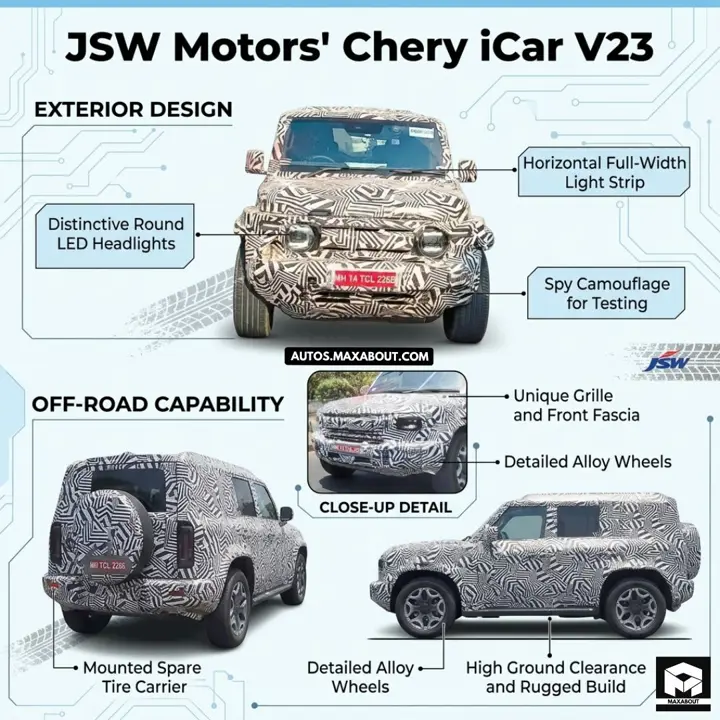 From the side profile, the SUV displays a floating roof design with roof rails and a gently sloping roofline. The rear section sports what seems to be connected LED taillamps, a design trend that's gaining popularity in India. Interestingly, the test vehicle appeared slightly longer than the international model, suggesting possible adaptations for the Indian market's preference for spacious interiors.
The camouflage pattern itself uses the standard swirl design, but doesn't completely hide the prominent character lines running across the doors. Though interior shots weren't available, the vehicle's proportions suggest a spacious five-seater configuration. Based on the testing location and timing, it appears JSW is deep into the localization and road-testing phase, aligning with their anticipated 2024 launch timeline.
Expected Specifications and Features
Based on what we know about the Chery iCar V23 platform, JSW's upcoming SUV will likely pack quite a punch under the hood. I expect it to feature a 1.5-liter turbocharged petrol engine producing somewhere around 150 bhp and 210-230 Nm of torque. Transmission options could include a 6-speed manual and a 7-speed DCT for those who prefer automatic.
Fuel efficiency should hover around 15-16 km/l, which seems reasonable for this segment in Indian conditions. I think JSW might also introduce a mild-hybrid variant later, especially considering the growing focus on fuel economy in our market.
On the features front, expect a large 10.25-inch touchscreen infotainment system with wireless Apple CarPlay and Android Auto. The SUV will likely come equipped with a digital instrument cluster, panoramic sunroof, ventilated seats, and wireless charging – essentially matching what competitors like Hyundai Creta and Kia Seltos offer.
Safety should be comprehensive with 6 airbags, electronic stability control, and hill-start assist. I'm particularly interested to see if they'll include ADAS features like lane keep assist and adaptive cruise control, which would give them an edge in this competitive segment.
The interior will likely feature premium soft-touch materials and possibly leatherette upholstery in higher variants. With competitors raising the bar on feature lists, I expect JSW to come prepared with ambient lighting, a premium sound system, and possibly even a heads-up display in the top-spec version.
JSW-Chery Partnership: Strategic Implications
The JSW-Chery alliance represents a significant strategic move in India's evolving automotive landscape. Chery brings impressive credentials to this partnership, with a global footprint spanning over 80 countries and a robust portfolio of engines and electrification technologies. Their experience in markets like Russia, Brazil, and the Middle East gives them valuable insights into emerging market preferences.
JSW Group, while new to automobiles, brings manufacturing excellence and deep understanding of the Indian market. I think their planned ₹4,000 crore investment for the new facility in Odisha demonstrates serious commitment. Their focus on achieving 60-70% localization from launch is particularly smart in a price-sensitive market like India.
What makes this partnership interesting compared to others like Skoda-VW's India 2.0 or Citroen's entry is the balanced power dynamics. Unlike BYD's solo approach or Citroen's cautious rollout, JSW-Chery seems positioned between complete foreign control and total localization.
From a competitive standpoint, this alliance will likely pressure established players like Hyundai-Kia and Maruti-Toyota to accelerate their technology adoption. The timing seems opportune too, with Indian consumers increasingly willing to try new brands if the value proposition is compelling. The success will ultimately depend on their pricing strategy and after-sales network development.
Market Positioning and Potential Pricing
Based on the spy shots and industry reports, the JSW-Chery SUV appears to be targeting the highly competitive mid-size SUV segment in India. This positions it directly against established heavy-hitters like the Hyundai Creta, Kia Seltos, Maruti Grand Vitara, Toyota Urban Cruiser Hyryder, and Volkswagen Taigun.
In terms of pricing, I expect JSW Motors to adopt an aggressive strategy, likely positioning the vehicle between ₹10-16 lakh (ex-showroom). The lower variants might undercut Creta's base price to gain initial market attention, while higher trims could offer premium features at more competitive prices than equivalent Seltos or Taigun variants.
The value proposition will likely center around offering newer technology and possibly better build quality at competitive prices. If they can deliver European-inspired design elements with strong safety credentials (something Chinese platforms have improved on significantly), they might attract buyers who prioritize these aspects.
However, the success of this pricing strategy hinges on several factors: perception of a new brand, service network reliability, and resale value confidence. Even with competitive pricing, Indian consumers remain wary of newcomers without established after-sales support. JSW's existing industrial reputation might help mitigate some concerns, but they'll need to demonstrate long-term commitment to automotive service excellence.
Challenges for a New Entrant in the Indian Market
Breaking into India's automotive market is no small feat. JSW Motors faces several uphill battles that every new player must overcome, particularly with a vehicle based on Chinese technology.
Building a dealer network from scratch requires enormous investment. I've seen brands like MG Motor struggle initially with limited touchpoints before gradually expanding. JSW will need strategic geographical placement across metropolitan areas and tier-2 cities to ensure adequate market coverage.
After-sales service remains a critical pain point for Indian consumers. Kia managed to quickly establish credibility by deploying robust service infrastructure early on. JSW must ensure spare parts availability and trained technicians from day one—something Citroen initially struggled with.
Brand perception presents another challenge. The Chinese connection (through Chery) may trigger skepticism among potential buyers. MG faced similar hurdles but overcame them through transparent communication and quality products. JSW's established industrial reputation helps, but automotive credibility must be earned separately.
Regulatory compliance introduces additional complexity, from emissions standards to safety certifications. The constantly evolving CAFE norms and BS-VI standards require sophisticated engineering capabilities that established manufacturers have spent years perfecting.
What might work in JSW's favor is their understanding of the Indian business landscape and potential integration with their existing industrial ecosystem. If they can translate this advantage into tangible consumer benefits, they stand a fighting chance in this fiercely competitive market.
Expected Launch Timeline and Future Product Strategy
Based on the current testing phase we're seeing, I expect JSW Motors to introduce their Chery iCar V23-based SUV somewhere between mid to late 2024. Typically, homologation and final adjustments take 6-8 months after road testing begins in India. The company seems to be working at an aggressive pace, understanding that timing is crucial in today's competitive market.
Looking at their broader strategy, this SUV appears to be just the beginning. Industry reports suggest JSW plans to establish a comprehensive lineup with at least 3-4 models within the next five years. Their approach seems to follow a well-trodden path – start with an SUV to capture market attention, then expand to other segments including sedans and possibly compact vehicles.
On the manufacturing front, JSW is likely leveraging their industrial expertise to set up facilities that can scale quickly. I think their partnership with Chery indicates a pragmatic approach – why reinvent the wheel when you can adapt proven platforms to Indian conditions?
While official details remain limited, there are whispers about electrification plans in their product roadmap. Given India's push toward EVs and JSW's own involvement in the energy sector, I wouldn't be surprised if we see electric variants following shortly after the conventional models establish the brand presence.
Verdict: What This Means for Indian Car Buyers
For us Indian car buyers, JSW Motors' entry brings more than just another badge on dealership floors. Competition almost always benefits consumers - potentially driving better pricing, features, and customer service across the market. Based on the spy shots, JSW seems poised to enter the competitive SUV segment with a product that balances global design with Indian requirements.
Should you wait for this new offering? I think it depends on your timeline. Established brands offer the security of proven service networks and resale value. However, newcomers often arrive with aggressive pricing and feature-loaded packages to gain market share. JSW's industrial background suggests they understand the importance of after-sales support.
Realistically, expect pricing to be competitive but not disruptively low - perhaps in the ₹12-18 lakh bracket depending on variants. I'd recommend watching their initial launch closely, particularly regarding warranty terms and service center expansion plans before making your decision.
No comments yet
Be the first to share your thoughts!
Want to read more automotive news?
Stay updated with the latest car launches, reviews, and industry insights.
Browse All News