
JSW and Skoda Volkswagen India Sign Non-Binding Partnership MoU
JSW and Skoda Auto Volkswagen India have signed a non-binding memorandum of understanding to explore a partnership in India. The reported company statement points to joint control and cooperation across localisation, products, manufacturing and research and development. It is an important step in th...
Editorial Team
JSW and Skoda Auto Volkswagen India have signed a non-binding memorandum of understanding to explore a partnership in India. The reported company statement points to joint control and cooperation across localisation, products, manufacturing and research and development. It is an important step in the talks, but it is not a completed acquisition or a final joint-venture agreement.
That distinction matters. A non-binding MoU records the direction the parties want to examine. It can guide negotiations and due diligence, but it does not settle the final shareholding, investment, valuation, approvals or closing timetable. Those details will require definitive agreements and, where applicable, regulatory clearances.
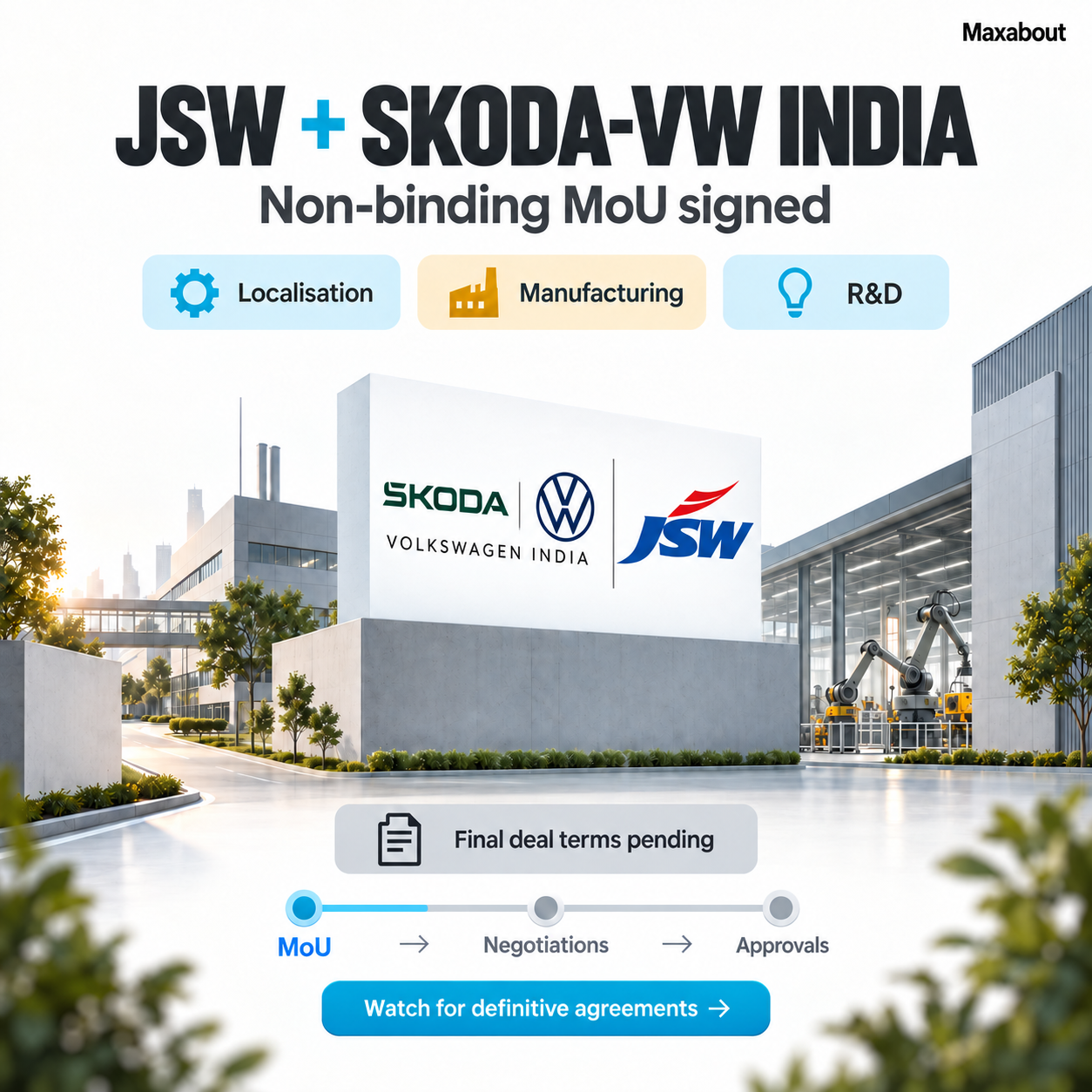
What the JSW Skoda Volkswagen India MoU covers
The confirmed themes are broader than a single vehicle programme. The companies are exploring localisation, manufacturing and R&D cooperation, alongside a structure involving joint control. That could eventually affect how vehicles and components are developed or built for India, but no specific production allocation or launch has been confirmed.
Some reports have discussed possible ownership ratios and future vehicle architectures. These should be treated as negotiation-stage reporting rather than final deal terms. The signed MoU itself does not establish a completed 51:49 venture, a fixed investment amount or a committed model plan.
Why localisation is central
Greater localisation can reduce exposure to imported parts, improve supply-chain control and make it easier to adapt products for Indian conditions. For a global manufacturer, a strong local partner may also support sourcing, manufacturing scale and capital deployment. For JSW, an alliance could deepen its position in the mobility sector.
However, localisation ambitions do not immediately translate into lower prices. Pricing depends on the eventual product plan, volumes, taxes, component costs and competitive positioning. Buyers should not expect near-term price changes merely because an MoU has been signed.
What car buyers should watch next
Definitive agreements: these would turn the broad MoU into binding commercial terms.
Ownership and investment: the final equity split and capital commitments remain open.
Regulatory approvals: the proposed structure may require formal clearances before closing.
Product decisions: confirmed platforms, models, localisation levels and launch timelines are still awaited.
The current milestone is therefore best read as a signal of serious intent. It advances the discussion beyond exploratory talks, while leaving the commercially important questions unresolved. Until binding agreements are announced, claims about an acquisition, guaranteed model launches or fixed pricing would run ahead of the evidence.
Explore the story
Related news

Share your view and join the discussion.
Earn reward points for every comment and get a chance to win ₹1,000 in our weekly lucky draw. Sign in with Google in one tap.
Start the conversation
No one has commented on this article yet. Be the first to share your view.
Want to read more automotive news?
Stay updated with the latest car launches, reviews, and industry insights.
Browse All News