
JK Tyre plans another 4–5% price hike: what replacement buyers should check
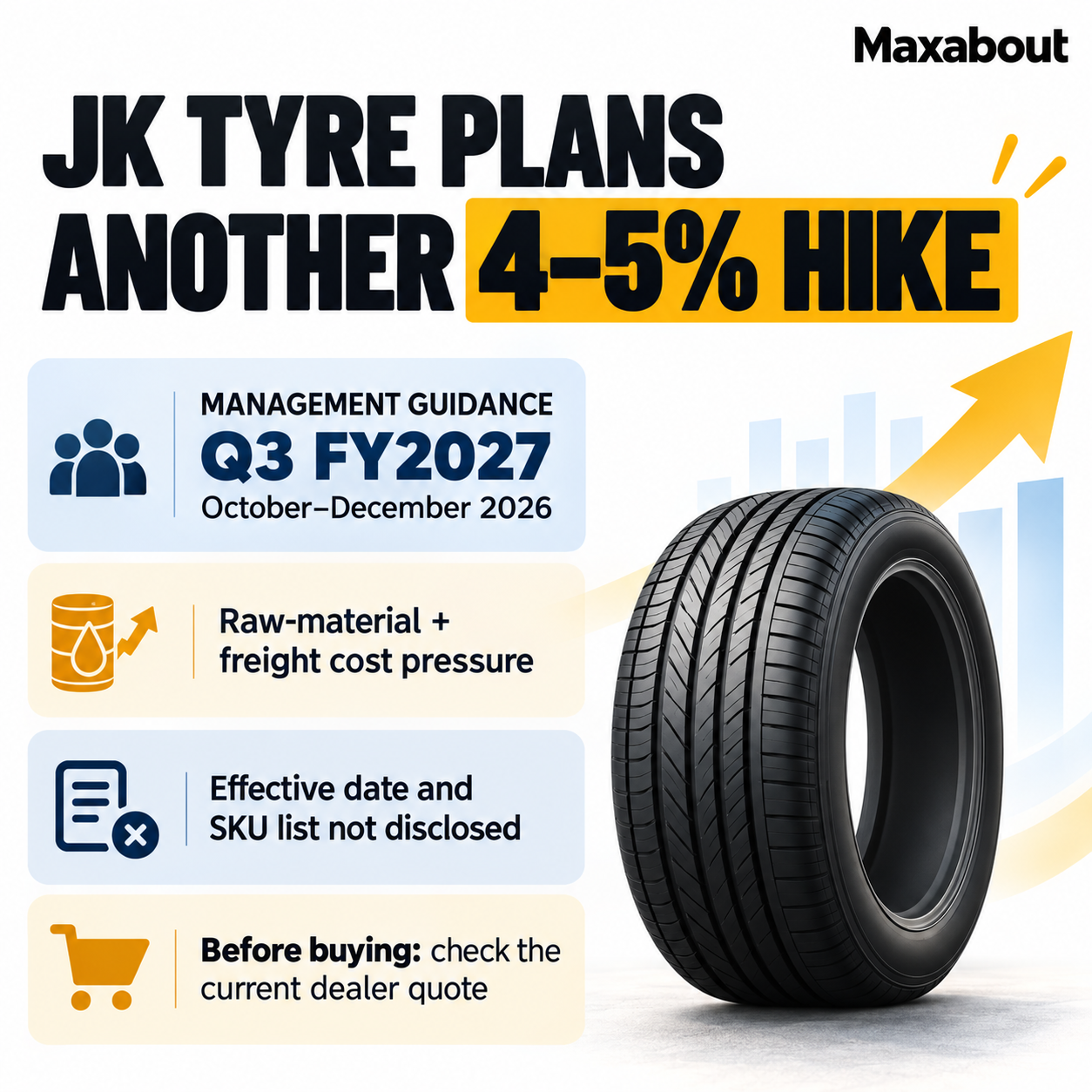
JK Tyre plans a further 4–5% price increase in the October–December 2026 quarter, according to management comments reported after its quarterly results. The company cites elevated raw-material and container-freight costs. For replacement buyers, the distinction is important: this is a stated pricing...
JK Tyre plans a further 4–5% price increase in the October–December 2026 quarter, according to management comments reported after its quarterly results. The company cites elevated raw-material and container-freight costs. For replacement buyers, the distinction is important: this is a stated pricing plan for Q3 FY2027, not a published tyre-size price list confirming that every product has already become dearer by the same percentage.
What is known about the planned increase?
Planned amount: another 4–5%.
Period: Q3 FY2027, the October–December 2026 quarter.
Reason given: higher raw-material and container-freight costs.
Still undisclosed: an exact effective date, tyre-size or SKU list and channel-by-channel implementation.
Why a headline percentage is not an exact replacement bill
The announced range describes management's intention. It does not identify a new selling price for a particular tyre size, load/speed specification or product line. It also does not establish whether a particular dealer's current quotation already reflects a change.
A useful purchase comparison therefore starts with the same exact tyre specification and a current quotation. Check the product, size, quantity and included charges together. Comparing one headline percentage with an older bill for a different specification can give a misleading impression of the actual change.
What management said about earlier increases
The latest plan follows earlier price revisions in the first half of the financial year. The checked coverage describes a first-quarter increase of around 4–5% and a second-quarter increase of 7%, with management putting the first-half cumulative increase at roughly 11–12%.
Those are reported company-level descriptions. They should not be mechanically added to the planned Q3 range to create a new exact cumulative increase for every tyre. The product mix, timing, channel and price base matter, and a complete SKU-level history has not been disclosed in the checked material.
Raw materials and freight explain the pressure
Management says higher input costs continue to weigh on profitability even as domestic demand grows. The reported results show revenue growth alongside a fall in profit and operating margin, illustrating why sales growth does not automatically remove cost pressure.
The company is seeking to pass through higher costs over time. The coverage also describes a lag between raw-material movements and selling-price revisions, with index-linked arrangements in the original-equipment business affecting when changes are reflected.
That helps explain why the timing of a company-level price plan should not be assumed to match every retail counter immediately. It does not establish a particular dealer discount, replacement-market increase or OEM contract change.
Questions to ask before placing an order
What is the exact tyre? Match the product and size rather than comparing different specifications under the same brand name.
How current is the quotation? Ask for its date, validity and the price that will apply when the order is fulfilled.
What is included? Clarify the quantity and any quoted fitting or other charges before comparing totals.
Has this product's price changed? Ask for confirmation for the particular SKU instead of assuming the whole range has moved by 4–5%.
Key details at a glance
| Question | Position in the checked announcement |
|---|---|
| How much is planned? | A further 4–5% company-level price increase |
| When? | Q3 FY2027 / October–December 2026 |
| What costs are cited? | Raw materials and container freight |
| Is there an exact implementation date? | Not disclosed in the checked material |
| Is every tyre affected equally? | No uniform SKU-level change is established by the guidance |
FAQs
Have all JK Tyre products already become 4–5% more expensive?
The checked statement sets out a plan. It does not establish implementation for every product or dealer quotation.
Can the earlier and planned increases be added into one exact total?
Not for an individual tyre without the relevant price bases and implementation history. Retain management's approximate first-half description and treat the Q3 plan separately.
The practical takeaway from the JK Tyre price-hike plan is to check a current, like-for-like quotation. Management's intended 4–5% increase explains the direction of pricing pressure, while the exact purchase cost still depends on the product and terms actually offered.
Explore the story
Related news


Share your view and join the discussion.
Earn reward points for every comment and get a chance to win ₹1,000 in our weekly lucky draw. Sign in with Google in one tap.
Start the conversation
No one has commented on this article yet. Be the first to share your view.
Want to read more automotive news?
Stay updated with the latest car launches, reviews, and industry insights.
Browse All News