
India's Ethanol Roadmap: E85 & E100 Timeline Explained
India's Ethanol Roadmap: Understanding the E85 and E100 TimelineThe Indian government has been quietly revolutionizing our fuel ecosystem with an ambitious ethanol blending program. What started as a modest initiative has evolved into a comprehensive roadmap toward greater energy independence and re...
Editorial Team
India's Ethanol Roadmap: Understanding the E85 and E100 Timeline
The Indian government has been quietly revolutionizing our fuel ecosystem with an ambitious ethanol blending program. What started as a modest initiative has evolved into a comprehensive roadmap toward greater energy independence and reduced emissions.
Ethanol is essentially alcohol derived from plant materials—primarily sugarcane and food grains in India's case. The current E20 program (20% ethanol blended with 80% petrol) is already being rolled out, but the government isn't stopping there. The next frontier includes E85 (85% ethanol) and eventually E100 (pure ethanol fuel).
Why this push? I think it makes perfect sense when you consider our national priorities:
Reduced oil imports - potentially saving billions in foreign exchange
Support for our agricultural sector - creating additional demand for crops
Lower emissions - ethanol burns cleaner than conventional fuels
For the average vehicle owner, this transition means potential changes to fuel costs, possible modifications to existing vehicles, and new options when purchasing future vehicles. The timeline stretches across this decade, giving both manufacturers and consumers time to adapt.
The Technical Differences: E20 vs E85 vs E100 Explained
Understanding ethanol blends is simpler than it sounds. The numbers actually tell you exactly what's in the fuel - E20 contains 20% ethanol and 80% petrol, E85 has 85% ethanol and 15% petrol, while E100 is pure ethanol with no petroleum component.
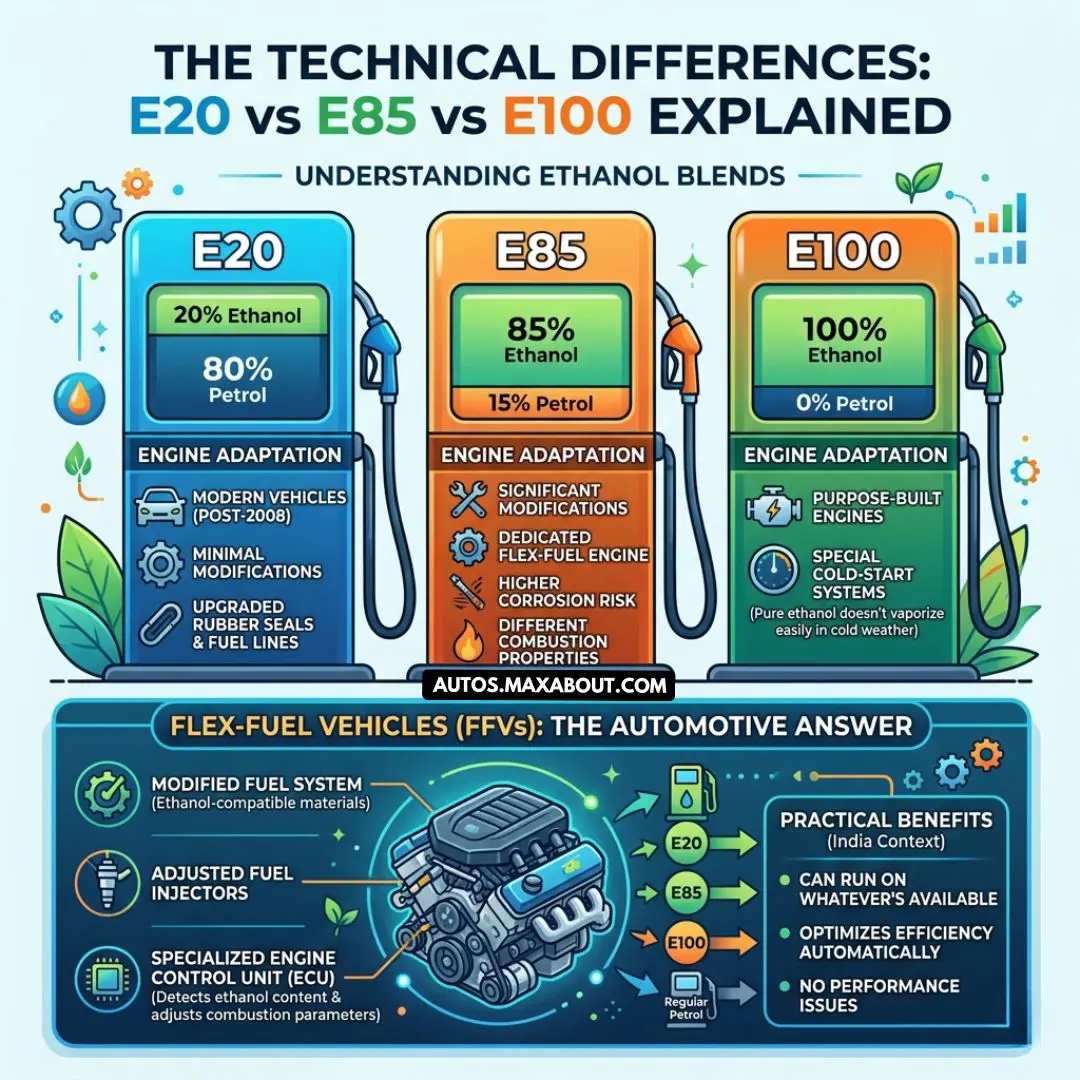 Each blend requires different levels of engine adaptation:
E20 - Most modern vehicles (post-2008) can run on this with minimal modifications. Some rubber seals and fuel lines might need upgrades.
E85 - Requires significant modifications or a dedicated flex-fuel engine. The higher ethanol content is more corrosive and has different combustion properties.
E100 - Demands purpose-built engines with special cold-start systems (pure ethanol doesn't vaporize easily in cold weather).
Flex-fuel vehicles (FFVs) are the automotive industry's answer to this transition. What makes them special? They contain modified fuel systems with ethanol-compatible materials, adjusted fuel injectors, and specialized engine control units that can detect the ethanol content and adjust combustion parameters accordingly.
In practical terms, this means a flex-fuel vehicle in India could run on whatever's available - from regular petrol to E20, E85, or even E100 in some cases - without any performance issues. The engine automatically adapts to optimize efficiency based on what's in your tank.
Implementation Timeline: When Will E85 and E100 Reach Indian Pumps?
The government has outlined an ambitious rollout plan for higher ethanol blends. Based on official announcements, E85 is scheduled to begin appearing at select pumps in major metropolitan areas by late 2023, with a small network of around 50-60 stations as a pilot project.
The phased implementation looks something like this:
Phase 1 (2023-2024): E85 pilot projects in Delhi, Mumbai, Bangalore, and Pune
Phase 2 (2024-2026): Expansion to all major cities and state capitals
Phase 3 (2026-2030): Nationwide availability of both E85 and E100
E100 faces more significant infrastructure challenges, so it's following a more cautious timeline. Maharashtra and Uttar Pradesh, with their strong sugarcane industries, will likely see the first E100 pumps around mid-2024.
I think the most realistic timeline will depend on overcoming several hurdles: establishing reliable ethanol production capacity, upgrading the fuel distribution infrastructure, and dealing with seasonal supply variations. While the government's targets are ambitious, I expect we'll see widespread E85 availability only by 2025-26, with E100 following a year or two later.
What E85 and E100 Mean for Vehicle Owners
For existing vehicle owners in India, the transition to higher ethanol blends presents both challenges and opportunities. Most vehicles currently on Indian roads are designed for E10 (10% ethanol) or E20 at most, making compatibility a significant concern.
If you own a vehicle manufactured before 2020, it likely isn't fully compatible with E85 or E100 fuels. Using these higher blends could potentially damage fuel system components like rubber seals and plastic parts that weren't designed to handle ethanol's corrosive properties. I've noticed that manufacturers like Maruti Suzuki and Tata have only recently begun mentioning "ethanol-ready" features in their newer models.
In terms of performance, expect about 20-30% lower fuel efficiency with E85 compared to petrol, as ethanol has lower energy content. This means more frequent refueling stops, especially during long highway journeys between cities like Mumbai and Pune where fuel stations might be limited.
What this means for your warranty: Using E85 in non-compatible vehicles will likely void your warranty. Manufacturers like Hyundai and Honda have already indicated that warranty terms may change as these fuels roll out.
For future vehicle buyers, flex-fuel vehicles (FFVs) designed to run on any blend from E0 to E85 will become increasingly common. These will feature modified fuel systems, different engine calibrations, and special materials for ethanol compatibility. Expect a slight price premium of around ₹15,000-25,000 for these modifications.
Biodiesel's Position in India's Alternative Fuel Strategy
While ethanol dominates the headlines, biodiesel occupies a different corner in India's alternative fuel ecosystem. Unlike ethanol's focus on passenger vehicles, biodiesel is primarily targeted at commercial and heavy transport segments. I've noticed this strategic differentiation makes perfect sense when you consider India's diverse transportation needs.
From what I understand, biodiesel offers superior lubricity and higher energy density compared to ethanol, making it particularly suitable for diesel engines in trucks, buses, and agricultural equipment. The government appears to be pursuing a two-pronged approach – ethanol for personal mobility and biodiesel for commercial transport.
The production pathways differ significantly too. While ethanol relies on sugarcane and surplus food grains, biodiesel utilizes non-edible oil sources like jatropha and used cooking oil through the RUCO (Repurpose Used Cooking Oil) initiative. This addresses both waste management and fuel production.
However, biodiesel faces more significant implementation challenges in India. The fragmented collection infrastructure for feedstock and higher production costs (approximately ₹15-20 per liter more than conventional diesel) have slowed its adoption. The government's 5% biodiesel blending target has consistently fallen short, achieving only about 0.1-0.2% nationwide.
Economic Impact: Pricing, Subsidies, and Market Dynamics
When E85 and E100 fuels arrive in India, expect pricing to be the key adoption driver. Based on current projections, E85 could be priced approximately 15-20% lower than conventional petrol, making it an attractive option for cost-conscious consumers. E100, while potentially even cheaper, will likely see its price advantage partially offset by its lower energy density (requiring more frequent refueling).
The government appears ready to support this transition through various financial mechanisms. I anticipate subsidies of around ₹3-5 per liter initially to incentivize adoption, alongside tax benefits for ethanol producers and possibly reduced GST rates on flex-fuel vehicles.
From a macroeconomic perspective, widespread ethanol adoption could significantly reduce India's fuel import bill - potentially saving ₹30,000-40,000 crore annually at scale. For our rural economy, this represents a massive opportunity, potentially generating ₹20,000 crore in additional income for sugarcane farmers while creating an estimated 5-6 lakh jobs in distillation and distribution.
The market dynamics will likely favor regions with strong sugarcane production initially, with states like Maharashtra, Uttar Pradesh and Karnataka seeing faster adoption due to more robust supply chains and potentially stronger local incentives.
Environmental Benefits and Challenges
Looking at the environmental picture, higher ethanol blends offer significant benefits in reducing greenhouse gas emissions. E85 can cut CO2 emissions by approximately 35-40% compared to conventional petrol, while E100 pushes this reduction even further. In the Indian context, where air pollution is a critical issue in major cities, this represents a tangible improvement in urban air quality.
However, I think we need to consider the full ecological footprint. Expanding sugarcane cultivation for ethanol raises legitimate concerns about water usage – especially concerning given that many Indian agricultural regions already face water stress. A hectare of sugarcane requires roughly 20,000-30,000 cubic meters of water annually, significantly more than many other crops.
The food versus fuel debate also deserves attention. Using agricultural land for fuel production could potentially impact food prices, though India's periodic sugar surpluses somewhat mitigate this concern in the short term.
When compared to electric mobility, ethanol presents a mixed picture. While EVs offer zero tailpipe emissions, their overall environmental impact depends heavily on how electricity is generated. Given India's current coal-heavy power mix, ethanol might actually offer comparable lifecycle emissions benefits while requiring far less infrastructure investment upfront.
Industry Preparedness: How Manufacturers and Infrastructure Are Adapting
The transition to higher ethanol blends is seeing varied responses from manufacturers in India. Maruti Suzuki has been particularly proactive, announcing plans to introduce flex-fuel vehicles capable of running on E85 blends by 2025. Toyota, leveraging its global experience with flex-fuel technology in Brazil, is also adapting several models for the Indian market.
I've noticed Tata Motors making significant strides too, having already conducted extensive testing of their engines with higher ethanol percentages. Meanwhile, Hyundai appears to be taking a more cautious approach, though they've committed to offering flex-fuel variants once the regulatory framework solidifies.
Infrastructure remains a challenge. Currently, there are fewer than 100 E85 pumps nationwide, mostly concentrated in Maharashtra and Uttar Pradesh. The oil marketing companies have outlined plans to establish at least 2,000 high-blend ethanol stations across major corridors by 2026, though I think this timeline seems ambitious given the current pace.
For vehicle owners, the transition will require minimal changes for E20 compatibility, but E85 and E100 will demand substantial modifications to fuel systems and engine calibration. Most manufacturers are focusing on new models rather than retrofitting existing ones, which makes sense from an engineering perspective.
Conclusion: What Two-Wheeler Owners Should Know and Do
As a two-wheeler owner in India, the ethanol roadmap has several important implications. If you're riding a newer model (post-2020), your vehicle is likely already E20 compatible, but not suited for E85 or E100 without significant modifications.
When purchasing a new motorcycle or scooter, I recommend specifically asking dealers about ethanol compatibility levels. Some manufacturers like TVS and Bajaj are already highlighting their "flex-fuel ready" options, which could be a smart long-term investment.
For existing vehicle owners, check your owner's manual or contact your service center to confirm compatibility. Using higher ethanol blends in incompatible vehicles risks fuel system damage and voided warranties.
Performance-wise, expect slightly lower mileage (5-7%) with higher ethanol blends, though maintenance requirements should remain similar. As for resale value, E20-compatible models will likely hold their value better as the transition progresses.
The most practical approach is to stay informed but not panic - this transition will happen gradually, giving most riders sufficient time to adapt.
No comments yet
Be the first to share your thoughts!
Want to read more automotive news?
Stay updated with the latest car launches, reviews, and industry insights.
Browse All News