
India Used Car Market to Hit $70 Billion by FY31
$70 billion. Let that number sink in for a moment. That's where India's used car market is projected to land by FY31 — and honestly, it doesn't surprise me one bit.Think about what's happening on the ground. In Pune, a young professional picks up a two-year-old hatchback instead of stretching their ...
Editorial Team
$70 billion. Let that number sink in for a moment. That's where India's used car market is projected to land by FY31 — and honestly, it doesn't surprise me one bit.
Think about what's happening on the ground. In Pune, a young professional picks up a two-year-old hatchback instead of stretching their budget on a new one. In Hyderabad, a family upgrades to a pre-owned SUV that would've been completely out of reach brand new. In Lucknow, a first-time buyer walks into an organized dealership — not a dusty roadside lot — and drives away with a certified, warranty-backed vehicle. This is the new normal.
The used car space in India has quietly undergone a serious transformation. What was once a fragmented, trust-your-luck kind of market has evolved into something far more structured. Better inspection standards, financing options, and digital platforms have changed how people buy and sell pre-owned vehicles.
And this growth matters for real buyers. More competition means better deals. More organized players mean improved accountability. More options mean smarter choices. If you've ever considered buying a used car — or selling one — understanding where this market is headed could genuinely save you money and stress. That's exactly what we're going to unpack here.
What's Actually Driving This Massive Growth in Pre-Owned Car Sales
The short answer? New cars have become genuinely expensive. A decent entry-level hatchback now easily crosses ₹7–8 lakh on-road, and anything with a bit of feature content pushes well past ₹10 lakh. For a first-time buyer in Kanpur, Rajkot, or Coimbatore, that's a serious financial commitment. A two or three-year-old version of the same car, with similar features, often comes in ₹3–4 lakh cheaper. That gap is hard to ignore.
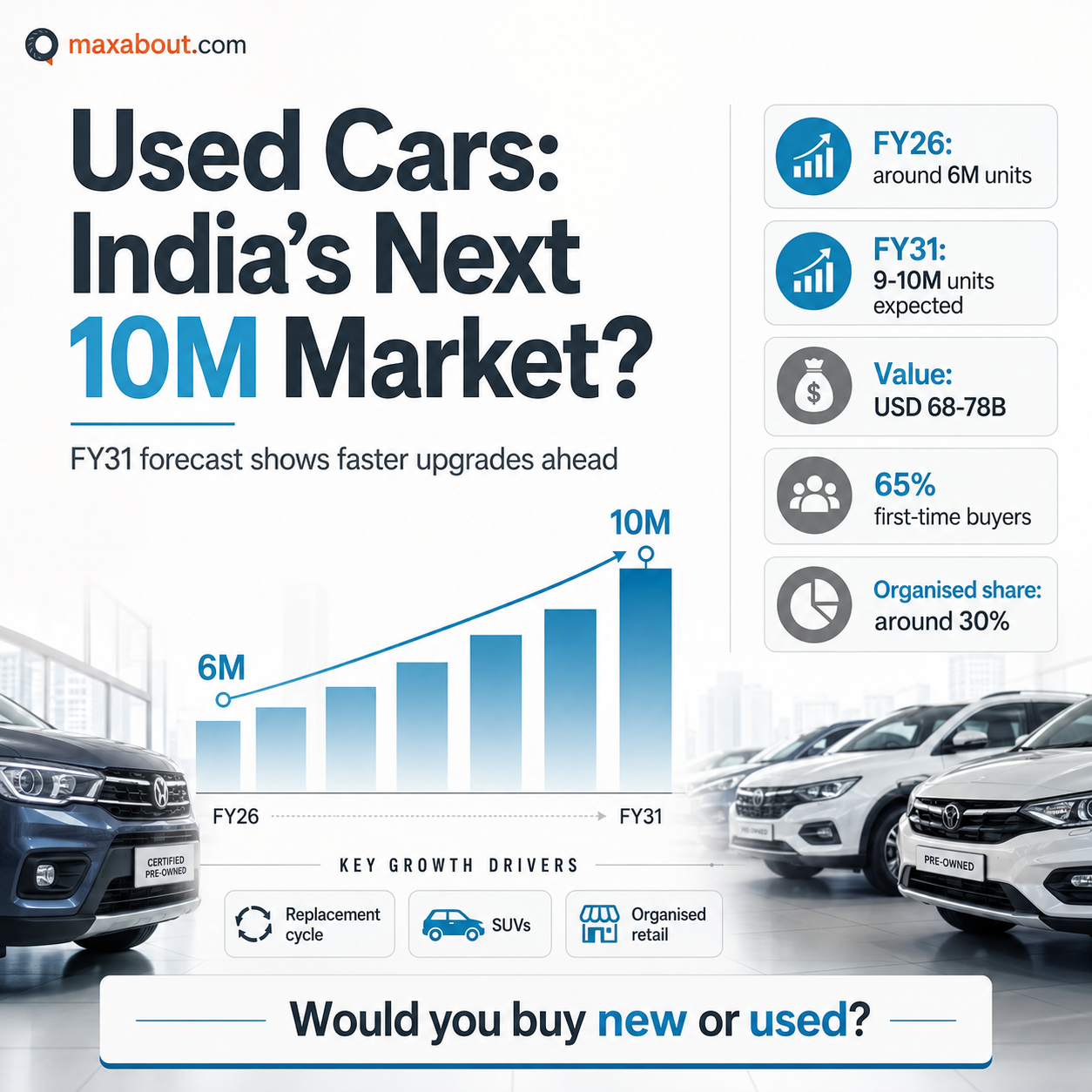 But price alone doesn't explain everything. The organized sector's expansion has arguably been the bigger structural shift. When certified pre-owned programs started offering proper inspections, documented service histories, and actual warranties, buyer hesitation dropped considerably. From what industry observers consistently note, trust was always the missing ingredient in used car transactions. That's now being addressed — systematically.
Digital platforms have played a quiet but powerful role here too. Being able to compare multiple vehicles across cities, check ownership history, and read detailed condition reports from your phone has fundamentally changed buyer confidence. Transparency that simply didn't exist a decade ago is now expected as standard.
Then there's the financing angle. Banks and NBFCs have become noticeably more comfortable lending against used vehicles — better loan-to-value ratios, longer tenures, faster approvals. This has effectively brought a whole new segment of buyers into the market, particularly younger professionals making their first major purchase decision with a pragmatic eye on value rather than prestige.
Organized vs Unorganized: The Structural Shift That's Changing Everything
For most of India's automotive history, buying a used car meant knowing someone who knew someone. A local dealer operating out of a modest roadside lot, a neighbor selling their old sedan, or a classified listing with a phone number and a prayer. That ecosystem — informal, relationship-driven, and largely undocumented — still accounts for the majority of used car transactions today. Especially in Tier 2 and Tier 3 towns, this unorganized segment isn't going anywhere soon.
And honestly, it has real advantages. Price flexibility is the obvious one. Without overhead costs from refurbishment centers or franchise fees, independent sellers and small dealers can negotiate hard. For a buyer who knows cars, who can inspect a vehicle themselves or bring along someone who can, the unorganized market often delivers better value per rupee spent.
But something meaningful is shifting at the other end. The organized segment — manufacturer-certified programs, large multi-brand dealers, and digital-first platforms — is steadily gaining ground, particularly in metros like Bengaluru, Pune, and Delhi NCR. What they're offering isn't just a cleaner showroom. It's documented service history, standardized inspection reports, return windows, and warranties. For a first-time used car buyer with no mechanical background, that structure carries genuine weight.
The trade-off is real, though. Organized channels typically price vehicles higher to recover reconditioning and operational costs. Whether that premium is worth it depends entirely on the buyer's risk appetite and technical knowledge.
What a ₹70 Billion Market Means for Buyers: More Choices, But Also More Complexity
A bigger market sounds like good news for buyers, and in many ways it is. More inventory, more price points, more variety. But here's the honest reality — scale also brings confusion. When thousands of listings compete for your attention, knowing which ones to trust becomes its own challenge.
Depreciation curves alone can trip up unprepared buyers. A three-year-old diesel SUV might look attractively priced until you factor in higher maintenance cycles approaching. Understanding where a specific model sits on its depreciation trajectory — whether it's still falling sharply or beginning to stabilize — genuinely affects whether you're getting value or inheriting someone else's problem.
Then there's the paperwork reality. RC transfers, loan clearance certificates, insurance transfers — none of this is particularly straightforward. Insurance transfer has quirks most buyers discover only after the purchase. Loan clearance verification requires checking with the financier directly, not just taking the seller's word.
Physical condition checks matter equally. Flood-damaged vehicles and accident-repaired cars can present surprisingly well visually. An independent inspection from a trusted mechanic — not the seller's recommended one — is worth every rupee.
And that "certified" label? It doesn't mean the same thing everywhere. Certification standards vary considerably between platforms and dealers.
For buyers in Tier 2 cities like Nagpur or Coimbatore, organized options remain limited. Local dealer networks and personal references still carry most of the weight — which means due diligence becomes even more personal, and more essential.
Which Car Segments Are Seeing the Most Action in the Pre-Owned Space
Not every segment moves equally in the used car market. Some categories consistently draw crowds, while others stay quiet. And the patterns are quite telling about how Indian buyers actually think.
Hatchbacks remain the backbone of pre-owned buying. The Maruti Swift, Hyundai i20, and Wagon R dominate entry-level used car searches — largely because spare parts are cheap, service centers exist even in smaller towns, and running costs stay predictable. For a first-time buyer in Lucknow or Bhopal working with a tight budget, a well-maintained Swift at ₹4–5 lakh still makes enormous practical sense.
But the more interesting story is happening one segment up. Pre-owned compact SUVs — particularly the Hyundai Creta and Kia Seltos — are seeing genuinely strong demand. The logic is straightforward: buyers who cannot stretch to a new Creta at ₹17–18 lakh are discovering they can own a two or three-year-old one for considerably less. More road presence, better features, without the full new-car price.
Diesel variants in this segment deserve a specific mention. On long highway runs — think Mumbai to Pune or Delhi to Chandigarh regularly — the fuel cost difference adds up meaningfully. Diesel used cars had fallen out of favour for a while, but practical economics on Indian highways are bringing buyers back.
Then there is the quieter but growing world of used luxury cars. A pre-owned BMW 3 Series or Mercedes C-Class at ₹20–25 lakh attracts buyers who want the badge and the cabin experience without new-car depreciation hitting them immediately. The catch, of course, is maintenance costs — which is why proximity to authorized service centers in cities like Hyderabad or Pune genuinely influences these purchase decisions.
The Role of Technology and Digital Platforms in Building Buyer Trust
Something genuinely interesting has shifted in how people approach used car buying. A few years ago, the information advantage sat almost entirely with the dealer. They knew what the car was worth. The buyer guessed. That gap is closing fast, and technology is the reason.
AI-based pricing engines now pull together thousands of data points — mileage, registration year, city, service history, accident records — and spit out a reasonably accurate market value within seconds. A buyer sitting in Nagpur or Coimbatore no longer has to rely on gut feeling or whatever number a dealer presents with a straight face. They can cross-check instantly. That shift in leverage is significant.
Vehicle history reports have added another layer of confidence. Knowing whether a car has a clean title, how many owners it has had, or whether it was involved in a major accident — this used to require connections or luck. Now it requires a registration number and a few minutes.
Doorstep test drives and home delivery models, offered by several organized platforms, have made the process feel closer to buying something on an e-commerce site. For buyers in smaller cities where quality used car inventory was traditionally thin, this kind of reach genuinely matters.
But — and this needs saying clearly — none of this replaces a physical inspection by a trusted mechanic. Photos can be carefully framed to hide panel damage. Listings sometimes carry outdated or optimistic mileage figures. Virtual inspections, however thorough they appear, have real limits. Before any used car purchase, getting an independent mechanical check done remains the single most important step a buyer can take.
Challenges That Could Slow Down or Complicate This $70 Billion Dream
The projections are exciting. But before getting swept up in the numbers, it's worth asking — what could realistically get in the way?
Start with documentation. RC transfers remain a genuine headache across India, largely because vehicle ownership rules aren't uniformly applied between states. A car bought in Maharashtra and transferred to Karnataka can trigger a paperwork maze that takes weeks, sometimes months, to resolve. For first-time buyers unfamiliar with the process, this friction alone can kill an otherwise good deal.
Then there's the absence of a standardized national inspection framework. Unlike mature markets where certified pre-owned programs carry legal weight and consistent inspection protocols, India's certification landscape is still fragmented. One dealer's "fully inspected" claim means something very different from another's.
Financing gaps add another layer of difficulty. Buyers with thin credit histories — particularly in smaller towns and rural areas — often find used car loans either unavailable or priced at rates that make the purchase barely sensible.
Odometer fraud and undisclosed accident histories remain stubborn problems too. And rising used car prices, a lingering post-pandemic effect, have quietly narrowed the gap with entry-level new cars in certain segments — which genuinely weakens the used market's core value proposition.
None of this makes the $70 billion target impossible. But these aren't minor footnotes — they're structural issues that the industry will need to honestly confront.
Should You Buy a Used Car Right Now — Or Wait and Watch?
Honestly? It depends heavily on who you are and what you're looking for. The market isn't uniformly good or bad for buyers right now — it's uneven, and that nuance matters.
If you're in a metro city — Bengaluru, Pune, Delhi, Mumbai — hunting for a 2-4 year old compact SUV like a Creta or Seltos, this is probably a reasonable time to buy. Inventory is decent, organized platforms have better coverage in these cities, and certified pre-owned programs give you some peace of mind. You have options, leverage, and recourse if things go wrong.
But if you're looking for a diesel sedan in a smaller city, or chasing something very specific in a thin market? The balance tips toward sellers. Fewer choices, less organized support, and shakier inspection infrastructure mean you carry more risk.
Pricing is still stubbornly high in popular segments. Don't let the market's growth story rush your decision. A booming industry report doesn't mean every deal on the lot is a smart one.
My honest advice — get an independent mechanical inspection, not just the seller's certified stamp. Check service history records carefully. And if a price feels too close to a new car's on-road cost, step back and reconsider. The market looks exciting on paper. Your purchase needs to make sense in your driveway.
No comments yet
Be the first to share your thoughts!
Want to read more automotive news?
Stay updated with the latest car launches, reviews, and industry insights.
Browse All News