
India PV Sales Hit Record 4.37 Lakh Units in April 2026
India's passenger vehicle market just did something it has never done before. In April 2026, 4.37 lakh units were sold in a single month — a 25% jump year-on-year, according to SIAM data. That is not a small uptick. That is a record, and it deserves a moment of genuine reflection.To put this in pers...
Editorial Team
India's passenger vehicle market just did something it has never done before. In April 2026, 4.37 lakh units were sold in a single month — a 25% jump year-on-year, according to SIAM data. That is not a small uptick. That is a record, and it deserves a moment of genuine reflection.
To put this in perspective, April is historically not the strongest month for auto sales. The financial year has just begun, dealerships are recalibrating inventory, and consumers are often cautious after the previous quarter's spending. So hitting an all-time high specifically in April makes this number even more striking.
What does it actually mean? In my view, this is less about cars and more about confidence. Rising household incomes, better access to financing, and a growing preference for personal mobility over public transport — especially post-pandemic — are all converging at once. From what industry analysts have been observing, first-time buyers from Tier 2 and Tier 3 cities are increasingly driving these numbers.
This is not a temporary spike driven by a festival or a fleet purchase surge. It feels like something more structural — a middle class that is actively choosing to move up, and choosing four wheels as the most visible expression of that choice.
What Exactly Does SIAM's April 2026 Data Tell Us?
So let's actually unpack what this number means. When SIAM reports 4.37 lakh passenger vehicles sold in April 2026, they are not talking about one category. The "passenger vehicle" umbrella covers three segments — cars (sedans and hatchbacks), utility vehicles (SUVs, crossovers, MPVs), and vans. That combined figure, up 25% compared to April 2025, is the highest ever recorded for a single month in India's automotive history.
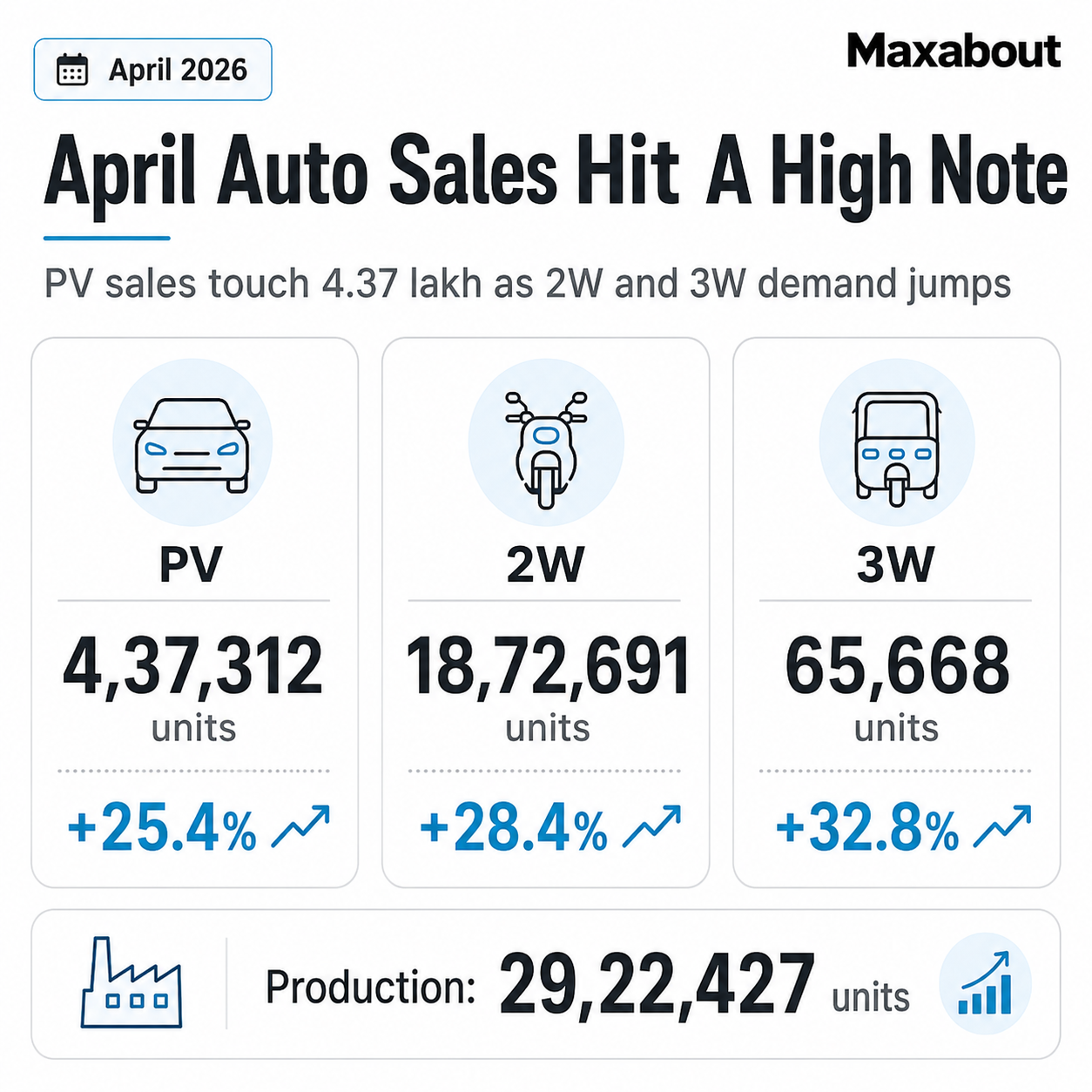 To put 25% in perspective — that is not a modest improvement. Most mature automotive markets consider 5-6% annual growth healthy. A single-month jump of a quarter over the previous year is genuinely significant, especially when the base period was not particularly weak.
Now, which segment is doing the heavy lifting here? Almost certainly utility vehicles. This has been the defining story of Indian PV sales for the better part of four years now. Compact SUVs and midsize SUVs have consistently outpaced sedans and hatchbacks — buyers are clearly prioritizing ground clearance, road presence, and perceived value. From what recent industry data consistently shows, UV sales now account for well over half of total PV volumes, a shift that would have seemed unlikely a decade ago.
The traditional hatchback, once the backbone of Indian car sales, has steadily lost ground — not because it disappeared, but because the SUV moved into territory that was previously considered aspirational.
The SUV Wave: Why Indians Are Choosing Bigger Vehicles Than Ever Before
It is not hard to understand why this shift happened. Spend an afternoon driving through the outskirts of Pune, or navigate a pothole-riddled stretch on the way to a Tier 2 town, and the appeal of extra ground clearance becomes immediately obvious. Indian roads — even in major cities — demand a vehicle that can absorb punishment without drama. SUVs, almost by design, fit that requirement better than most alternatives.
But ground clearance alone does not explain a decade-long cultural shift. Perceived safety, seating capacity, and social visibility all play equally important roles. A growing number of Indian families are prioritizing three-row configurations or at least the option of fitting four adults comfortably without feeling cramped. The compact SUV segment, in particular, has struck the right balance — offering SUV proportions at prices that were previously associated with premium hatchbacks.
That said, the picture is not entirely rosy. Owning a larger vehicle in a city like Mumbai or Delhi comes with real consequences — tighter parking, heavier fuel bills, and insurance costs that noticeably exceed smaller alternatives. These are practical trade-offs that many urban buyers are consciously accepting, which says a lot about how strongly the value proposition of SUVs resonates today.
First-Time Buyers vs Upgraders: Who Is Actually Driving This Growth?
The honest answer is — both groups are pulling hard, and in roughly equal measure. What makes April 2026's numbers particularly interesting is that this is not a single-cohort story. Two very different types of buyers showed up in showrooms last month, motivated by very different reasons, and the market absorbed them all.
First-time buyers, especially from Tier 2 and Tier 3 cities, are a genuinely significant force right now. Places like Indore, Coimbatore, Nagpur, and Lucknow are seeing a wave of aspirational buyers who have been waiting for the right combination of affordable EMIs and a product that feels worthy of the purchase. Entry-level hatchbacks still serve this segment, but from what industry data suggests, compact SUVs priced between ₹7 lakh and ₹11 lakh are increasingly the first choice — not the second.
Then there are the upgraders. Existing owners moving from a hatchback to a compact SUV, or from a sedan to a mid-size SUV. This cohort tends to be more deliberate, more research-driven, and frankly, more willing to stretch the budget. Rising disposable incomes and easier auto loan access have made that stretch feel far less risky than it once did.
Post-pandemic personal mobility preferences also continue to hold firm. The desire to own rather than depend on shared transport has not faded — it has quietly solidified into a long-term behavioral shift that keeps showroom footfall consistently strong.
The Role of New Model Launches and Feature Upgrades in Pulling Buyers to Showrooms
Of course, sustained demand only tells part of the story. What has genuinely accelerated footfall in April 2026 is the sheer volume and quality of new product hitting the market. Industry observers and automotive journalists have widely noted that the current product pipeline — across established manufacturers and newer entrants alike — is arguably the strongest it has been in years.
The feature story is particularly compelling. Connected car technology, ADAS, panoramic sunroofs, and large touchscreen infotainment systems — features that once felt exclusive to vehicles priced well above ₹20 lakh — are now standard conversation in the ₹10–15 lakh segment. That shift changes the buyer's perception dramatically. Walking into a showroom and finding level-2 safety assists or a wireless charging pad on a ₹12 lakh variant? That feels like genuine value, and buyers are responding to it.
Then there is the growing appeal of CNG and mild-hybrid options that sit comfortably between conventional petrol and full electric. For cost-conscious families watching monthly fuel bills closely — especially in cities like Pune, Ahmedabad, and Delhi — these powertrains offer a practical middle ground. Better fuel efficiency without the range anxiety or charging infrastructure concerns that still make many buyers hesitant about fully electric vehicles.
Simply put, manufacturers have given buyers strong reasons to visit showrooms — and even stronger reasons to sign on the dotted line.
Is the Indian EV Market Still Playing Catch-Up in This Record?
Here's the honest truth about this 4.37 lakh unit milestone — the overwhelming majority of those vehicles run on petrol or diesel. EVs, while growing steadily, still represent a relatively small slice of total passenger vehicle sales in India. Based on industry trends, electric vehicles likely account for somewhere between 2-4% of total PV volumes. Impressive momentum, yes. A dominant force? Not quite yet.
The reasons aren't surprising. Charging infrastructure outside major cities remains genuinely patchy. Plan a highway trip from Hyderabad to Tirupati or Bengaluru to Coorg, and range anxiety becomes very real, very fast. High upfront costs also remain a significant barrier for families already stretching budgets to afford their first car.
That said, urban buyers in Bengaluru, Hyderabad, and Pune are warming up to EVs noticeably faster than smaller cities. Short daily commutes, home charging convenience, and rising fuel costs are shifting attitudes gradually but meaningfully.
The record itself is genuinely impressive — but the more interesting question is what future records look like. Will EVs move from a footnote to a headline? The infrastructure investment, competitive pricing pressure, and buyer awareness needed to get there is building — just not fast enough to claim this particular milestone as an electric victory.
What This Sales Record Means for Buyers Right Now
Here is the uncomfortable truth about buying a car during a record-breaking sales month: the market is not working in your favour. When 4.37 lakh units move in a single month, dealers know it. And they act accordingly.
Waiting periods are the first thing to check. Popular compact SUVs — already the most competitive segment — tend to stretch delivery timelines when volumes spike. From what industry observers are noting, certain high-demand models are already sitting at six to ten week waits in major cities like Bengaluru, Pune, and Delhi. That number can quietly creep higher without much warning.
Discounts, meanwhile, tend to shrink or disappear entirely. When a dealer has a queue of buyers, the incentive to negotiate drops significantly. Cash discounts, accessories bundles, extended warranties thrown in — these become harder to extract from a showroom that is already moving inventory without effort.
That said, strong volumes do eventually push manufacturers to expand production capacity, which can ease availability over a few months. It is not immediate relief, but it is worth knowing.
Practical advice if you are considering a purchase right now: get the exact delivery date in writing, compare finance rates across at least two or three lenders rather than accepting the showroom's default offer, and resist the pressure of market excitement. A buzzing sales environment can create a false sense of urgency. The right vehicle at the right terms matters far more than timing your purchase to a headline.
Can India Sustain This Momentum? The Road Ahead for Passenger Vehicle Sales
The honest answer is: probably yes, but not in a straight line.
April 2026's record of 4.37 lakh units is striking, but context matters. April typically benefits from year-end fleet renewals, fresh model launches, and consumer sentiment riding the financial new year. Some of this volume reflects timing rather than a permanent structural shift. The monsoon months ahead — June through September — traditionally soften showroom footfall across the country. That seasonal dip is predictable and should not be read as a reversal.
What genuinely supports a higher long-term baseline is harder to dismiss. Rising per capita incomes, accelerating urbanization, and India's extraordinarily young demographic create sustained first-time buyer demand that few markets globally can replicate right now. Infrastructure development — better highways connecting tier-2 cities, expanding metro corridors pushing aspirational suburban growth — is quietly making vehicle ownership both more practical and more desirable for millions of households.
But risks are real. Global economic uncertainty affects export earnings and employment confidence. Fuel price volatility remains a persistent concern for buyers calculating long-term running costs. Any upward movement in interest rates would directly pressure EMIs, which is where most purchase decisions actually live for the majority of Indian buyers.
In the next two to three years, a realistic picture looks like steady growth with occasional choppy months rather than unbroken record-setting. The underlying demand story for India is structurally sound. April 2026 probably reflects both genuine momentum and some favorable timing — not purely one or the other. What it does say clearly is that India's automotive market has matured into something that global manufacturers can no longer treat as a secondary priority. That, more than any single monthly number, is the real milestone.
Explore the story
Related news



Share your view and join the discussion.
Earn reward points for every comment and get a chance to win ₹1,000 in our weekly lucky draw. Sign in with Google in one tap.
Start the conversation
No one has commented on this article yet. Be the first to share your view.
Want to read more automotive news?
Stay updated with the latest car launches, reviews, and industry insights.
Browse All News