
India EV policy beyond subsidies: what changes for buyers and industry
India's EV policy beyond subsidies is taking shape around supply-chain resilience, charging access and vehicle software security. In remarks reported from an industry conclave on 27 October 2026, Ministry of Heavy Industries Additional Secretary Dr Hanif Qureshi described a shift from early purchase...
India's EV policy beyond subsidies is taking shape around supply-chain resilience, charging access and vehicle software security. In remarks reported from an industry conclave on 27 October 2026, Ministry of Heavy Industries Additional Secretary Dr Hanif Qureshi described a shift from early purchase support towards strengthening the wider electric mobility ecosystem. The remarks outline policy direction, not a single new rule ending every EV incentive. Existing schemes and their category-specific conditions still matter to buyers, while manufacturers face a longer task: localising components and building reliable production capacity.
What is changing in the policy conversation?
Supply chains: domestic magnets, batteries and traction components are receiving attention alongside vehicle assembly.
Usability: charging and financing can influence adoption after the initial purchase decision.
Security: connected vehicles bring software and data-protection concerns into the industrial-policy discussion.
Status: reported intentions, tender targets and final operating rules must be kept separate.
Moving beyond subsidies does not mean all incentives have ended
Purchase incentives can help establish demand, while manufacturing and infrastructure programmes address different constraints. Reducing reliance on one form of support does not automatically remove the others.
PM E-DRIVE has an overall outlay of ₹11,900 crore and runs until 31 March 2028. That scheme-wide endpoint should not be read as an identical eligibility window for every vehicle category. Its L5 electric three-wheeler segment closed on 26 December 2025 after reaching its target, while support for electric rickshaws and carts continues under the broader programme. Buyers should check the exact vehicle category and applicable scheme conditions rather than rely on a blanket claim that EV subsidies are over.
Why rare-earth magnets matter
Rare-earth permanent magnets are used in applications including electric vehicle motors. Building a domestic chain from processed material to finished magnets can reduce exposure to imported components, but a tender announcement is only one stage of that process.
The existing magnet-manufacturing scheme targets 6,000 metric tonnes a year of integrated capacity. Qureshi reportedly said around 21–22 companies had bid and that five manufacturers would be selected. Those comments do not establish a final list of winners.
His estimate of commercial production in around 18 months, with a possible variation of six months either way, is a forward-looking projection. It should not be presented as a guaranteed commissioning date or an immediate change in vehicle availability.
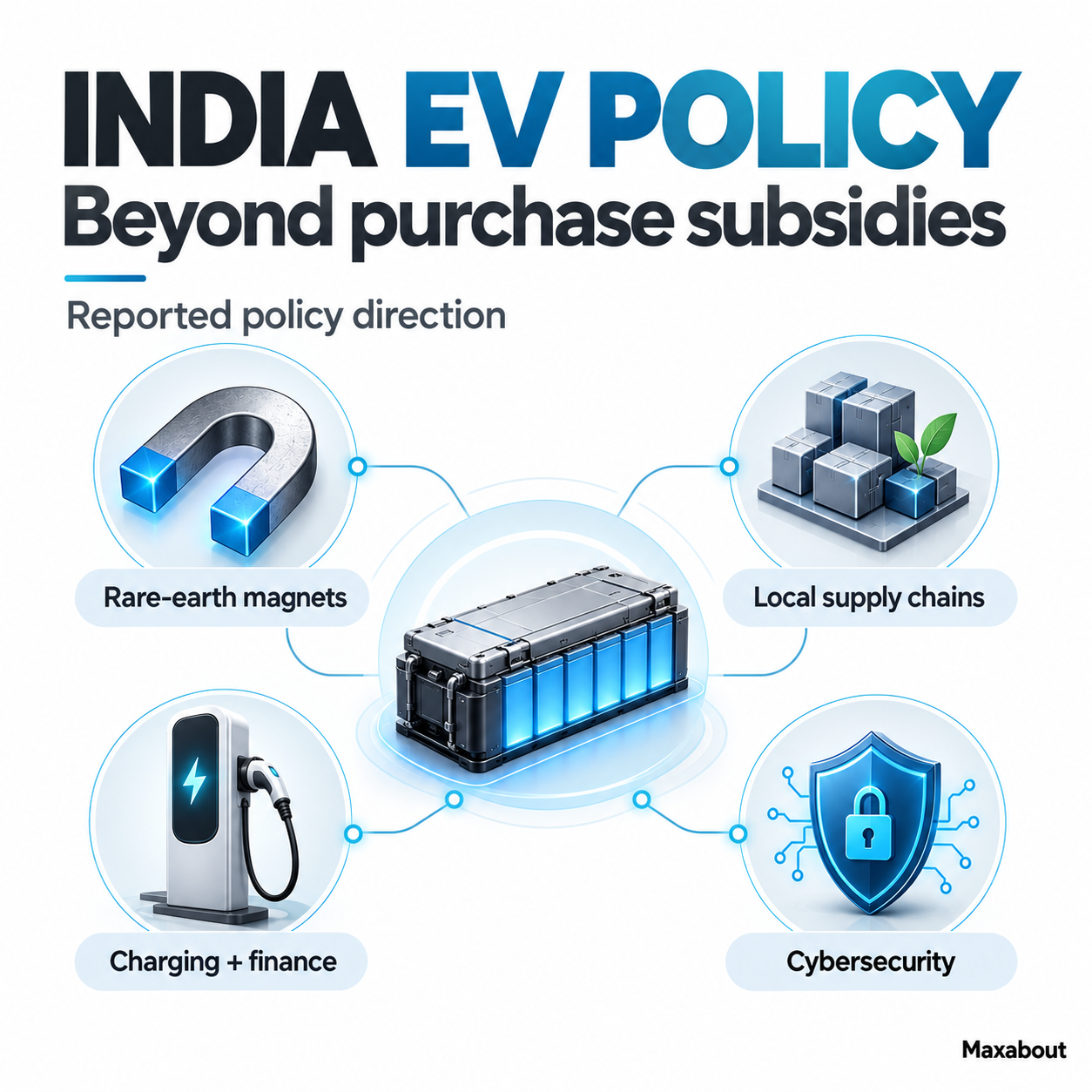
How the priorities affect buyers and manufacturers
| Priority | What it addresses | What to watch next |
|---|---|---|
| Local components and battery cells | Dependence on imported inputs and production bottlenecks | Commissioned, validated capacity rather than announced targets alone |
| Rare-earth magnets | A supply-chain constraint in important motor applications | Beneficiary awards and subsequent production milestones |
| Charging and finance | Everyday usability and the cost of adopting electric mobility | Reliable infrastructure and actual financing terms |
| Cybersecurity | Risks associated with connected software and vehicle data | Final requirements, implementation and continued software support |
Cybersecurity joins the EV ownership discussion
Qureshi highlighted vulnerabilities associated with automotive electronics and software, with work on cybersecurity and data protection involving the road transport ministry and automakers. The reported remarks do not establish a new compliance deadline for owners.
For buyers, the useful questions concern the manufacturer's software-update policy, support for connected functions and response to security issues. For suppliers, the challenge includes maintaining secure systems throughout a vehicle's life, rather than treating software as a one-time delivery.
What this means for India's electric vehicle market
Infrastructure, component availability and financing can shape demand alongside the purchase price. For people considering electric cars, localisation could strengthen supply resilience over time, but it does not by itself promise an immediate price reduction.
The reported approach also remains technology-neutral. Battery-electric vehicles sit within a broader transport strategy that includes other powertrains and fuels. That does not mean every technology receives identical incentives or faces the same operating requirements.
FAQs
Has India announced one new policy replacing all EV subsidies?
The conclave remarks describe a strategic direction. They do not replace the separate rules, eligibility conditions and timelines of existing programmes.
Have the magnet-scheme winners been confirmed?
The reported comments discuss bidders and intended selection. They do not constitute an award notification or identify a verified final beneficiary list.
Will localisation immediately make EVs cheaper?
No immediate price change follows automatically. Production costs, scale, technology, demand and commercial decisions also influence retail pricing.
India's EV policy beyond subsidies is best understood as a broader ecosystem effort. The next meaningful evidence will be final notifications, awarded projects, commissioned capacity and reliable services—not an assumption that every reported intention is already in force.
Explore the story
Related news
Share your view and join the discussion.
Earn reward points for every comment and get a chance to win ₹1,000 in our weekly lucky draw. Sign in with Google in one tap.
Start the conversation
No one has commented on this article yet. Be the first to share your view.
Want to read more automotive news?
Stay updated with the latest car launches, reviews, and industry insights.
Browse All News