
India EV Market Share Report: Tata Leads as Mahindra Dethrones MG Motor in H1 Sales
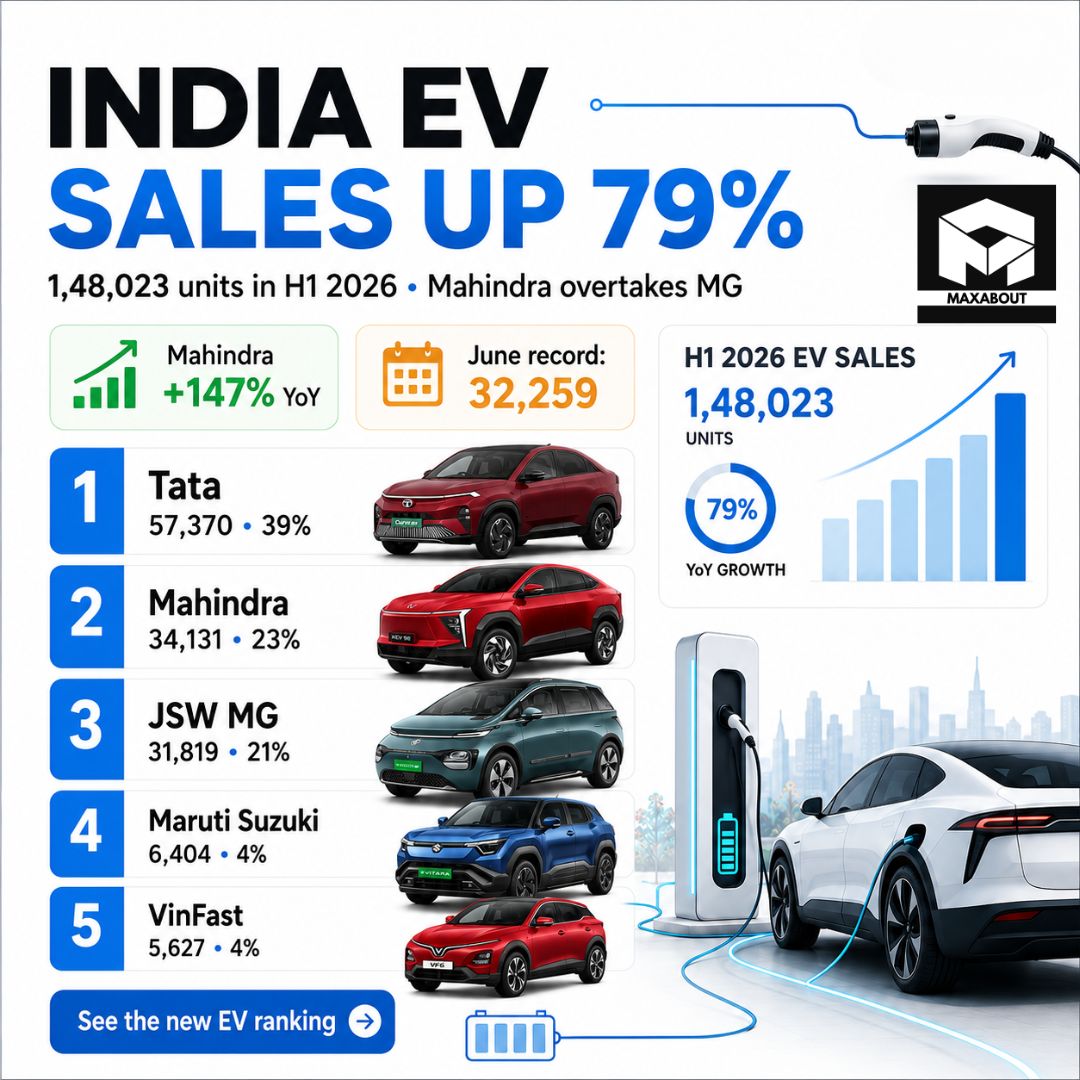
India’s passenger-vehicle electric market has had a decisive first half of 2026. Sales reached 148,023 EVs in January–June, up 79 percent from 82,535 in the same period of 2025, according to Autocar India. The headline is not just the rate of growth: Mahindra moved ahead of JSW MG Motor in the six-m...
Editorial Team
India’s passenger-vehicle electric market has had a decisive first half of 2026. Sales reached 148,023 EVs in January–June, up 79 percent from 82,535 in the same period of 2025, according to Autocar India. The headline is not just the rate of growth: Mahindra moved ahead of JSW MG Motor in the six-month ranking, while Tata Motors retained a substantial lead at the top.
India EV sales H1 2026: the ranking
| Rank | Maker | H1 2026 sales | Share | YoY change |
|---|---|---|---|---|
| 1 | Tata Motors | 57,370 | 39% | +82% |
| 2 | Mahindra | 34,131 | 23% | +147% |
| 3 | JSW MG Motor India | 31,819 | 21% | +18% |
| 4 | Maruti Suzuki | 6,404 | 4% | — |
| 5 | VinFast | 5,627 | 4% | — |
Shares and growth figures are rounded as reported; the table covers the leading makers reported by the source and should not be read as a complete model-by-model market census.
Mahindra takes second place, but Tata remains the benchmark
Mahindra’s 34,131 registrations put it 2,312 units ahead of JSW MG over the half year. That is a meaningful change in the competitive order because the two brands now account for 44 percent of the reported market between them. Mahindra’s 147 percent year-on-year growth was the fastest among the three largest players, but it is equally important not to overstate the result: Tata sold 23,239 more EVs than Mahindra and still held about 39 percent of the market.
For buyers, that spread matters. A fast-growing challenger can broaden choice, but Tata’s scale remains relevant when shoppers compare variants, service reach, used-market confidence and the practical support around a high-voltage vehicle. Market share is a snapshot, not a guarantee of ownership experience; local charging access and dealer capability still deserve a test before purchase.
A bigger market, not merely a reshuffle
The most useful reading of the H1 result is that the market expanded sharply while its leadership group diversified. Tata grew 82 percent year on year, so its lead was not created by rivals standing still. Mahindra gained rapidly, while MG also added volume despite a slower 18 percent growth rate. Maruti Suzuki and VinFast together contributed 12,031 units in the reported figures, showing that newer EV programmes are beginning to register at a national scale.
There is a useful distinction here. Autocar Professional reported total Indian retail EV sales across vehicle categories at about 1.56 million in H1 2026, up 44 percent year on year. Passenger EVs are only one part of that wider electrification story; do not compare the 148,023 passenger-vehicle figure directly with two- or three-wheeler totals.
Why the H1 numbers matter for an EV shortlist
Choice is widening: more serious participants can mean more body styles, battery sizes and price points, but specifications and delivery timelines remain model-specific.
Ownership homework still wins: verify home-charging feasibility, apartment permissions, public charging on regular routes and the nearest capable workshop before putting down a booking amount.
Compare the complete deal: on-road price, warranty terms, battery coverage, insurance and charging hardware can change the real cost more than a headline ex-showroom number.
Watch the next two quarters: H1 provides momentum, not a full-year forecast. Monthly mix can be affected by launches, supply, dispatch timing and fleet demand.
What to watch next
The new order places pressure on every major player. Tata has to defend a large base while the market grows around it. Mahindra has demonstrated a stronger run rate and will be watched for whether it can sustain that pace. MG’s next moves matter because a 21 percent share is still a powerful platform, not a marginal position. Maruti Suzuki and VinFast now have a visible foothold in the dataset, making product execution and customer support the next questions rather than mere market entry.
India’s H1 2026 passenger EV growth therefore deserves more than a “record sales” label. It is evidence of a market becoming broader and more competitive, while still being led by one established manufacturer. The next test is whether that competition translates into better products, clearer value and easier ownership for Indian customers.
Frequently asked questions
How many passenger EVs were sold in India in H1 2026?
Autocar India reported 148,023 units, 79 percent higher than the 82,535 reported for H1 2025.
Did Mahindra overtake MG in EV sales?
Yes. Mahindra reported 34,131 H1 2026 EV sales versus JSW MG Motor India’s 31,819, a margin of 2,312 units.
Which company led India’s EV market in H1 2026?
Tata Motors led the reported passenger-EV market with 57,370 units and an estimated 39 percent share.
Explore the story
Related news



Share your view and join the discussion.
Earn reward points for every comment and get a chance to win ₹1,000 in our weekly lucky draw. Sign in with Google in one tap.
Start the conversation
No one has commented on this article yet. Be the first to share your view.
Want to read more automotive news?
Stay updated with the latest car launches, reviews, and industry insights.
Browse All News