
India-EU FTA Car Import Duty Plan: 1 Lakh-CBU First-Year Quota Explained
The reported India-EU Free Trade Agreement car tariff schedule could open a substantially lower-duty route for selected European completely built-up cars, but it is not a showroom price cut yet. In the first year after the agreement enters into force, the plan is reported to cover 1,00,000 CBU inter...
Editorial Team
The reported India-EU Free Trade Agreement car tariff schedule could open a substantially lower-duty route for selected European completely built-up cars, but it is not a showroom price cut yet. In the first year after the agreement enters into force, the plan is reported to cover 1,00,000 CBU internal-combustion and non-plug-in hybrid cars. Within the quota, cars valued from €15,000 to €35,000 would attract 35% duty, while higher-value cars would attract 30%. The agreement still needs to be signed and complete internal procedures before these concessions can apply.
What you need to know
The reported first-year quota is 1,00,000 CBU cars, covering ICE and non-plug-in hybrid models.
Within the quota, the reported first-year duty is 35% for cars valued at €15,000–€35,000 and 30% for cars above €35,000.
Cars below €15,000 are not reported to receive the first-year concession.
The agreement is not yet signed or in force; implementation could follow only after the required procedures.
Battery-electric and plug-in hybrid vehicles are reported to receive separate preferential access from year five.
How the first-year import quota is reported to work
The 1,00,000-unit first-year allocation is not a blanket reduction for every European car sold in India. It is a quota for eligible CBU imports and is divided by customs value. The reported schedule assigns 34,000 units to the €15,000–€35,000 band, 33,000 units to the €35,000–€50,000 band and 33,000 units to vehicles above €50,000.
| Reported first-year price band | Quota | Within-quota duty |
|---|---|---|
| €15,000–€35,000 | 34,000 cars | 35% |
| €35,000–€50,000 | 33,000 cars | 30% |
| Above €50,000 | 33,000 cars | 30% |
| Below €15,000 | No first-year concession reported | Existing treatment would continue |
Cars imported outside these allocations would not automatically receive the quoted concessional rate. That distinction matters because quota availability, the qualifying customs value and the manufacturer's import plan could all affect whether a specific variant uses the lower-duty route.
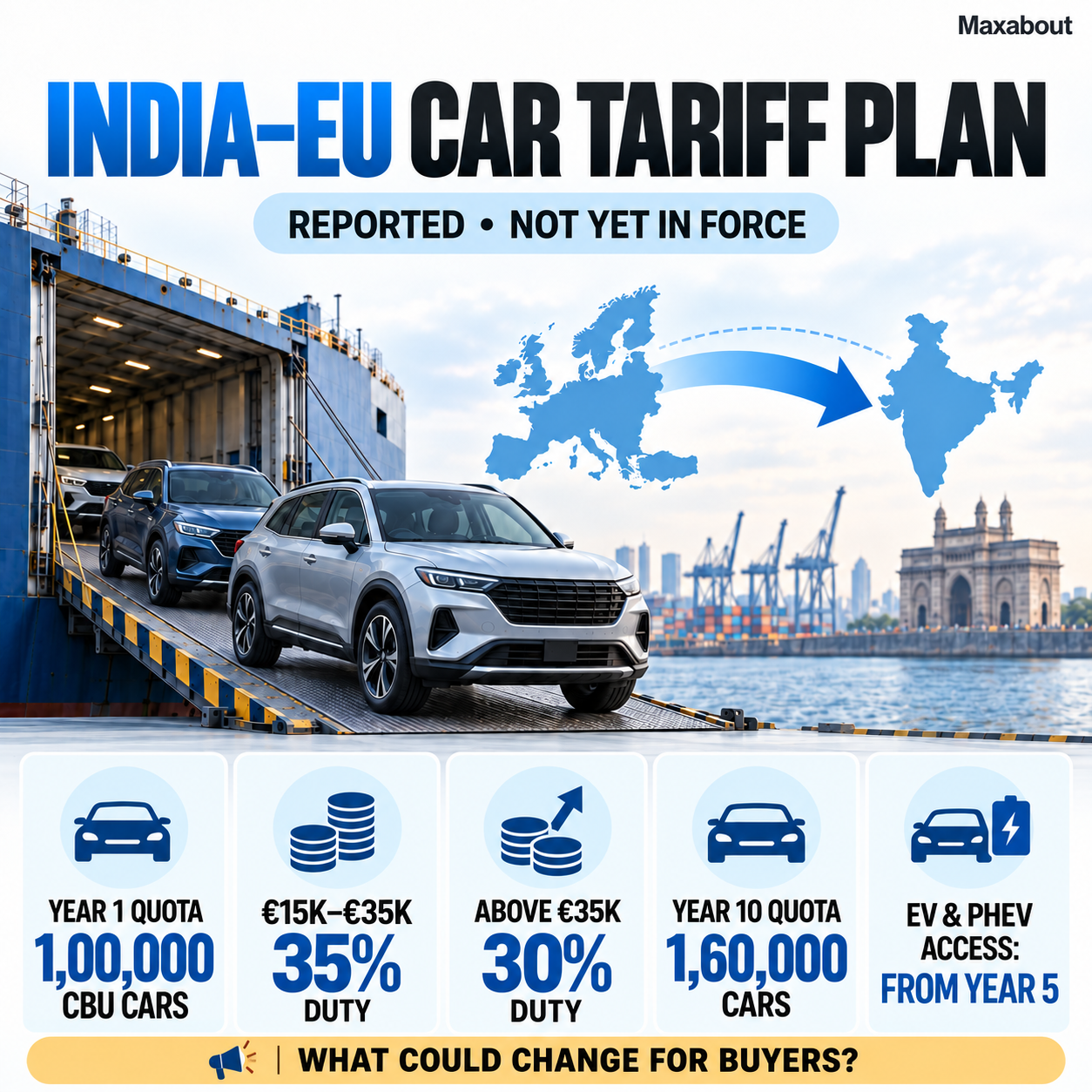
Reported quota and duty timeline
| Stage | Reported ICE/non-plug-in hybrid quota | Key change |
|---|---|---|
| Year 1 | 1,00,000 cars | 30–35% within-quota duty, depending on value |
| Year 2 | 1,07,500 cars | Quota begins to expand |
| Year 5 | 1,30,000 cars | Separate EV/PHEV preferential access begins |
| Year 10 onward | 1,60,000 cars | Preferential duty is reported to reach 10% across the three eligible bands |
The staged schedule is designed to change access gradually, not all at once. Reports also indicate that out-of-quota duties, initially much higher, are scheduled to decline over time. The exact landed-cost effect for a model will still depend on its value, origin, quota eligibility and the rules in the final implemented agreement.
EV and plug-in hybrid cars follow a separate path
Pure electric and plug-in hybrid CBUs are not reported to be part of the initial 1,00,000-car quota. Preferential access for qualifying EVs and PHEVs priced above €20,000 is reported to start in year five, with a separate quota of 20,000 vehicles. That allocation is reported to rise to 90,000 vehicles by year 14, while the preferential duty would begin at 30% in year five and fall to 10% from year ten.
This delayed treatment means the policy should not be interpreted as an immediate reduction for imported European EVs. Buyers comparing an imported EV with a locally assembled model will need to watch the final implementation date and the individual manufacturer's sourcing strategy.
What it could mean for Indian car buyers
Lower within-quota duty could make a wider range of niche, performance and luxury European models commercially viable as CBUs. Manufacturers could test demand with smaller import batches before considering local assembly, and buyers might gain access to variants that are currently difficult to price competitively.
However, a lower customs rate does not translate rupee-for-rupee into a lower ex-showroom price. Freight, insurance, currency movements, homologation, other taxes, dealer margins and product positioning still contribute to the final figure. An OEM may also use the concession to improve equipment or margins rather than pass through the full saving.
What remains unconfirmed
The date on which the agreement will be signed.
The final date it will enter into force after internal procedures.
Which manufacturers, models and variants will use each quota band.
How quota access will be administered and allocated in practice.
The retail-price change, if any, for an individual imported car.
Until those details are official, the responsible reading is that this is a reported future tariff schedule, not a live benefit available at dealerships.
FAQs
Has India already reduced import duty on European cars?
No. The reported schedule is linked to an agreement that is not yet signed or in force. Existing duties remain relevant until implementation.
Will every European car get 30% import duty?
No. The reported 30% rate applies to eligible higher-value cars within specified first-year quota bands. The €15,000–€35,000 band is reported at 35%, and out-of-quota imports follow different treatment.
Are imported European EVs included from year one?
No. Battery-electric and plug-in hybrid preferential access is reported to begin separately from year five for qualifying vehicles.
Could imported car prices fall immediately after signing?
Not necessarily. Entry into force, quota eligibility, exchange rates, taxes and each manufacturer's pricing decision will determine the real buyer impact.
The India-EU FTA car import duty plan is potentially important because it creates a staged, lower-duty pathway for eligible European CBUs. Its first-year 1 lakh-car quota and 30–35% bands are the headline figures, but buyers should wait for signing, implementation rules and model-level announcements before treating them as a price forecast.
Explore the story
Related news
Share your view and join the discussion.
Earn reward points for every comment and get a chance to win ₹1,000 in our weekly lucky draw. Sign in with Google in one tap.
Start the conversation
No one has commented on this article yet. Be the first to share your view.
Want to read more automotive news?
Stay updated with the latest car launches, reviews, and industry insights.
Browse All News