
India Approves 31 More ECMS Projects: What It Means for EVs and Auto Electronics
India's Ministry of Electronics and Information Technology has approved 31 additional projects under the Electronics Components Manufacturing Scheme, involving ₹6,844 crore of incremental planned investment. The approvals cover materials and sub-assemblies used in electric-vehicle batteries, automot...
Editorial Team
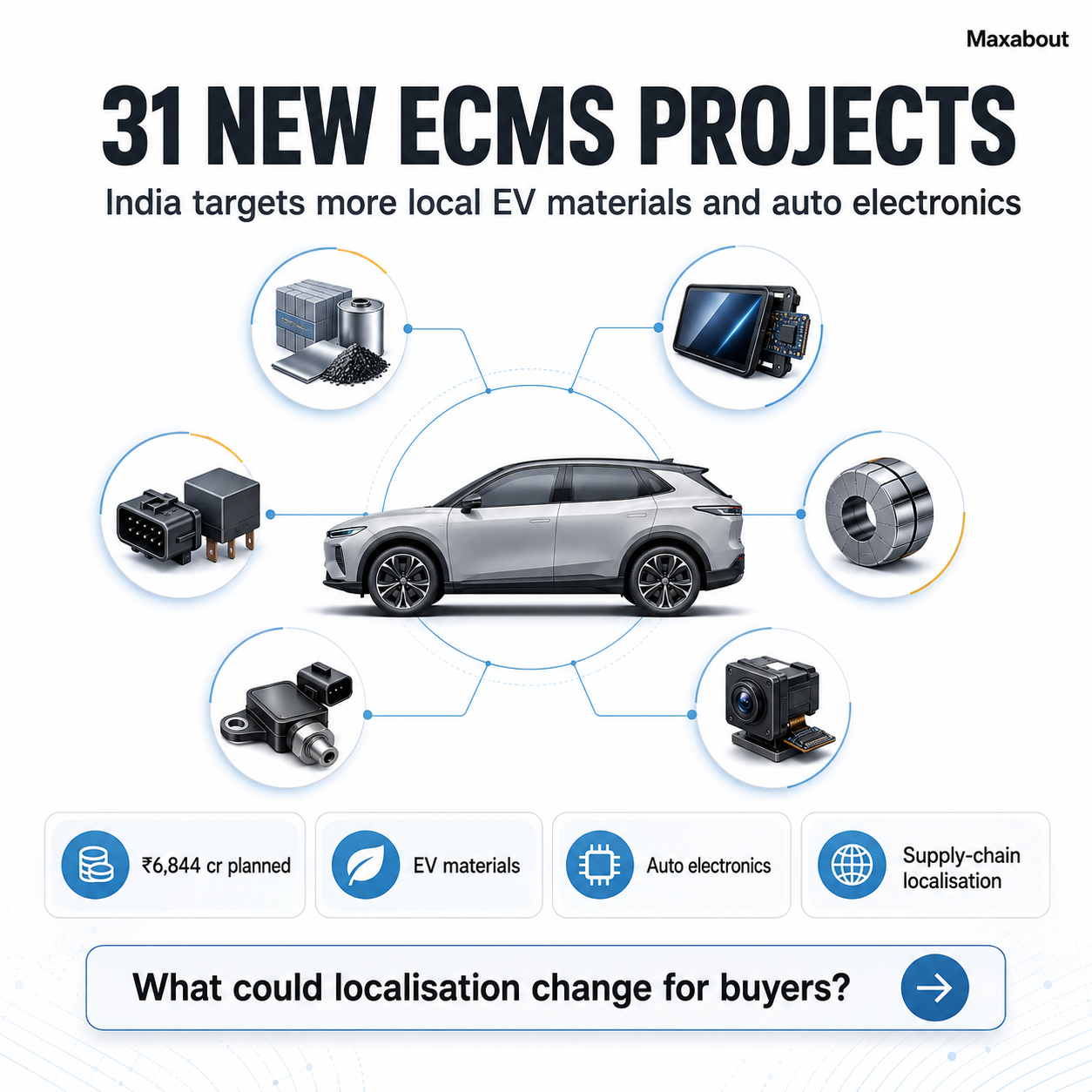
India's Ministry of Electronics and Information Technology has approved 31 additional projects under the Electronics Components Manufacturing Scheme, involving ₹6,844 crore of incremental planned investment. The approvals cover materials and sub-assemblies used in electric-vehicle batteries, automotive electronics and other electronics manufacturing.
The announcement takes cumulative ECMS approvals to 106 projects across 15 states. Reported scheme totals include ₹69,548 crore of approved investment, projected production worth ₹5,34,101 crore and 74,628 projected direct jobs.
Which vehicle-related components are covered?
| Component | Vehicle relevance |
|---|---|
| Anode material | Core lithium-ion battery component |
| Conductive additives | Improve electrical pathways in battery electrodes |
| Electrolyte additives | Support battery performance, life and safety |
| Rare-earth permanent magnets | Used in traction motors and other high-efficiency motors |
| Display-module sub-assemblies | Instrument clusters and infotainment systems |
| Connectors, relays and transducers | Power distribution, switching and sensing |
| Camera-module sub-assemblies | Parking, surround-view and driver-assistance systems |
Why localisation matters to vehicle makers
Modern vehicles depend on a growing number of electronic components, and electric vehicles add further demand for battery materials, power electronics and high-efficiency motors. Local production can reduce exposure to international freight disruption, long lead times and currency movements.
It can also shorten supplier response times and make it easier for vehicle manufacturers to work with component companies during design changes. These benefits depend on actual capacity, quality, yields and competitive pricing—not approval alone.
Potential impact on EV costs
Battery materials and permanent magnets are important cost and supply-chain inputs. Domestic capacity could improve resilience and, over time, reduce some import-linked costs. It would be premature to translate the announced investment directly into a specific vehicle-price reduction.
Vehicle prices also depend on cells, packs, electronics, volumes, taxes, commodities, warranties and manufacturer strategy. Localisation is one enabling factor rather than a guarantee of cheaper EVs.
Approved, planned and projected are different
| Figure | How to read it |
|---|---|
| 31 additional projects | Approved under the scheme |
| ₹6,844 crore | Incremental planned investment |
| 106 cumulative projects | Total approvals reported across 15 states |
| ₹69,548 crore | Total approved investment reported |
| ₹5,34,101 crore production | Projected, not realised output |
| 74,628 direct jobs | Projected, not current employment |
The report says 38 plants are operating and 16 more are in advanced equipment setup. That gives the programme some current manufacturing base, while much of the wider economic impact remains dependent on execution.
What to watch next
Plant commissioning and commercial production dates
Actual versus approved investment
Domestic value addition and import substitution
Quality certification and automotive customer contracts
Realised production and employment
Scale-up of battery-material and rare-earth capacity
Frequently asked questions
What is ECMS?
The Electronics Components Manufacturing Scheme is intended to encourage investment and domestic production across electronics-component supply chains.
How many new projects were approved?
The latest announcement covers 31 additional projects with ₹6,844 crore of planned incremental investment.
Will the projects reduce EV prices?
They may improve localisation and resilience, but no specific price reduction can be inferred until plants deliver components at competitive scale.
Are the production and job figures already achieved?
No. The ₹5,34,101 crore production figure and 74,628 direct jobs are projections linked to approved projects.
Explore the story
Related news



Share your view and join the discussion.
Earn reward points for every comment and get a chance to win ₹1,000 in our weekly lucky draw. Sign in with Google in one tap.
Start the conversation
No one has commented on this article yet. Be the first to share your view.
Want to read more automotive news?
Stay updated with the latest car launches, reviews, and industry insights.
Browse All News