
India ADAS Radar Licence Exemption: Why 77GHz Radar And 5.9GHz V2X Matter
India has reportedly removed a key licensing hurdle for automotive radar and connected-car communication, a move that could make radar-based ADAS and V2X safety technology easier to introduce in future cars. The reported exemption covers the 77GHz-81GHz radar band and the 5.9GHz V2X band, both of wh...
Editorial Team
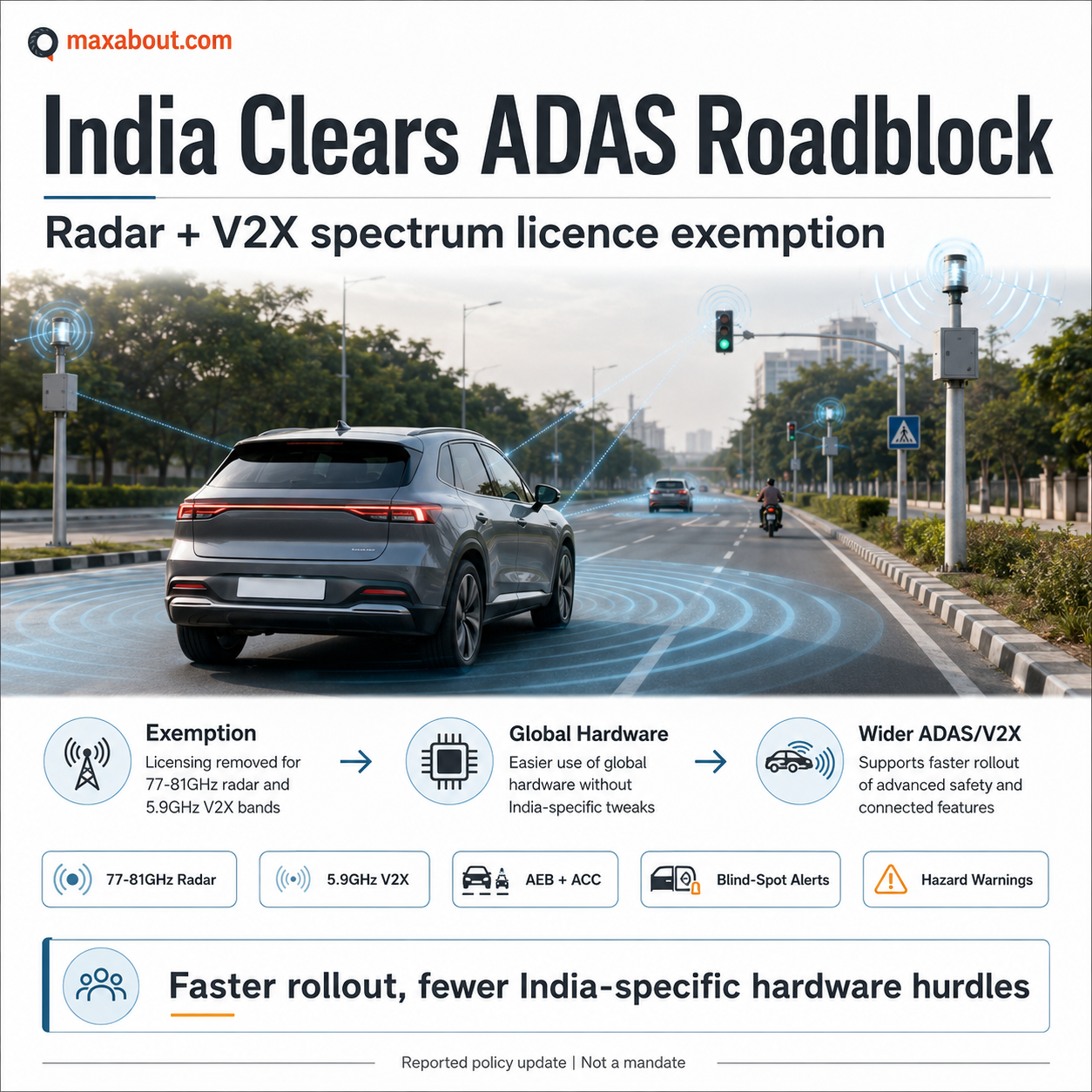
India has reportedly removed a key licensing hurdle for automotive radar and connected-car communication, a move that could make radar-based ADAS and V2X safety technology easier to introduce in future cars. The reported exemption covers the 77GHz-81GHz radar band and the 5.9GHz V2X band, both of which are important for advanced driver assistance and vehicle-to-everything communication.
What You Need To Know
The update reportedly exempts automotive radar systems in the 77GHz-81GHz range from licensing requirements.
The 5.9GHz band used for connected-car and V2X communication is also reported to be covered.
This does not mean self-driving cars are launching immediately in India.
It could make it easier for carmakers and suppliers to bring global radar ADAS hardware and V2X systems to India.
Possible feature areas include AEB, adaptive cruise control, blind-spot alerts and hazard warnings.
Why 77GHz Radar And 5.9GHz V2X Matter
| Technology band | What it supports | Why it matters in India |
|---|---|---|
| 77GHz-81GHz automotive radar | Object detection, distance measurement and speed sensing | Supports radar ADAS features such as AEB, adaptive cruise control and blind-spot monitoring |
| 5.9GHz V2X | Vehicle-to-vehicle and vehicle-to-infrastructure communication | Can enable hazard warnings, road-side alerts and connected safety messages beyond line of sight |
This Is Not A Self-Driving Launch
The phrase "self-driving technology" can sound dramatic, but the reported change is more specific. It removes or reduces a spectrum-licensing barrier for technologies that help cars sense objects and communicate safety alerts. That is different from approving fully autonomous cars for Indian roads.
For buyers, the more realistic near-term impact is that future models may find it easier to use radar sensors and connected-car hardware already available in other global markets. Carmakers still need to package, price, calibrate and validate these features for Indian conditions.
What It Could Mean For Indian Buyers
More radar ADAS options: Cars that currently rely mainly on camera-based ADAS could eventually add radar-backed functions on more variants.
Less India-specific hardware friction: Global platforms may need fewer market-specific changes if spectrum usage is aligned more closely with other regions.
Better safety roadmap: AEB, adaptive cruise control, blind-spot alerts and V2X warnings become easier to plan when the regulatory base is clearer.
No immediate guarantee: The exemption does not force any manufacturer to add these features or lower prices immediately.
What Carmakers And Suppliers May Watch Next
Luxury brands, mass-market manufacturers and component suppliers may all benefit if radar and V2X hardware can be deployed with fewer licensing hurdles. Suppliers working on sensors, chipsets and connected-car modules could see clearer demand signals, while carmakers may find it easier to align Indian specifications with global safety packages.
The key unknown is timing. Even after a regulatory hurdle is removed, ADAS and V2X rollout depends on hardware cost, vehicle architecture, software calibration, road infrastructure, homologation and consumer willingness to pay.
FAQs
What is the India ADAS radar licence exemption?
It is a reported policy update that removes licensing requirements for automotive radar in the 77GHz-81GHz band and V2X communication in the 5.9GHz band.
Does this mean self-driving cars are now legal in India?
No. The update supports radar ADAS and connected safety technologies, but it is not an approval for fully autonomous cars.
Which car safety features could benefit?
Features such as autonomous emergency braking, adaptive cruise control, blind-spot monitoring and V2X hazard warnings could become easier to package in future vehicles.
Will car prices drop because of this exemption?
There is no immediate price guarantee. The benefit is mainly reduced regulatory friction and better readiness for global radar and V2X hardware.
The reported India ADAS radar licence exemption is best understood as an enabling step. It does not instantly transform the market, but it can help create a clearer path for safer, more connected cars in India.
Explore the story
Related news


Share your view and join the discussion.
Earn reward points for every comment and get a chance to win ₹1,000 in our weekly lucky draw. Sign in with Google in one tap.
Start the conversation
No one has commented on this article yet. Be the first to share your view.
Want to read more automotive news?
Stay updated with the latest car launches, reviews, and industry insights.
Browse All News