
IIT Kanpur Startup ScaNxt Inks Historic Deal for Electric Compact Tractors
Something interesting is happening in India's agricultural sector, and it's not getting nearly enough attention. While most of the EV conversation stays locked on passenger cars and two-wheelers, a quiet but genuinely significant shift is beginning to take shape in the fields — literally.An IIT Kanp...
Editorial Team
Something interesting is happening in India's agricultural sector, and it's not getting nearly enough attention. While most of the EV conversation stays locked on passenger cars and two-wheelers, a quiet but genuinely significant shift is beginning to take shape in the fields — literally.
An IIT Kanpur-incubated startup has recently inked a formal pact to develop and deploy what is being described as India's first 100% electric compact tractor. That's not a concept rendering or a lab prototype gathering dust somewhere. This is a commercial agreement — the kind that signals real intent, real capital, and a real timeline.
So what does "100% electric compact tractor" actually mean in practical terms? Unlike hybrid farm equipment that still leans on a diesel engine for heavy work, a fully electric compact tractor runs entirely on battery power. No fuel tank. No exhaust. Quieter operation, lower running costs, and — critically for Indian farmers — far less dependence on fluctuating diesel prices.
From what industry observers are noting, compact tractors in this segment typically serve small and marginal landholdings, which represent the overwhelming majority of Indian farms. That makes this development relevant not just to agriculture, but to rural electrification goals, farm income stability, and India's broader EV ambitions all at once.
This one is worth watching closely.
What Is a Compact Electric Tractor and Who Actually Needs One?
Let's clear up some confusion first. A compact tractor is not simply a smaller version of the massive diesel machines you see hauling heavy loads across large Punjab wheat fields. It is a fundamentally different category — lighter, more maneuverable, typically under 40 horsepower, and designed for precision work rather than bulk power.
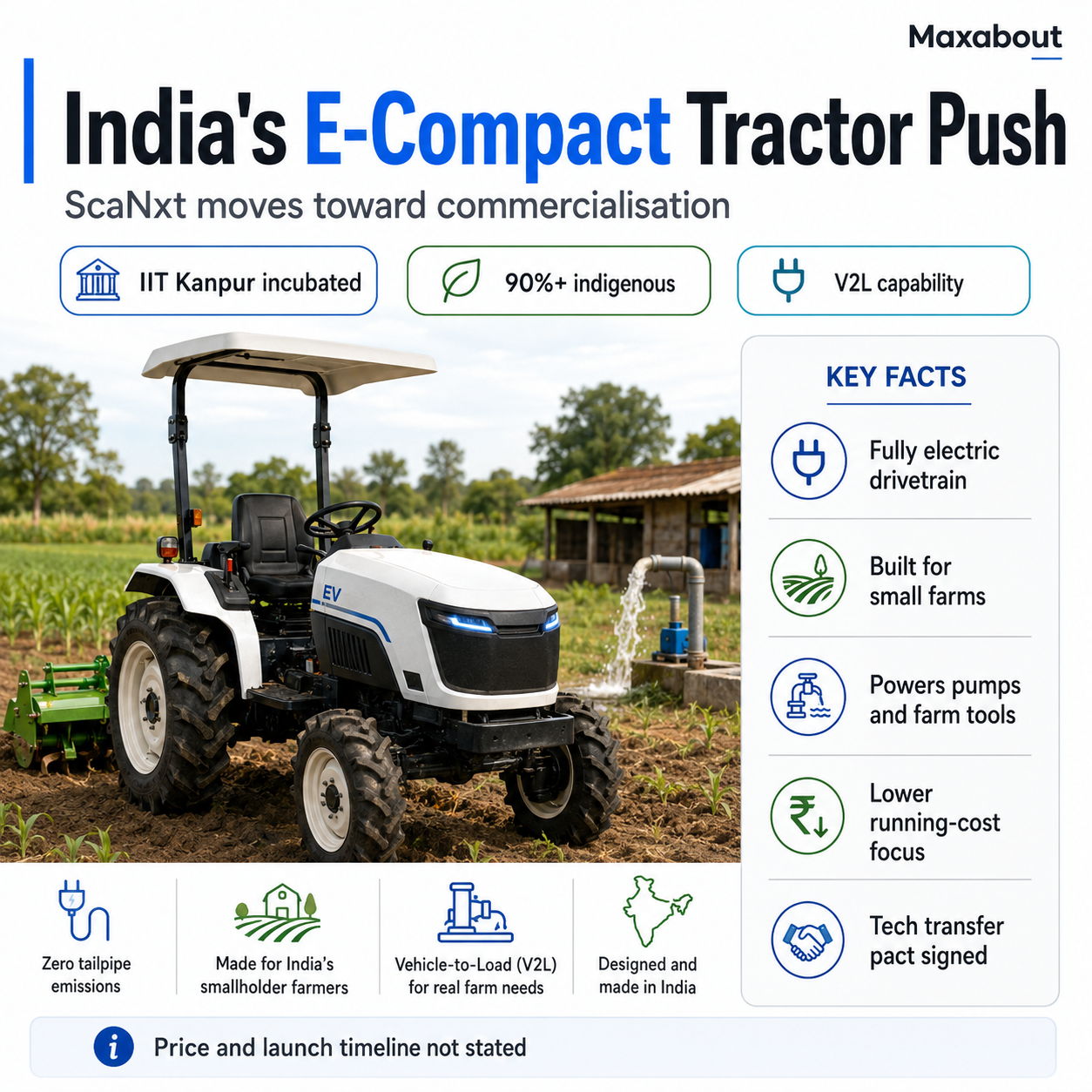 Think of it this way. A full-size agricultural tractor is built to plow hundreds of acres efficiently. A compact tractor is built to work within tight spaces — between crop rows in Maharashtra's vineyards, inside fruit orchards in Karnataka's hilly terrain, or across the narrow field boundaries that define smallholder farming across Uttar Pradesh.
And here is where the real opportunity sits. India has roughly 86% of its farming community classified as small and marginal landholders — people managing under two hectares. For them, a large diesel tractor is simply impractical. Too expensive to buy, too costly to run, and honestly too large to use effectively on their land.
Beyond farming, the applications are broader than most people realize — airport ground operations, large university campuses, logistics yards, and municipal groundskeeping all represent genuine demand. A compact electric tractor fits naturally into each of these environments.
The IIT Kanpur Connection: Why Academic Incubation Matters for Deep Tech in India
There is something genuinely different about a startup that emerges from an IIT environment. It is not just the prestige — it is the access to serious research infrastructure, faculty mentorship, and a culture that actually tolerates long development cycles. Deep tech is not built in ninety days.
IIT Kanpur's incubation ecosystem has quietly produced ventures that go well beyond app-based businesses. The institute has historically invested in startups tackling hard engineering problems — the kind that require real intellectual capital, not just a clever business model. An electric tractor with genuine agricultural utility sits firmly in that category.
What this pact signals is arguably more interesting than the product itself. An industry partner signing a formal agreement with an academically incubated startup means external validation has arrived. Someone with commercial stakes believes this technology is ready to move beyond the laboratory.
India's clean-tech and agri-tech startup space has matured considerably. Early conversations were dominated by passion; today, industry reports consistently show institutional capital and corporate partnerships flowing into these sectors with real seriousness. Electric mobility conversations in India have, for too long, revolved exclusively around passenger cars and two-wheelers. This development pushes that boundary further — into working machinery, into fields, into practical infrastructure.
How Does a 100% Electric Tractor Stack Up Against Diesel Alternatives in India?
This is where things get genuinely interesting — and honestly, complicated. The technical case for electric tractors is stronger than most people assume, but the practical realities of rural India introduce friction that cannot be dismissed.
Starting with what electric actually does well here: electric motors deliver instant, full torque from zero RPM. For tractor applications — pulling implements through resistant soil, operating a rotavator, running a water pump — that torque characteristic is arguably better suited than a diesel engine, which needs to build through its power band. From what engineers and early testers have observed, this translates to more consistent pulling force during demanding fieldwork.
Running costs tell a compelling story too. Diesel consumption on a typical 45-50 HP tractor runs roughly ₹300–400 per hour of field operation at current fuel prices. Electric equivalents, even at rural grid tariffs, could realistically bring that below ₹80–100 per hour. Over a farming season, that difference compounds significantly.
But the challenges deserve equal honesty. Rural electrification in India remains uneven — reliable three-phase power, essential for faster charging, is still inconsistent across many agricultural districts. Charging an adequately sized battery pack could take several hours, versus a quick diesel refuel. And the upfront cost will almost certainly be higher than a comparable diesel tractor, at least initially.
Lower maintenance is a genuine advantage — no engine oil changes, fewer moving parts, reduced servicing frequency. For operators spending full days in fields, quieter operation and zero tailpipe emissions are meaningful quality-of-life improvements, not minor footnotes.
The Real Challenges: Can Electric Tractors Actually Work on Indian Farms and Roads?
Let's be honest about this. The optimism is warranted, but so is the skepticism.
Start with power supply. A farmer in Vidarbha or eastern Uttar Pradesh doesn't always have the luxury of reliable overnight electricity. Load shedding, voltage fluctuations, and outright supply gaps are everyday realities in many rural districts. Plugging in an expensive electric tractor and waking up to an uncharged battery — during sowing season — is not a theoretical inconvenience. It's a genuine operational risk.
Then there's the cost conversation. From what industry observers note, electric tractors will carry a significantly higher sticker price upfront. A small farmer already stretching finances through Kisan Credit Card loans isn't evaluating this on a ten-year total cost of ownership spreadsheet. The immediate outflow matters enormously. Government subsidy frameworks like PM-KUSUM focus primarily on solar pumps, and whether similar support extends meaningfully to electric tractors remains unclear.
Servicing is perhaps the most underrated concern. High-voltage battery systems require trained technicians. Rural service networks for conventional diesel tractors are already stretched thin. Who retrains local mechanics? What happens when the battery pack degrades after five or six years of hard field use? Replacement costs could quietly erase years of fuel savings.
These aren't reasons to dismiss the technology. They're the real questions that need real answers before widespread adoption becomes realistic.
Electric Tractors and India's Broader EV Push: More Connected Than You Think
Most conversations about India's electric vehicle transition circle around the same subjects — passenger cars, two-wheelers, electric buses in cities. Agriculture rarely enters that conversation. That's a significant oversight.
Diesel-powered tractors and farm equipment account for a substantial share of India's total diesel consumption. Electrifying even a modest fraction of the country's roughly nine million tractors would have measurable implications for fuel import bills and carbon output. The numbers aren't trivial.
The government's broader EV targets have gradually started acknowledging agricultural equipment as part of the equation. That policy recognition, even if still early-stage, creates a more hospitable environment for startups working in this space.
Globally, manufacturers in Europe and North America have already launched electric tractor prototypes and limited commercial models — signaling that this transition is directionally inevitable. India entering this space now, through an IIT-incubated venture, means building domestic capability before the global market fully matures. That timing matters.
The larger point is this: farm electrification and urban EV adoption are part of the same story. One just gets far less attention. If this compact tractor project succeeds at scale, it could quietly become one of India's more consequential clean energy contributions.
What This Means for Indian Farmers, Agri-Tech Investors, and the EV Ecosystem
If this project delivers on its promise, the benefits spread across several groups — and the ripple effects could be significant.
Small and marginal farmers stand to gain the most immediately. Lower fuel costs, reduced maintenance, and simpler operation could genuinely improve margins for landholdings where every rupee counts. A farmer running a compact electric tractor in Punjab or Vidarbha does not care about the technology story — they care whether it saves money and does not break down during sowing season.
For agri-tech investors, a validated compact electric tractor category opens a credible new investment thesis. Success here creates a template. Electric tillers, electric harvesters, solar-powered irrigation equipment — the domino effects are real if the foundation holds.
The broader EV ecosystem also benefits quietly. Rural demand for battery packs, charging infrastructure, and grid upgrades follows adoption. That is not a small thing.
My honest take? This is genuinely promising, but a pact signing is not proof of concept. Real-world deployment across varied terrain, weather, and usage patterns will tell the actual story. Watch this space — not with skepticism, but with informed patience.
Explore the story
Related news



Share your view and join the discussion.
Earn reward points for every comment and get a chance to win ₹1,000 in our weekly lucky draw. Sign in with Google in one tap.
Start the conversation
No one has commented on this article yet. Be the first to share your view.
Want to read more automotive news?
Stay updated with the latest car launches, reviews, and industry insights.
Browse All News