
How to Spot a Well-Kept Used Car: Checks That Reveal Neglect
Two used cars can share the same model year and a similar odometer reading yet have very different maintenance histories. Use this used car inspection checklist to compare the car's physical condition with its service invoices, the seller's answers and its behaviour on a safe test drive. A clean cab...
Two used cars can share the same model year and a similar odometer reading yet have very different maintenance histories. Use this used car inspection checklist to compare the car's physical condition with its service invoices, the seller's answers and its behaviour on a safe test drive. A clean cabin or shiny engine bay is only a starting point. Use the checks below to decide what needs explaining, what needs an independent inspection and when to leave the car on your shortlist rather than pay a deposit.
Used car inspection checklist: the essentials
Evidence of care: dated invoices, work recorded against mileage and repairs that can be explained.
Condition that makes sense: wear broadly consistent with age, use and the claimed history.
Access to checks: a cold start, a safe test drive and an independent inspection before committing.
Limits of a viewing: a reassuring sign is not proof that the car is mechanically sound.
A checklist to use at the viewing
Save this section on your phone or print it. Mark each item as checked, needs investigation or not checked, and write down the evidence. An unchecked item is not a pass. This checklist focuses on petrol and diesel cars; EV battery health and high-voltage systems need a specialist assessment.
Before you travel
Identify the exact car: confirm its model, engine, transmission, year and advertised mileage.
Request the evidence: ask for service invoices, the registration certificate (RC), insurance details and records of major repairs.
Arrange the checks: ask for a daylight viewing, a cold start, a safe test drive and permission for an independent inspection.
With the car parked
Match the identity: compare the registration and accessible VIN/chassis identification with the documents; ask the seller to explain any mismatch.
Compare panels: inspect paint finish, gaps, glass and visible corrosion. Ask about repairs rather than assuming every repaint means a serious crash.
Inspect tyres: check all tyres for visible damage and uneven wear; include the spare or supplied repair kit where fitted.
Look for water traces: check accessible carpets, the boot floor and spare-wheel well for damp, staining or unusual smells.
Try cabin equipment: operate the windows, locks, mirrors, lights, wipers, washers, air conditioning and infotainment while parked.
Check visible restraints: look for damaged belt webbing and check buckle operation. Leave airbag and pretensioner inspection to a qualified professional.
Check cold-engine observations: note visible leaks and check accessible fluid levels only as the handbook permits. Never open a hot coolant cap.
Starting and driving
Observe the start: note starting difficulty, persistent unusual noises and warning lamps. Compare lamp behaviour with the handbook; ask for unexplained warnings to be diagnosed.
Assess normal controls: notice steering pull, vibration, gear changes, clutch behaviour where fitted, and ordinary braking at legal speeds.
Check comfort functions: confirm the air conditioning works and listen for recurring noises without audio masking them.
Record what changed: note warnings or symptoms that appeared during the drive and give those observations to the inspector.
Before paying a deposit
Reconcile the history: compare dated mileage entries with the odometer and apparent wear. Wear alone cannot prove tampering.
Commission the inspection: ask for a written report covering relevant mechanical, body, safety and diagnostic checks, with exclusions clearly stated.
Budget for findings: obtain estimates for due maintenance and identified repairs before comparing the final purchase cost.
Resolve paperwork: confirm the seller's authority to sell, ownership-transfer arrangements and any finance-related documentation with the appropriate provider or registration authority.
For each car, keep a note of asking price, mileage, evidence seen, checks not completed, defects, repair estimates and the next action. This makes comparisons more useful than a simple good/bad score.
Well-kept or neglected? Compare the signs
Read this table as a guide to follow-up questions, not a pass-or-fail diagnosis. A car can have an innocent explanation for one warning sign; several unexplained inconsistencies deserve more caution.
| Area | Reassuring sign | Warning sign | Next step |
|---|---|---|---|
| Service history | Invoices with dates, mileage and work carried out | Missing periods or entries that do not agree with the odometer story | Compare with the exact model's maintenance schedule and verify records with the workshop, with the seller's permission |
| Tyres | Suitable specification, compatible fitment and wear without an obvious irregular pattern | Bulges, cracks, damaged tread or marked uneven wear | Ask a tyre professional to assess condition, fitment and possible alignment or suspension issues |
| Boot and cabin | Dry carpets and no unexplained staining or strong masking fragrance | Damp, musty smells, water marks or corrosion | Investigate leaks, previous water exposure and repairs |
| Paint and panels | Consistent finish and gaps that look reasonably even | Overspray, mismatched finish or poorly aligned panels | Ask what was repaired and have the repair quality assessed |
| Engine bay | Fluid levels checked correctly and no unexplained visible leaks | Leaks, contaminated-looking fluid or unexplained residue | Get a mechanic's assessment; do not diagnose from colour or cleanliness alone |
| Starting and driving | Normal starting and predictable controls without unexplained warnings | Persistent warning lights, unusual noises, vibration or pulling | Stop if unsafe and arrange diagnosis before buying |
Start with the details a seller cannot explain away with polish
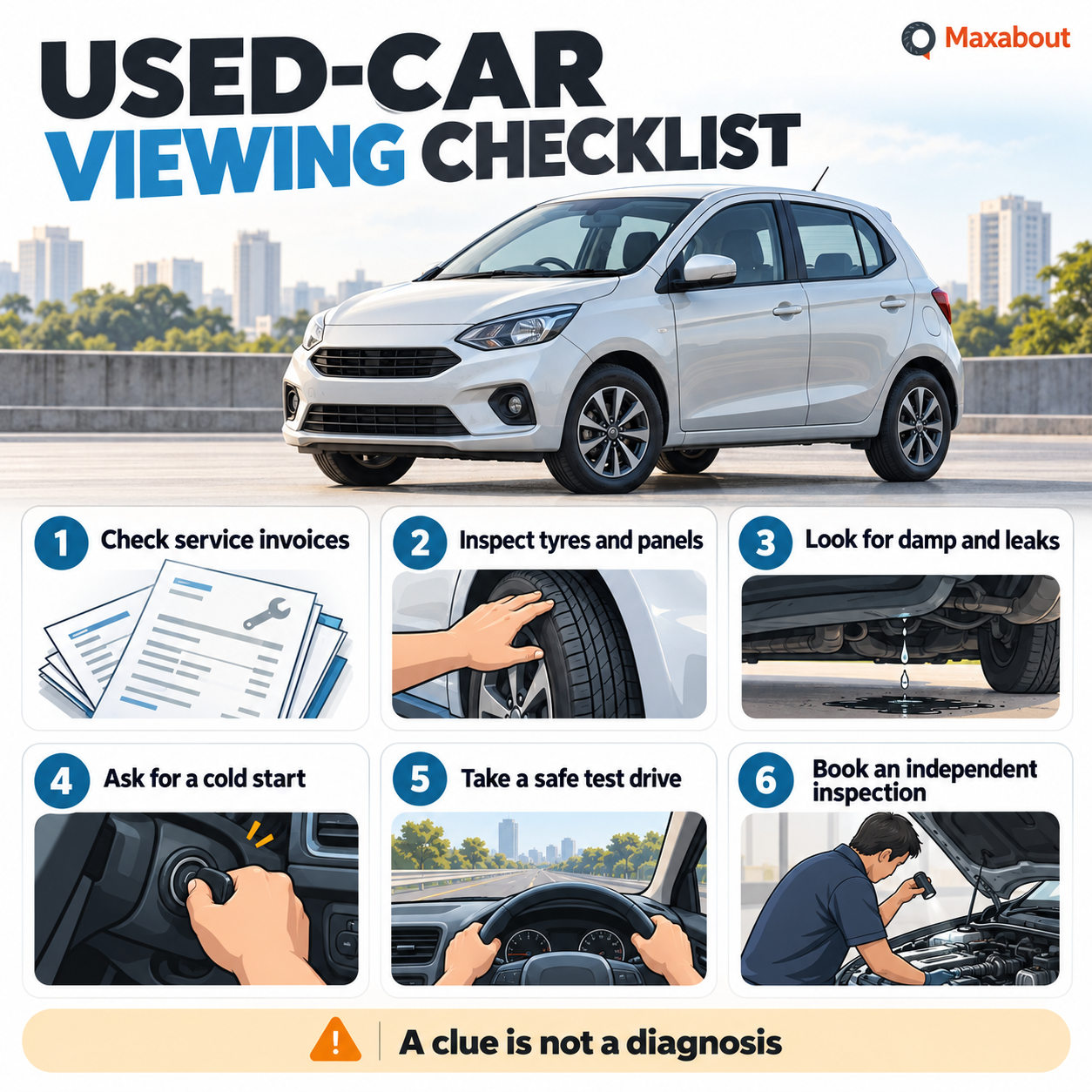
Arrange to view the car in good daylight. Walk around it before discussing price. Compare the paint finish across neighbouring panels and look along the bonnet, doors and boot for uneven gaps. Overspray on rubber trim or a different paint texture can suggest repair work, but it does not establish how serious that work was. Ask for the reason and any supporting invoices or photographs.
If you book a car inspection Chennai service, ask the inspector to assess any unexplained paintwork or panel alignment as part of the agreed used-car inspection.
Open the boot and, with permission, lift the removable floor cover. Check for damp, stains and corrosion around the spare-wheel well. Inspect the spare wheel or supplied repair kit and tools, where fitted. Missing equipment is worth budgeting for; a dry boot is useful evidence of its present condition, not a guarantee against previous water damage.
Check every tyre, not just the front pair. Look for damage and irregular wear, and ask about replacement dates and alignment work. Four tyres do not need to share the same manufacturing week to indicate responsible ownership. A puncture or different rates of wear may explain a replacement. Compatibility with the car and correct fitment matter more than a neat matching-date story.
Under the bonnet: inspect safely and avoid instant diagnoses
A spotless engine bay can reflect ordinary care or recent preparation for sale. Dirt alone does not prove neglect, either. Ask about recent cleaning, visible leaks and fluid top-ups, then compare the answers with the service records.
Only check items you can safely identify, following the owner's handbook. For a dipstick check, use the specified procedure and conditions. Oil colour alone cannot tell you whether oil is fresh or whether an engine is healthy. An unusual appearance or level needs professional assessment rather than a confident verdict at the roadside.
Inspect the coolant reservoir externally when the engine is cold and follow the handbook's instructions. Never open a hot cooling-system cap. Do not assume green or pink fluid is correct, or that another colour proves years of water-only top-ups. The required coolant specification depends on the vehicle.
Look for visible corrosion around the battery and ask about its age, starting problems and replacement history. Corrosion does not establish how long a car was parked. Leave electrical testing, hose assessment and checks near moving or hot components to the inspector.
Use service records to test the story
Ask for invoices as well as a stamped booklet or a screenshot of digital history. Build a simple sequence of dates, mileage and work performed. Then compare it with the manufacturer's schedule for the exact model and engine, including time limits and any separate replacement items. There is no universal 10,000 km rule for every car.
A routine service entry does not automatically mean brake fluid, coolant or every filter was replaced. Check the actual work listed. Equally, a missing stamp does not prove the car ran on old oil: work may have been done elsewhere. Ask for the invoice and, with permission, confirm it with the workshop.
Review the vehicle identity, registration and insurance documents alongside the car. Ask directly about accident repairs, water exposure, major mechanical work and insurance claims. A no-claim bonus is not an accident-free certificate. It cannot substitute for a physical inspection or establish that every repair was declared.
Take a safe test drive, with distractions off
Ask the seller to leave the engine unstarted before your visit where practical. A cold start gives you another opportunity to observe starting behaviour and unusual noises. Ask an inspector to assess persistent rattles, difficult starting or warning lights; a brief sound alone is not a reliable diagnosis.
Use a permitted route and legal speeds, with the seller's agreement and suitable driving cover. Turn the audio off and pay attention to steering, vibration, gear changes, clutch operation where applicable, and ordinary braking. Include typical road surfaces without deliberately hitting potholes or pushing the car hard.
Do not attempt a sudden high-speed brake test on a public road. If the car pulls, shudders or behaves unpredictably during normal driving, stop when safe and arrange inspection. A high clutch bite point is a reason to ask questions; clutch design and adjustment vary, so it does not establish remaining life by itself.
What should an independent inspection add?
A viewing helps you collect observations. A professional assessment should investigate the concerns you recorded and explain what could not be checked. Ask whether the agreed scope includes an underbody examination using suitable workshop equipment, diagnostic fault-code reading where supported, repair-quality assessment and a road test. A clean scan or inspection score is not a guarantee against future faults.
For a used car inspection Bangalore appointment, ask for the same written scope, findings and exclusions. Check whether used-car assessment is included rather than assuming a new-car delivery checklist covers the same work.
Buyer checks: visible condition, document consistency, accessible controls and ordinary driving observations.
Professional checks: structural concerns, underbody condition, safety-system faults, leaks and mechanical or electronic diagnosis.
Do not attempt: crawling under an unsupported car, opening a hot coolant system, touching airbag wiring or emergency braking on a public road.
Ask these questions before discussing a deposit
Which scheduled jobs are due next, by time as well as mileage?
Why were the tyres, battery or body panels replaced?
Has the car needed frequent oil or coolant top-ups?
What accident, water-damage or major mechanical repairs have been carried out?
Can the service history be verified, and will the seller allow an independent inspection?
When should you pause or walk away?
Pause for evidence: unexplained service gaps, inconsistent mileage records, missing repair invoices or questions about the seller's authority to sell.
Pause for diagnosis: persistent warning lights, unusual noises, vibration, leaks or suspected water or structural damage.
Leave if checks are refused: do not let pressure to pay replace a reasonable independent inspection.
Negotiate only after assessment: a documented cosmetic repair or due maintenance can be priced in once its scope and cost are understood. A discount does not resolve an unsafe or unexplained defect.
FAQs
Can a low-mileage used car still be neglected?
Yes. Low mileage does not establish that time-based maintenance was completed or that storage conditions were suitable. Check its records and present condition together.
Does a repainted panel mean I should reject the car?
Not automatically. Cosmetic work and more extensive repairs have different implications. Ask why it was painted and have the repair quality and surrounding structure assessed.
Can I judge a used car without any tools?
You can identify questions and visible concerns during a viewing. You cannot reliably rule out hidden mechanical, electrical or structural faults without further checks.
The strongest sign of a well-kept used car is consistency: records that support the seller's account, condition that fits the history and checks that do not leave major questions unanswered. Use the viewing to gather evidence, then let an independent assessment guide the buying decision.
Explore the story
Related news





Share your view and join the discussion.
Earn reward points for every comment and get a chance to win ₹1,000 in our weekly lucky draw. Sign in with Google in one tap.
Start the conversation
No one has commented on this article yet. Be the first to share your view.
Want to read more automotive news?
Stay updated with the latest car launches, reviews, and industry insights.
Browse All News