
Honda ZR-V SUV India Launch: Premium Hybrid SUV Arriving May 22 via CBU
Honda ZR-V: The New Flagship Hybrid Coming to IndiaMark your calendars for May 22nd! Honda is set to introduce its new flagship hybrid SUV, the ZR-V, to the Indian market. Coming in as a Completely Built Unit (CBU), this premium offering will sit above the current Honda lineup in India.The ZR-V repr...
Editorial Team
Honda ZR-V: The New Flagship Hybrid Coming to India
Mark your calendars for May 22nd! Honda is set to introduce its new flagship hybrid SUV, the ZR-V, to the Indian market. Coming in as a Completely Built Unit (CBU), this premium offering will sit above the current Honda lineup in India.
The ZR-V represents Honda's serious commitment to expanding its hybrid footprint in India at a time when competitors are still figuring out their electrification strategy. I think this is a smart move considering our market's gradual transition toward greener mobility options.
For premium SUV buyers in India, this launch is particularly significant. The ZR-V brings Honda's refined hybrid technology in a package designed for those wanting sophistication without compromising on efficiency. Based on what I've seen, it appears Honda is targeting the growing segment of environmentally-conscious luxury SUV enthusiasts.
While CBU imports typically command higher price points, they often bring international-spec features without dilution. Let's examine what makes the ZR-V special and whether it might be worth considering in India's increasingly competitive premium SUV landscape.
Design and Dimensions: How the ZR-V Fits in the Indian Context
The Honda ZR-V brings a sophisticated European design language that's distinct from both the compact HR-V and the rugged CR-V in Honda's lineup. Standing at approximately 4.5 meters in length, it positions itself perfectly between these two models, offering an urban-friendly footprint that's substantial enough for premium presence on Indian roads.
What caught my attention immediately is its ground clearance of around 185mm – particularly important for handling our infamous speed breakers and uneven road surfaces. The sleek front fascia with its aggressive LED headlights and clean body lines gives it a more upmarket appearance compared to the CR-V currently available here.
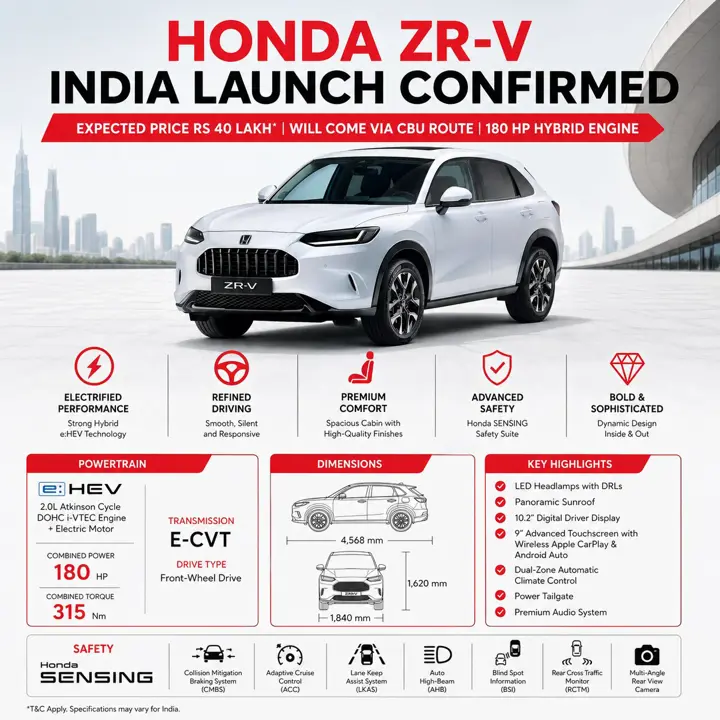 Inside, the ZR-V offers a driver-focused cockpit with what appears to be premium materials and a minimalist dashboard design. The boot space of approximately 380 liters isn't class-leading but should be adequate for weekend getaways. Where it truly shines is in cabin space – the rear seats offer surprisingly generous legroom, which will be appreciated during long highway journeys between major cities.
When parked alongside segment competitors like the Jeep Compass or Volkswagen Tiguan, the ZR-V holds its own with balanced proportions that don't feel overwhelming in tight urban spaces while maintaining substantial road presence. The thoughtful dimensions suggest Honda has carefully considered the sweet spot for premium SUV buyers in India.
Powertrain and Performance: The Hybrid Advantage
The Honda ZR-V's highlight for the Indian market is undoubtedly its e:HEV (Hybrid Electric Vehicle) powertrain. Based on international specifications, we're looking at a 2.0-liter petrol engine paired with dual electric motors producing a combined output of around 181 bhp and 315 Nm of torque. The system is likely to come with an e-CVT transmission that Honda has refined over generations.
What makes this setup particularly interesting for Indian conditions is the potential fuel efficiency. I expect figures around 20-22 km/l in real-world driving, which would position it significantly above conventional petrol SUVs in the segment. The hybrid system should excel particularly in start-stop urban traffic conditions in cities like Mumbai and Bengaluru, where the electric motors can take over during crawling traffic.
The e:HEV system differs from mild hybrids offered by competitors as it can operate in pure EV mode for limited distances. This should translate to a smoother driving experience and better low-end torque response – something that would prove valuable when tackling speed breakers and uneven road surfaces that are common across Indian cities.
Performance-wise, expect 0-100 km/h times of around 8-8.5 seconds – respectable for a vehicle in this segment. However, the real advantage will be in everyday drivability rather than outright speed. When compared to other premium hybrids like the Toyota Urban Cruiser Hyryder or the upcoming Maruti Grand Vitara, the ZR-V's system appears more sophisticated with potentially better power delivery.
Features and Technology: What Indian Buyers Can Expect
The Honda ZR-V is set to arrive packed with premium features that should impress tech-savvy Indian buyers. At the center of the cabin, expect a 9-inch touchscreen infotainment system with wireless Apple CarPlay and Android Auto integration – particularly useful for navigating through congested city routes in Bengaluru or Mumbai.
Honda's Sensing suite will likely be the standout offering, bringing advanced driver assistance systems to the table. This includes adaptive cruise control, lane-keeping assist, and collision mitigation braking – features that can be genuinely useful on unpredictable Indian highways where sudden obstacles are common.
Other expected amenities include:
Dual-zone climate control (a blessing during our scorching summers)
Wireless charging pad
Panoramic sunroof
Leather upholstery with ventilated front seats
360-degree camera system (particularly valuable for navigating tight parking spots in urban areas)
In terms of safety, expect 6 airbags, ABS with EBD, stability control, and hill-start assist as standard. While these features match what's offered in similarly priced vehicles like the Jeep Compass, I think the ZR-V might miss out on some India-specific features like dedicated rear AC vents or dust filtration systems that competitors have started offering.
For our market, the 360-degree camera and high ground clearance might prove more valuable than some of the advanced driving assists that work better on well-marked Western roads than on our diverse road infrastructure.
Expected Pricing and Positioning in India
Given that Honda is bringing the ZR-V via the CBU route, expect a significant price premium compared to locally assembled SUVs. I anticipate pricing to start around ₹35-40 lakh, positioning it above the locally assembled Honda CR-V and directly against the Jeep Compass and Volkswagen Tiguan.
The import duties will substantially inflate the price—typically adding 60-100% over international pricing. This places the ZR-V in a challenging spot where it needs to justify its premium over established players like the Tucson (₹29-35 lakh) and even the entry-level luxury SUVs like the BMW X1 (starting around ₹45 lakh).
Maintenance costs will likely be higher than locally assembled Hondas, with parts potentially taking longer to arrive at service centers. However, Honda's reliability record should translate to fewer workshop visits compared to some European competitors.
Resale value is another concern—CBU models historically depreciate faster in India due to their initial premium and parts availability concerns. I think buyers who value Honda's hybrid technology and the exclusivity factor will find value here, but more price-conscious customers might find better value in the locally assembled options in our market.
CBU Strategy: Implications for Indian Buyers
Honda's decision to bring the ZR-V via the CBU route signals a significant shift in their approach to the Indian market. As a completely imported vehicle, expect longer waiting periods—likely 2-3 months after booking—since units will arrive in batches rather than rolling off a local production line.
The CBU strategy carries mixed implications for buyers. On the positive side, you'll get the exact same vehicle sold in international markets without any India-specific cost-cutting. However, customization options will be limited to what Honda offers globally, unlike locally manufactured vehicles that often get India-specific variants.
Service readiness is my biggest concern. While Honda's established network can handle maintenance, specialized training for this hybrid powertrain may initially be limited to select dealerships in metro cities. Parts availability might involve delays, especially for body panels or electronics.
I believe this is clearly a market testing strategy—Honda is gauging premium SUV demand before committing to local assembly. If successful, we might see CKD operations within 12-18 months, potentially reducing prices by 15-20%. This approach suggests Honda is seriously targeting the ₹25+ lakh segment where Japanese brands have historically struggled against European competitors.
Competition Analysis: Where the ZR-V Stands
The Honda ZR-V enters a fiercely competitive premium SUV battleground where established players have already secured loyal followings. The most direct competition comes from the Hyundai Tucson (₹29-35 lakh) and Volkswagen Tiguan (₹35.2 lakh), both offering strong brand recognition and established service networks.
Against the Tucson, the ZR-V likely offers superior refinement and Honda's legendary reliability, but Hyundai counters with a more extensive dealer network and potentially better parts availability. The Tiguan brings German engineering and prestige, though at a higher price point and with higher maintenance costs typical of European brands in India.
In the hybrid space, the Toyota Urban Cruiser Hyryder and Maruti Suzuki Grand Vitara offer strong hybrid options at significantly lower price points (₹15-19 lakh), though they compete in a segment below in terms of premium feel and features.
Honda's strengths in India have always been build quality and engine refinement, which should translate well to the ZR-V. However, I'm concerned about the brand's relatively limited service presence compared to Hyundai or Maruti. For urban buyers in metro cities, this might not matter, but those in Tier-2 cities should consider service accessibility.
Resale value is likely to be the ZR-V's weakest point initially, as CBU imports typically depreciate faster than locally assembled vehicles. This could be a significant drawback for value-conscious Indian buyers who traditionally factor resale into purchase decisions.
Conclusion: Is the Honda ZR-V Worth Waiting For?
After weighing all factors, I think the ZR-V presents a mixed value proposition for Indian buyers. For affluent early adopters who prioritize Japanese reliability and hybrid technology, the ZR-V could be worth the premium. The vehicle's sophisticated hybrid system and premium features make it appealing for environmentally conscious urban drivers.
However, price-sensitive buyers might want to hold off. If Honda transitions to local assembly in the future, we could see more competitive pricing. Currently at an estimated ₹35 lakh entry point, it's positioned against established players with stronger service networks.
This launch signals Honda's renewed focus on India's premium segment, which I find encouraging. The company seems to be testing waters with the ZR-V before potentially deeper investments. For most practical buyers, though, I'd suggest either waiting for potential CKD versions or exploring alternatives like the Tucson or Compass that offer better service support and established resale patterns.
Explore the story
Related news
Share your view and join the discussion.
Earn reward points for every comment and get a chance to win ₹1,000 in our weekly lucky draw. Sign in with Google in one tap.
Start the conversation
No one has commented on this article yet. Be the first to share your view.
Want to read more automotive news?
Stay updated with the latest car launches, reviews, and industry insights.
Browse All News