
Honda, Suzuki and Yamaha Reported E-Scooter Retail Reaches 10,735 in 2026
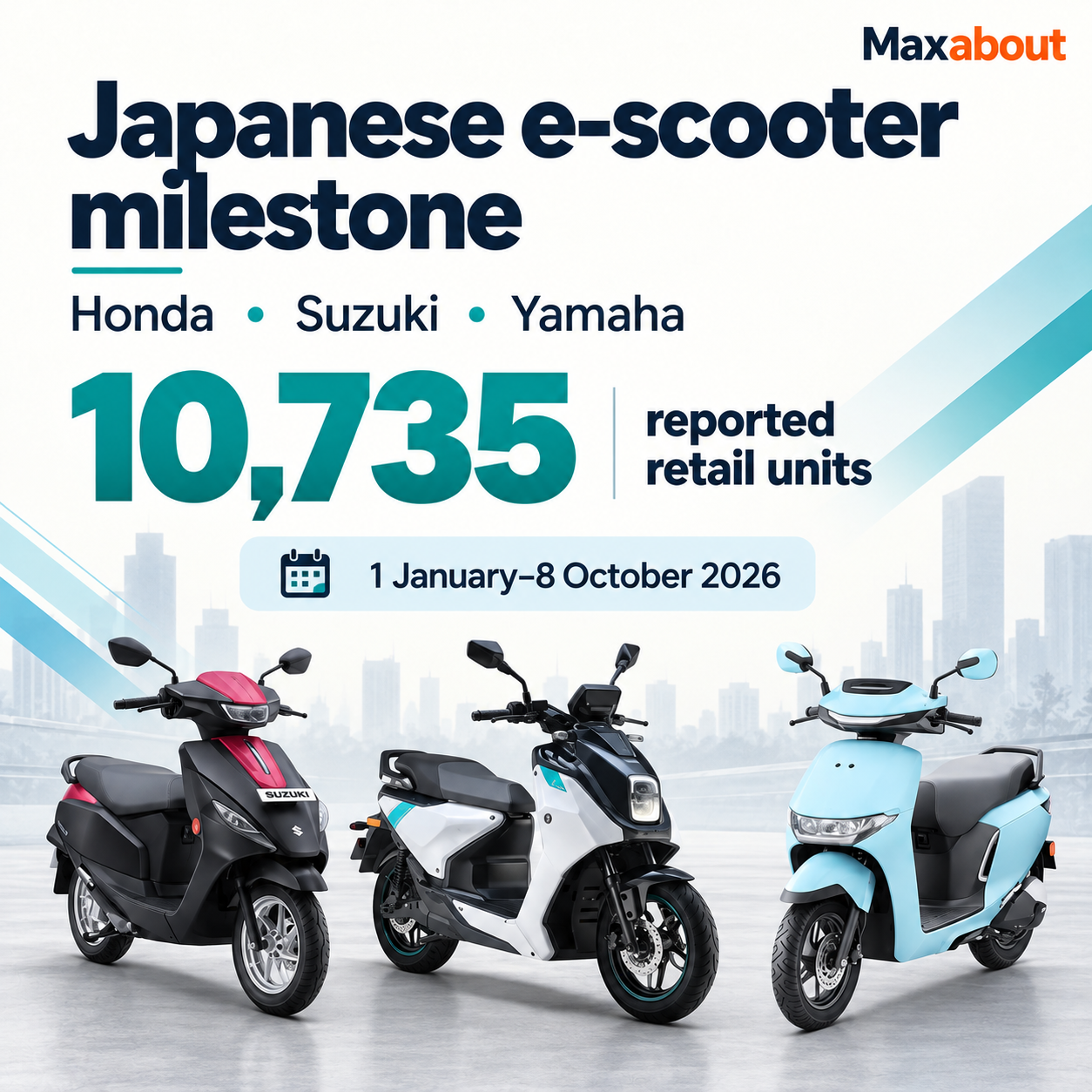
Honda, Suzuki and Yamaha together recorded 10,735 electric-scooter retail units in India between 1 January and 8 October 2026, according to published VAHAN-derived reporting. The combined total has crossed 10,000, but its share of the reported electric two-wheeler market remains small. The figures d...
Honda, Suzuki and Yamaha together recorded 10,735 electric-scooter retail units in India between 1 January and 8 October 2026, according to published VAHAN-derived reporting. The combined total has crossed 10,000, but its share of the reported electric two-wheeler market remains small. The figures describe retail registrations over a stated window, rather than factory dispatches or a completed full calendar year.
How the reported total breaks down
Autocar India's checked report provides separate totals for all three manufacturers. Honda accounts for 5,536 units, Suzuki for 4,133 and Yamaha for 1,066. These add to the combined 10,735. The figures are brand-level electric-scooter totals, rather than a complete model-by-model ranking.
| Manufacturer | Reported retail units | Period |
|---|---|---|
| Honda | 5,536 | 1 January–8 October 2026 |
| Suzuki | 4,133 | 1 January–8 October 2026 |
| Yamaha | 1,066 | 1 January–8 October 2026 |
| Combined | 10,735 | 1 January–8 October 2026 |
Within this three-brand total, the calculated shares are approximately 51.57% for Honda, 38.50% for Suzuki and 9.93% for Yamaha. Those percentages use the group total as their denominator. They are not the brands' individual shares of the entire Indian electric two-wheeler market.
Keep monthly and year-to-date comparisons separate
The same published report gives an overall electric two-wheeler total of 16,10,854 for 1 January–8 October. Against that stated denominator, the three manufacturers' 10,735 units represent approximately 0.666%, or about 0.67% when rounded.
For September alone, the trio recorded 1,996 units against a reported Indian electric two-wheeler total of 2,07,850. That calculation is approximately 0.96%, which is often described as about 1%. The September share and the year-to-date share answer different questions because their reporting windows differ.
| Window | Trio retail units | Reported market denominator | Calculated share |
|---|---|---|---|
| 1 January–8 October 2026 | 10,735 | 16,10,854 electric two-wheelers | About 0.67% |
| September 2026 | 1,996 | 2,07,850 electric two-wheelers | About 0.96% |
These are calculations from the published figures, not a fresh independent extraction of the VAHAN dashboard. Dashboard coverage, filters and later revisions can affect a reproduced count. A registration-based retail figure should also be kept separate from a manufacturer's wholesale or production announcement.
What the milestone means
The three manufacturers now have a combined five-figure retail total during the stated period. That establishes a larger operating base, while the market-share comparison shows that the group remains a small part of India's electric two-wheeler registrations. A positive absolute milestone and a modest relative share can both be true.
The checked coverage identifies Honda's Activa e and QC1, Suzuki's e-Access and Yamaha's EC-06 as products associated with these brands' entry into the category. It does not provide a complete model-wise split for the cumulative total. The figures therefore cannot establish which individual scooter leads within each manufacturer's range.
For readers comparing electric two-wheelers, registration volumes provide market context. They do not establish an individual model's battery life, real-world range, service quality or suitability for a particular city. Those need their own model and local-network checks.
Avoid the mixed-window headline
A cumulative figure through 8 October should not be presented as a direct comparison with a single week of another manufacturer's sales. The appropriate comparison uses the same period, geography, registration basis and vehicle category. This article therefore uses the stated year-to-date and September windows separately.
Product pricing, launch timing and network coverage may help explain differences between brands, but the registration totals alone do not prove a single cause. No unsupported conclusion about customer satisfaction, reliability or future sales is drawn from this dataset.
FAQs
Is 10,735 the total for the whole of 2026?
No. It is the published combined retail figure for 1 January–8 October 2026.
What is Yamaha's separate reported total?
The checked Autocar India report gives 1,066 units for the same period.
Why are the market shares about 0.67% and 0.96%?
The first uses the year-to-date period; the second uses September alone. Each divides the trio's units by the market total for its own window.
Are these factory dispatch figures?
The checked coverage describes VAHAN-derived retail registrations, which should not be equated with wholesales.
The Japanese e-scooter retail milestone is best understood with its reporting period and denominator intact: 10,735 combined units through 8 October, with a reported market share still below 1% over that cumulative window.
Explore the story
Related news

Share your view and join the discussion.
Earn reward points for every comment and get a chance to win ₹1,000 in our weekly lucky draw. Sign in with Google in one tap.
Start the conversation
No one has commented on this article yet. Be the first to share your view.
Want to read more automotive news?
Stay updated with the latest car launches, reviews, and industry insights.
Browse All News