
Honda India 125cc and EV Push Planned for 2028
Honda doesn't make quiet moves. So when word started circulating about a serious dual push — doubling down on 125cc commuters and accelerating an EV roadmap for 2028 — it felt like something worth paying attention to.This isn't just another product announcement. It looks more like Honda recalibratin...
Editorial Team
Honda doesn't make quiet moves. So when word started circulating about a serious dual push — doubling down on 125cc commuters and accelerating an EV roadmap for 2028 — it felt like something worth paying attention to.
This isn't just another product announcement. It looks more like Honda recalibrating how it sees India entirely. Not as a high-volume, low-margin afterthought, but as a market worth genuinely investing in — on two very different fronts at once.
Think about who actually buys two-wheelers in India. The person riding to a software office in Pune every morning. The courier delivery rider weaving through Bengaluru traffic. The small shop owner in Jaipur who needs something reliable, affordable to run, and easy to service. These are real, everyday buyers — and the 125cc segment is their world. Honda clearly hasn't forgotten that.
But then there's the other side of this story. EVs. The 2028 target suggests Honda is thinking seriously about timing — not rushing, but not sleeping either.
What makes this interesting is the combination. Most manufacturers are sprinting toward EVs while quietly neglecting their bread-and-butter commuter lineup. Honda appears to be betting it can do both — and that tension, frankly, is what makes this strategy worth watching closely.
Why 125cc Still Rules the Road in India — And Honda Knows It
Walk through any street in Lucknow at 9am, or navigate the signal-heavy stretches of Chennai's Anna Salai, or follow the daily rhythm of a Nagpur government employee heading to work — and you'll notice something consistent. A 125cc commuter. Quietly running. Reliably showing up.
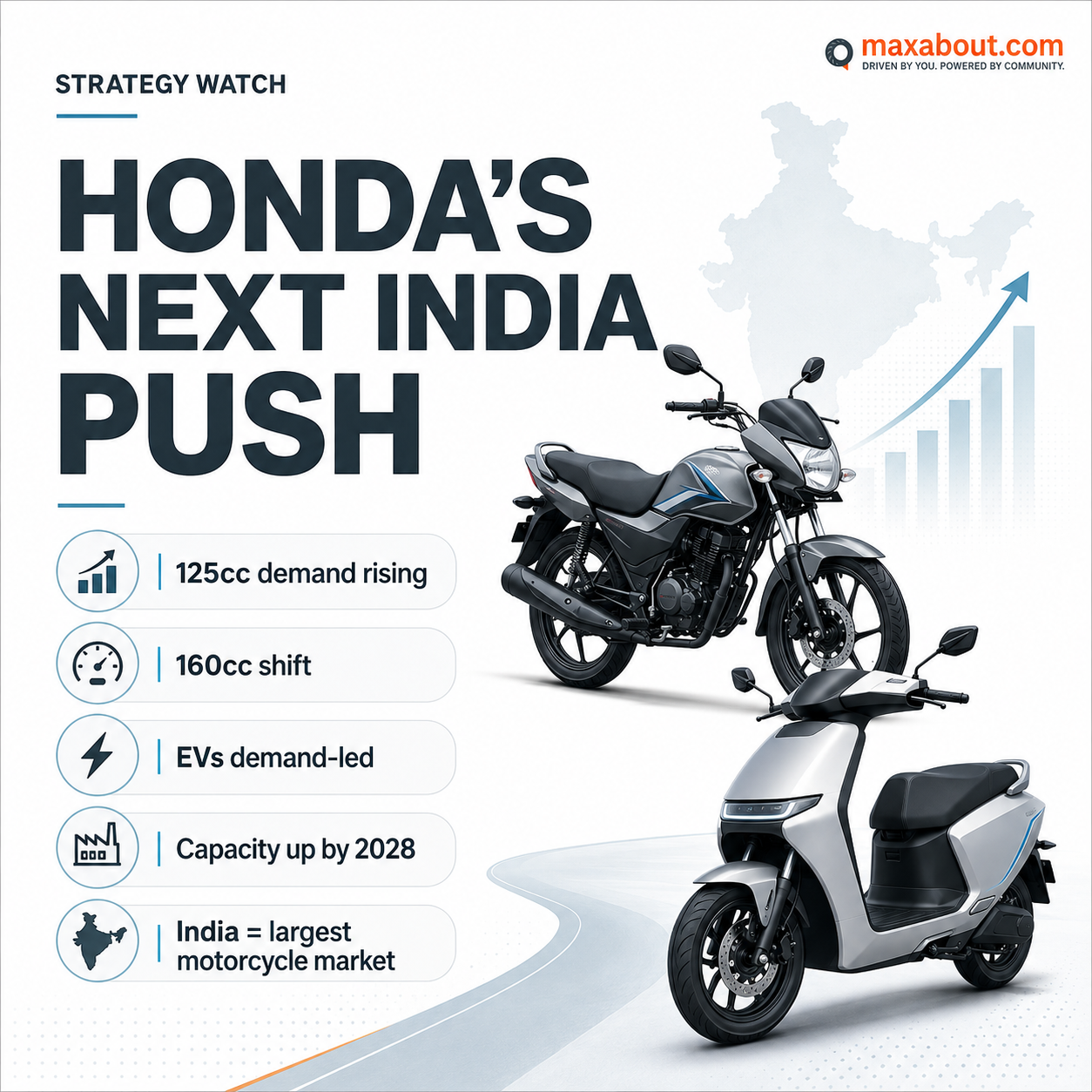 This isn't coincidence. The 125cc segment works because Indian roads demand a very specific kind of motorcycle. Not fast. Not flashy. Just dependable, fuel-efficient, and genuinely affordable to run over five to eight years.
Industry sales data has consistently shown that the 100cc-to-125cc band accounts for the largest volume in two-wheeler sales. And within that, 125cc has been steadily gaining ground as buyers step up from 100cc options, drawn by better highway composure and marginally stronger performance — without a significant jump in running costs.
Honda's Shine and SP 125 have been solid performers in this space. From what general market feedback and sales trends suggest, both models hold strong resale value and relatively low service costs — two factors that matter enormously to buyers in smaller cities and semi-urban areas where long-term ownership economics drive every purchase decision.
The sweet spot here is real. A 125cc engine in stop-and-go traffic returns fuel efficiency figures that EVs haven't yet matched in total cost transparency — especially when charging infrastructure remains thin outside metros. For someone in a tier-2 town, range anxiety isn't a buzzword. It's a genuine daily concern.
That's precisely why this segment isn't going anywhere soon.
What Honda Is Planning for Its 125cc Lineup by 2028
Honda hasn't been quiet about this. Official announcements and industry reports both point toward a deliberate push to refresh and expand the 125cc segment well before 2028. The signals are there if you follow them closely.
The most credible expectation centers on wider OBD2 compliance across the entire 125cc range. Regulatory timelines are firm on this, and Honda will need every model — from the Shine to the SP 125 — fully aligned. That's not optional. What's interesting is how Honda might use that compliance window to bundle in meaningful upgrades rather than just ticking a regulatory box.
From what industry observers have noted, smarter instrument clusters are likely on the roadmap. Bluetooth connectivity, turn-by-turn assist, and trip analytics — features that already exist on premium segments — could trickle down. Buyers in this space are increasingly aware of what's available higher up, and they're asking questions.
Build quality is another area where competition is applying real pressure. Brands have closed the gap noticeably, and Honda will need to respond with tighter fit-and-finish, better switchgear feel, and possibly revised suspension tuning suited to rougher roads — think Nagpur's older inner-city stretches or rural Karnataka highways.
Whether these arrive as facelifts or entirely new platforms remains unclear. But the direction feels deliberate.
Honda's EV Roadmap for India: Ambitious, But Is It Realistic?
Beyond the 125cc push, Honda has flagged electric vehicle intentions for India with 2028 appearing repeatedly in official communications. That timeline covers both two-wheelers and potentially entry-level cars, though specifics remain deliberately vague at this stage.
Honestly? Announcements are easy. Execution is the hard part.
The infrastructure reality outside major metros is still uncomfortable. Charging networks in cities like Pune or Bengaluru have improved, but travel even an hour toward smaller towns and the picture changes quickly. For a brand like Honda, which built its Indian reputation on reliability across diverse conditions, launching EVs that only work confidently in urban pockets would be a serious contradiction.
Battery cost pressures add another layer of difficulty. Indian buyers are exceptionally price-sensitive at entry level, and bridging the gap between what an EV costs to build and what buyers are willing to pay remains genuinely unsolved at scale. Competition from established players who entered earlier only tightens that pressure.
That said, the opportunity is real. Government incentives, improving grid reliability, and growing urban buyer openness to electric mobility create a window Honda would be unwise to ignore.
2028 is still years away. What matters now is whether the groundwork — local manufacturing, supply chain decisions, service network preparation — actually happens quietly behind the scenes.
How Honda's Strategy Stacks Up Against the Competition
The Indian two-wheeler market doesn't wait for anyone. While Honda has been deliberate and measured in its planning, several manufacturers have already staked out aggressive positions — both in the commuter 125cc space and in electric mobility.
On the EV side, some players entered the market years ahead of Honda's projected timeline. They've dealt with early adoption struggles, range anxiety concerns, and after-sales growing pains — but they've also built brand recognition among electric-curious buyers. Being first matters in consumer perception, even when the product isn't perfect yet. Honda entering in 2028 means it skips those painful early lessons, but it also means the conversation may already be happening without them.
In the 125cc commuter segment, competition has only intensified. Multiple manufacturers have expanded their lineups, improved fuel efficiency figures, and aggressively priced their offerings for value-conscious buyers across tier-2 and tier-3 cities. Honda isn't playing from behind here — it already holds strong ground — but sustaining that requires constant product refreshes, not just brand coasting.
Where Honda genuinely holds an edge is something harder to manufacture quickly: trust. Its service network across India — spanning smaller towns where riders actually depend on their bikes daily — is a real differentiator. From what most long-term owners report, reliability and resale value consistently rank among Honda's strongest suits.
Rivals may move faster. But Honda moving confidently, with that reputation behind it, could still land effectively.
What Indian Buyers Actually Want — And Whether Honda Is Listening
Here's the thing about Indian buyers: they are remarkably practical. Not in a cynical way — just grounded. A rider in Nagpur or Coimbatore upgrading from a 110cc to a 125cc is not chasing spec sheets. They want to know one thing: will this cost me less to run, and will someone fix it if it breaks down near home?
That question matters more than launch events or global strategy decks.
From what user feedback and ownership surveys consistently show, the priorities tend to cluster around the same things regardless of city or income bracket — fuel efficiency that holds up in real traffic, not just highway figures. Service centers close enough to actually use. Spare parts that don't require a two-week wait. And EMI options that don't stretch a household budget uncomfortably thin.
Honda's reported 125cc push for 2028 does speak to some of this. The 125cc segment sits at a sweet spot — meaningful upgrade from entry-level commuters, without crossing into premium pricing territory that most families won't consider. A buyer in a Tier 2 city who currently rides a basic 110cc understands this calculation instinctively.
The EV ambition, though, feels further from that same buyer's reality. Charging anxiety is real. Not theoretical — genuinely real, especially outside metro corridors. Someone commuting daily in a city like Bhopal or Lucknow needs charging infrastructure that simply isn't widespread yet.
Whether Honda's timeline accounts for that gap honestly — or optimistically — will matter enormously.
The Road to 2028: Key Milestones to Watch For
If you are planning a two-wheeler purchase in the next two to three years and Honda's upcoming lineup interests you, the waiting game requires a clear framework. Not vague optimism — actual markers worth tracking.
A few things will signal early whether this strategy is genuine or aspirational:
Auto Expo appearances: Honda's 2026 Expo presence will likely reveal production-ready 125cc variants and possibly a first serious EV concept for India.
Manufacturing announcements: Any confirmed capacity expansion at Honda's Rajasthan or Karnataka facilities would indicate real commitment rather than scheduled press releases.
Government FAME III updates: Revised EV incentives targeting sub-₹1 lakh two-wheelers would dramatically change Honda's EV pricing math.
125cc product launches: Watch for fuel-injected, feature-forward updates to existing platforms — early indicators of the broader 2028 push.
Honestly, the 125cc direction feels credible and close. The EV timeline feels ambitious but not impossible — contingent heavily on infrastructure and policy alignment outside Honda's direct control.
Stay watching. Just stay measured while doing it.
Explore the story
Related news
Share your view and join the discussion.
Earn reward points for every comment and get a chance to win ₹1,000 in our weekly lucky draw. Sign in with Google in one tap.
Start the conversation
No one has commented on this article yet. Be the first to share your view.
Want to read more automotive news?
Stay updated with the latest car launches, reviews, and industry insights.
Browse All News