
Honda Airblade Design Patented in India: What It Means
When a manufacturer files a design patent in India, it rarely happens by accident. These filings cost money, require legal groundwork, and — more importantly — they protect intellectual property in a specific market. That last part is the detail worth paying attention to.Honda has recently filed a d...
Editorial Team
When a manufacturer files a design patent in India, it rarely happens by accident. These filings cost money, require legal groundwork, and — more importantly — they protect intellectual property in a specific market. That last part is the detail worth paying attention to.
Honda has recently filed a design patent for the Airblade in India. For most Indian riders, that name probably draws a blank. The Airblade is a premium scooter that has built a solid reputation across Southeast Asian markets, particularly Thailand and Vietnam, where it sits comfortably in the sporty commuter segment. Think sharp styling, a relatively performance-oriented approach to daily riding, and a step up from your typical mass-market scooter.
So why does this patent filing matter here? Because Honda has used this exact playbook before. Design patents in new markets often serve as an early signal — a way to secure ground before any formal announcement. It does not confirm a launch. But it does suggest Honda is at least seriously evaluating whether the Airblade has a place in India.
Given how competitive and fast-moving the Indian premium scooter space has become, that evaluation makes a lot of sense right now. This is worth watching closely.
What Exactly Is the Honda Airblade and Why Does It Stand Out
So what is the Honda Airblade, really? At its core, it is a maxi-style scooter — a category that sits noticeably above the everyday commuter scooters most Indian buyers are familiar with. It originates from Southeast Asian markets, where Honda developed it specifically to meet demand for something more premium, more aggressive-looking, and more capable than a basic urban runabout.
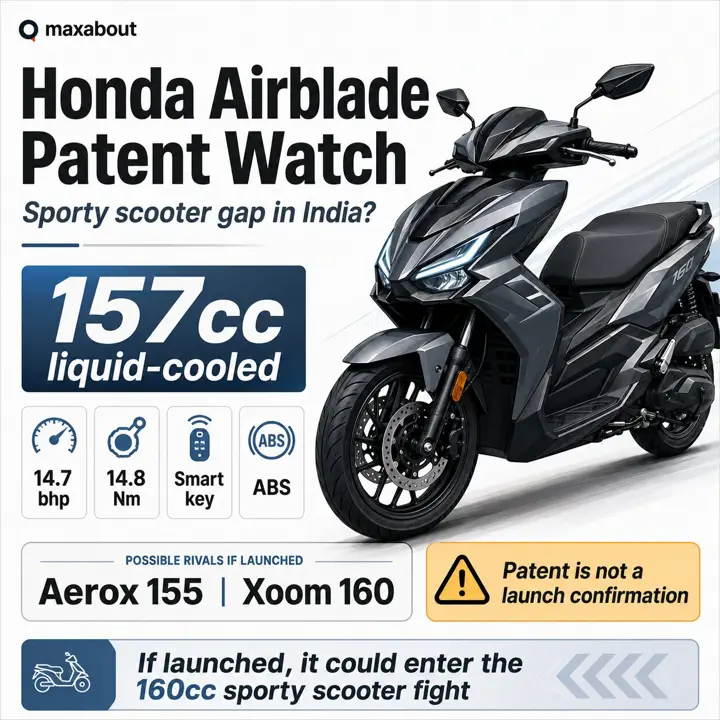 The design is the first thing that grabs attention. Unlike the rounded, conservative bodywork you typically see on popular Indian scooters, the Airblade carries sharp character lines, a sporty front fascia, and a distinctly angular silhouette. It looks like something built with intent — not just to move people, but to make a statement while doing it. From what reviews and coverage out of Vietnam and Thailand suggest, the overall fit and finish lives up to that visual promise.
International versions have been offered in 125cc and 160cc engine configurations, catering to different rider needs. The 160cc variant especially positions itself as something genuinely capable on faster roads — not just a city-only machine.
The lighting setup across the Airblade range is fully LED, front and rear, which still feels like a premium touch in this segment. Underseat storage is present but prioritised differently compared to typical Indian scooters — the focus here is clearly on sporty proportions over pure practicality. That is a trade-off worth knowing about.
What a Design Patent Filing Actually Means
Before excitement turns into showroom visits, it is worth understanding what a design patent filing actually is — and what it is not.
A design patent protects the visual appearance of a product. It covers the shape, lines, and aesthetic elements — not the mechanical specifications or the intention to sell. It is essentially Honda saying, "this look belongs to us in this market." That is very different from a homologation filing or a type approval, which are the regulatory steps that actually clear a vehicle for road use and sale in India.
Companies file design patents strategically, sometimes years before any confirmed launch. It is standard intellectual property practice — protecting an asset in a market they may or may not enter, simply to keep options open and prevent copying.
History gives us mixed signals here. The Honda X-ADV had design patent activity in India before it arrived. But there are also examples where filings quietly disappeared with no launch following. A filing is a possibility, not a promise.
So the honest reading is this — Honda clearly values the Airblade's design enough to protect it here. That signals genuine interest in the Indian market. But it stops well short of confirming anything. Managing that expectation now saves disappointment later.
How the Honda Airblade Could Fit Into Indian Road Conditions and Riding Culture
Setting aside the launch question for a moment — let's think practically. If the Airblade does arrive, does it actually make sense for how Indians ride every day?
The honest answer is: partly yes, partly no.
Ground clearance is the first real concern. Cities like Pune or Lucknow have stretches of road that look fine on Google Maps but feel completely different at 7 AM after overnight rain. Speed breakers in smaller towns are often unmarked and aggressively tall. From what I've seen in reviews of similar premium scooters, the Airblade's low, sporty stance — designed for smooth Southeast Asian roads — may not handle these situations as confidently as something like an Activa or Jupiter, which are built with Indian road chaos baked into their DNA.
Urban traffic density is another angle worth thinking about. In Mumbai or Delhi, filtering through tight gaps is practically a survival skill. A slightly wider, premium scooter becomes genuinely harder to maneuver in those conditions. The Airblade's dimensions, while sleek, aren't compact in the traditional Indian commuter sense.
Then there's fuel efficiency. Indian scooter buyers — even those spending ₹1.5 lakh or more — watch mileage carefully. The Airblade's performance-first tuning may deliver respectable numbers, but if it can't match the 45-50 kmpl benchmark that buyers mentally set, that becomes a conversation point at every dealership.
Parking in dense localities adds one more layer. Not everything premium translates perfectly here, and that's worth acknowledging upfront.
The Premium Scooter Segment in India: Is There Room for the Airblade?
Despite those practical questions, the market context actually works in Honda's favour. The premium scooter segment in India has quietly grown into something substantial over the last few years. Buyers are spending real money here now.
Post-pandemic, something shifted in how urban professionals think about their daily commute. There's a genuine willingness to spend ₹1.2 lakh to ₹1.5 lakh — and sometimes beyond — on a scooter that feels premium, looks distinctive, and offers more than basic transportation. The success of feature-rich scooters already competing in this band validates that appetite completely.
The more interesting question is whether Indian buyers are ready for a scooter that leads with sporty character rather than pure practicality. From what the market has shown recently, I think a section of buyers absolutely is. Young professionals in Bengaluru, Pune, and Hyderabad are increasingly choosing products that reflect a lifestyle, not just fulfil a commute requirement.
And if Honda does bring the Airblade here, they arrive with one enormous structural advantage — their service network. Thousands of authorised service centres spread across metros, tier-2 cities, and smaller towns means ownership anxiety drops considerably. That network trust is genuinely hard for newer brands to replicate, and for a premium product, after-sales confidence matters as much as the purchase decision itself.
What Indian Buyers Would Expect — And What Honda Needs to Get Right
If the Airblade does arrive here, pricing will be the first conversation. Based on Honda's typical India positioning strategy and what the international variant offers, a ₹1.1 lakh to ₹1.4 lakh range feels like a reasonable speculation — though that remains purely an estimate until official announcements surface.
At that price point, buyers will expect serious equipment. A fully digital instrument cluster is non-negotiable now. Bluetooth connectivity, USB charging, and full LED lighting are genuinely expected at this segment, not bonus features. The international Airblade actually checks most of these boxes reasonably well, which is encouraging.
Under-seat storage capacity will also matter enormously. Indian buyers carry helmets, laptop bags, groceries — practical storage isn't optional at this price. From what international reviews suggest, the Airblade's storage is decent but perhaps not exceptional.
Where Honda will need deliberate adaptation is suspension tuning. Roads in cities like Nagpur, Lucknow, or even stretches within Mumbai demand softer, more forgiving setup than what European or Southeast Asian markets typically require. The international specification may feel firm on broken surfaces.
The fuel tank is another genuine concern. Longer commutes between fuel stations in smaller cities make a larger tank preferable. If Honda can address these two specific points during localisation, the Airblade could genuinely become a compelling proposition rather than just an attractive one.
Honda's Strategy in India and the Bigger Picture
Honda Motorcycle and Scooter India has not been standing still. Over the past few years, there has been a deliberate, measured push upmarket — the Activa Premium edition, the H'ness CB350, the SP160. These are not accidental product decisions. They reflect Honda reading a market that is slowly but genuinely changing.
The Airblade patent fits this pattern quite naturally. Honda appears to be testing the appetite for globally-positioned products rather than purely India-specific, cost-driven ones. From what industry observers have noted, this approach is gaining traction precisely because the buyer profile is shifting.
Younger riders today — particularly in cities like Pune, Bengaluru, and Hyderabad — are increasingly drawn to products that carry design identity and international presence. Running costs still matter, but they are no longer the only conversation.
In my view, this signals something meaningful for the scooter segment overall. We may genuinely be entering a phase where aspiration and aesthetics carry real commercial weight. That is a healthy development. It pushes every manufacturer to think beyond the purely functional.
Whether the Airblade ultimately arrives or not, the fact that Honda is filing these patents tells its own story about where this market is heading.
Final Thoughts: Should Indian Riders Get Excited About the Honda Airblade?
Honestly? A measured yes. The Airblade's design is genuinely compelling, and Honda's instinct to explore this territory for India feels well-timed. Rider preferences are shifting. Premium scooters are no longer a fringe conversation.
But a patent is not a promise. It is an intention, sometimes a tentative one. So while the excitement is understandable, it is worth keeping expectations calibrated.
What works in the Airblade's favour is straightforward. Honda's service network is unmatched across India, which removes one of the biggest anxieties around owning a premium two-wheeler. The design appeals to a younger, more style-conscious buyer. And the brand trust Honda carries in this country is genuinely hard to overstate.
The real questions remain around pricing and road practicality. If Honda positions this north of ₹1.5 lakh, the audience narrows considerably. Suspension tuning for Indian roads will matter enormously.
So here is what I would like to know from you. Would a premium Honda scooter like the Airblade genuinely interest you? And more importantly, what price point would actually make it worth your consideration? That answer probably matters more to Honda's India team than any patent filing ever could.
No comments yet
Be the first to share your thoughts!
Want to read more automotive news?
Stay updated with the latest car launches, reviews, and industry insights.
Browse All News