
Hero's Sub-₹1 Lakh Electric Scooter Launch: August 2026 Plans Revealed
Hero's New Affordable Electric Scooter: What We Know So FarHero MotoCorp is making a significant move in the electric two-wheeler space with plans to launch a sub-₹1 lakh electric scooter in August 2026. This price point is particularly crucial in the Indian market where cost sensitivity remains a m...
Editorial Team
Hero's New Affordable Electric Scooter: What We Know So Far
Hero MotoCorp is making a significant move in the electric two-wheeler space with plans to launch a sub-₹1 lakh electric scooter in August 2026. This price point is particularly crucial in the Indian market where cost sensitivity remains a major factor in EV adoption.
Currently, Hero's Vida electric scooter lineup sits in the premium segment, with the V1 Pro priced around ₹1.45 lakh and the V1 Plus at approximately ₹1.30 lakh (ex-showroom). These existing models, while feature-rich, haven't captured the mass market that Hero traditionally dominates with its ICE offerings.
I think this sub-₹1 lakh strategic move makes perfect sense for Hero, especially considering the growing competition from Ola Electric, TVS, and Bajaj in the affordable EV space. For urban commuters dealing with rising fuel costs and traffic congestion in cities like Delhi, Mumbai, and Bangalore, an affordable e-scooter from a trusted brand like Hero could be the tipping point for many fence-sitters.
Expected Features and Specifications
Looking at Hero's trajectory with their existing Vida models, this sub-₹1 lakh variant will likely make some calculated compromises. I expect a smaller battery pack, probably around 1.5-2 kWh compared to the premium models' 3+ kWh capacity. This would translate to a real-world range of approximately 75-90 km on a full charge – sufficient for typical urban commutes in cities like Pune or Hyderabad.
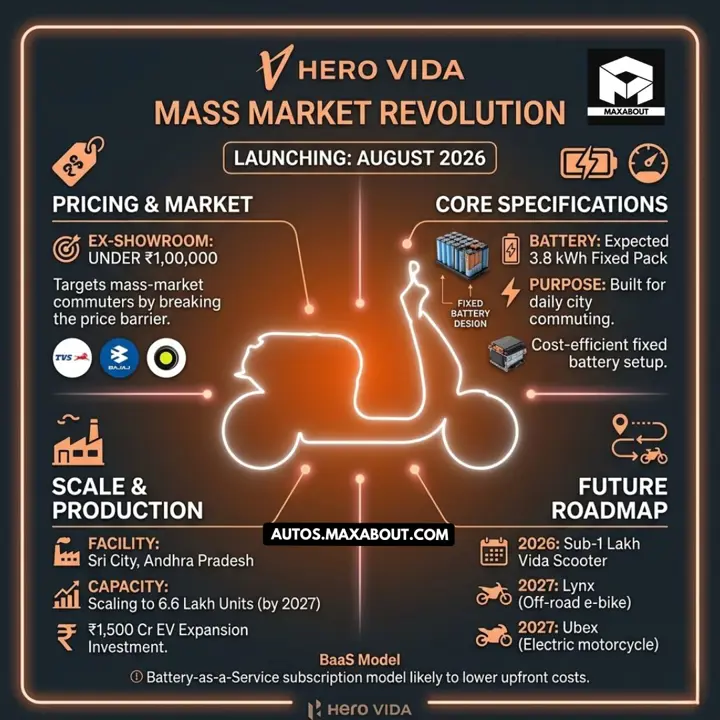 The motor output will likely be modest – around 1.5-2 kW – prioritizing efficiency over acceleration. This makes sense for a city commuter where stop-and-go traffic rarely allows utilizing higher power anyway. Charging time might be around 4-5 hours on standard domestic outlets, with perhaps a basic fast charging option.
For the price point, Hero might offer:
A simplified digital display (not the fancy touchscreen)
Basic connectivity features rather than the comprehensive app integration
Standard suspension setup instead of adjustable options
Drum brakes instead of disc brakes on both wheels
I think they'll maintain decent build quality and some signature elements like LED lighting, but may use more cost-effective materials for body panels. The key advantage will be access to Hero's extensive service network – a crucial factor for mainstream EV adoption in tier-2 and tier-3 cities.
Market Positioning and Competition
The sub-₹1 lakh electric scooter segment in India is becoming increasingly competitive, and Hero's upcoming Vida model will face strong rivals. Currently, models like Ola S1X (starting ₹89,999), TVS iQube (from ₹99,000), and Bajaj Chetak's base variant occupy this space, with Ather also rumored to be working on a more affordable option.
What I find interesting about Hero's approach is their potential to leverage manufacturing scale that smaller EV startups simply can't match. With their announced 2X production boost by 2027, they could achieve price advantages through economies of scale – something particularly important for cost-sensitive Indian buyers.
In terms of differentiation, I believe Hero will focus on three key areas:
Service network reliability – The vast Hero dealership network provides confidence for buyers in smaller cities
Battery reliability – Emphasizing safety and longevity rather than class-leading range
Value-oriented packages – Possibly including free service packages or extended warranties
For typical middle-class Indian consumers weighing the switch to electric, these practical considerations often matter more than high-end features. If Hero can deliver a scooter that offers 80-90km real-world range with demonstrably lower running costs than petrol alternatives, they could find significant success in this segment.
Hero's Production Expansion Plans
Hero's ambitious plan to double Vida production by 2027 speaks volumes about their confidence in the electric two-wheeler market. From what I understand, they're upgrading their manufacturing capabilities at the Chittor facility while also preparing to leverage their existing ICE production infrastructure for EV components.
This production boost should address one of the biggest pain points in the EV market - waiting periods. Currently, many electric scooters have waiting times of 2-3 months in major cities, which turns off potential buyers. With expanded capacity, Hero could potentially bring this down to 2-3 weeks.
What I find particularly interesting is how this fits into Hero's broader strategy. Rather than creating separate premium and mass-market divisions like some competitors, they appear to be focusing on scaling a single, cost-optimized platform that can be produced efficiently at volume.
The timing also suggests Hero is preparing for the tipping point around 2027-28 when battery prices are expected to drop below the critical ₹7,500/kWh threshold, making electric two-wheelers genuinely cost-competitive with petrol models even without subsidies. By establishing production capacity ahead of this shift, they're positioning themselves to capitalize when mainstream adoption accelerates.
What This Means for Indian EV Adoption
An affordable electric scooter from a major player like Hero could be the catalyst India's EV transition needs. I think we're approaching a critical moment where pricing finally aligns with what average Indians can afford. When trusted brands offer electric options under ₹1 lakh, it removes one of the biggest barriers to adoption.
The ripple effects should be significant. More affordable EVs will likely accelerate charging infrastructure development, especially in tier-2 and tier-3 cities where it's currently sparse. I've noticed many housing societies in Pune and Bangalore already installing charging points in anticipation of growing demand.
Government policies are increasingly supportive too. The FAME subsidies might be phased out, but many states are introducing their own incentives, road tax exemptions, and simplified registration processes. With Hero ramping up production, we can expect more competitive pricing across the industry.
For our congested cities like Delhi and Mumbai, the environmental impact could be substantial. Electric scooters produce zero tailpipe emissions, and when you consider that two-wheelers make up nearly 75% of India's vehicle fleet, the potential air quality improvements are enormous.
Potential Challenges and Limitations
Despite the promising outlook, Hero faces several hurdles with this ambitious launch. Battery technology remains a significant constraint - while prices are falling, truly affordable batteries with decent range still struggle in extreme Indian temperatures, especially during summer months in cities like Chennai and Jaipur.
The charging infrastructure presents another major challenge. While metros are seeing rapid charger deployment, tier-2 and tier-3 cities lag considerably behind. I've heard from friends in smaller towns like Jalandhar and Trichy that finding reliable charging points is still a significant concern that would make them hesitate before committing.
Consumer perception about electric vehicle reliability hasn't fully matured either. Many potential buyers worry about:
Resale value uncertainty
Battery replacement costs after 3-5 years
Service network readiness for electric vehicles
Meanwhile, competition is intensifying. Ola Electric, Ather, and even traditional players like TVS are expanding aggressively in this space, potentially squeezing Hero's margins and market share.
Is It Worth Waiting For?
Deciding whether to wait for Hero's upcoming sub-₹1 lakh electric scooter involves weighing several factors. For daily commuters who need immediate transportation, waiting until 2026 simply isn't practical. If you're spending significant money on ride-sharing or public transport, the economics favor buying something now.
From my perspective, waiting makes sense if:
You already have a reliable vehicle for current needs
Your budget is strictly under ₹1 lakh for an electric scooter
You value Hero's service network (which is unmatched in reach across India)
For urban riders dealing with tight parking and short commutes, existing options like Ather 450S or TVS iQube might better serve immediate needs. I think the technology improvements by 2026 will be substantial, but that's a long wait in a rapidly evolving market.
If you're particularly cost-sensitive, consider that first-generation electric scooters might see significant price drops as newer models arrive, potentially offering better value in 12-18 months rather than waiting 3+ years. The perfect vehicle is always the one that meets your needs today while fitting your financial situation.
Conclusion: The Road Ahead for Hero and Electric Mobility in India
Hero's ambitious sub-₹1 lakh electric scooter represents more than just another product launch—it signals a turning point for mainstream EV adoption in India. This move will likely push competitors to recalibrate their strategies, potentially triggering a wave of affordability across the market.
Looking ahead, I expect we'll see a gradual but definitive shift in urban transportation. As battery technology improves and production scales up, the total cost of ownership for electric vehicles should become increasingly favorable compared to petrol alternatives, especially in congested cities like Mumbai and Bengaluru.
For the average Indian consumer, patience might be rewarded with better technology at lower prices, but the EV revolution won't wait. The next 3-5 years will transform our streets, charging infrastructure, and relationship with personal mobility in ways we're only beginning to understand.
Explore the story
Related news

Share your view and join the discussion.
Earn reward points for every comment and get a chance to win ₹1,000 in our weekly lucky draw. Sign in with Google in one tap.
Start the conversation
No one has commented on this article yet. Be the first to share your view.
Want to read more automotive news?
Stay updated with the latest car launches, reviews, and industry insights.
Browse All News