
Hero MotoCorp FY27 Investment Plan: ₹1,500 Crore Allocated for EV & Scooter Growth
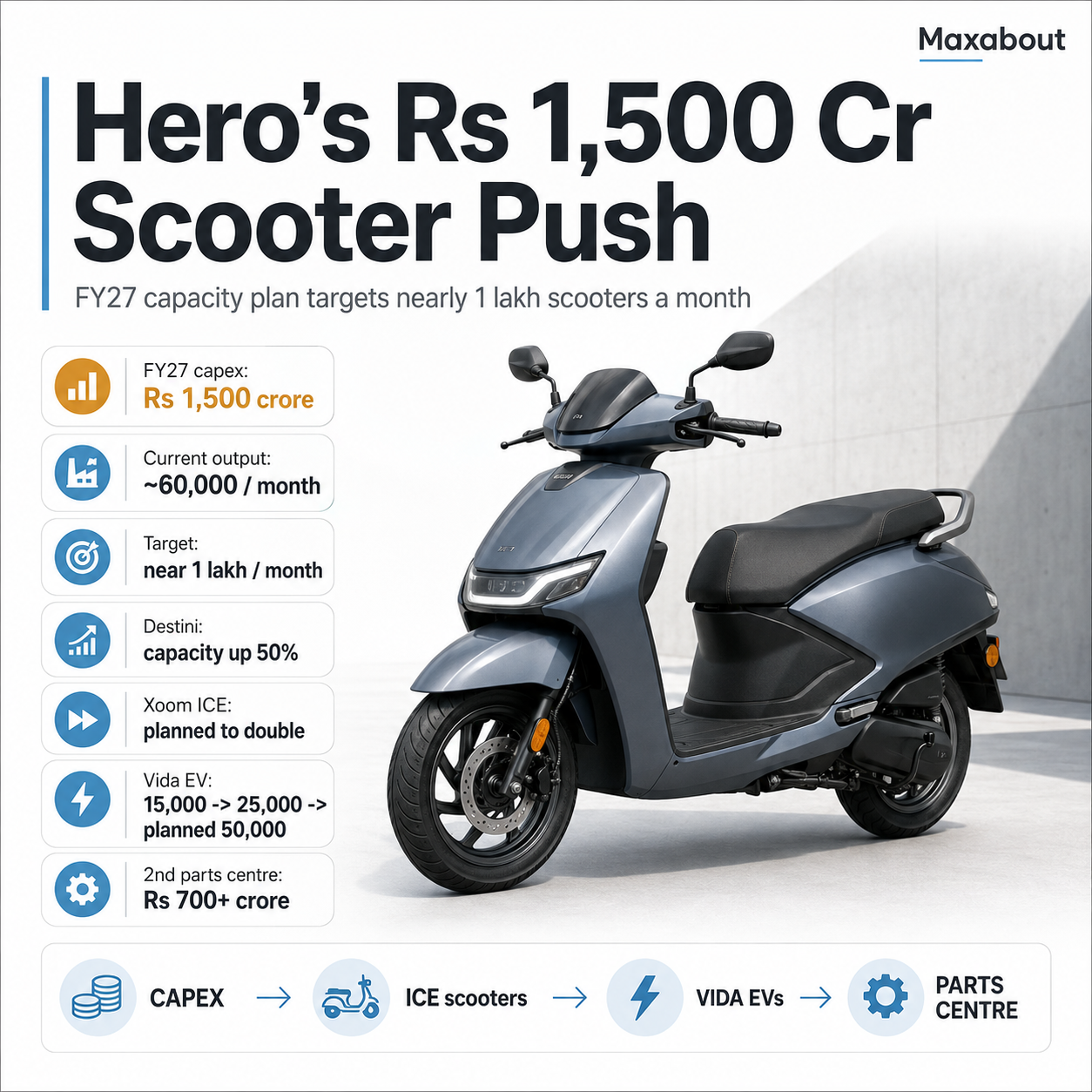
₹1,500 crore. That is not a small number by any measure. When Hero MotoCorp announced plans to pour that kind of capital into its operations for FY27, it was hard not to sit up and pay attention. This is one of the largest single-year investment commitments the company has made in recent memory, and...
Editorial Team
₹1,500 crore. That is not a small number by any measure. When Hero MotoCorp announced plans to pour that kind of capital into its operations for FY27, it was hard not to sit up and pay attention. This is one of the largest single-year investment commitments the company has made in recent memory, and the details behind it reveal something genuinely interesting about where India's two-wheeler market is heading.
Hero has long been the undisputed king of Indian motorcycles. Models like the Splendor have been the default choice for millions of daily commuters across smaller towns and rural India for decades. That dominance is real and well-earned. But here is the thing — the scooter segment has been quietly eating into overall two-wheeler growth, especially in urban markets, and Hero has historically played second fiddle there to rivals.
So when a company of Hero's scale decides to double its scooter production capacity, that signals a serious strategic shift. This is not routine maintenance spending. This is a deliberate pivot toward a segment they know they need to win.
For everyday buyers in cities like Pune, Hyderabad, or Lucknow, this investment could eventually mean more product choices, better availability, and potentially sharper pricing. From what industry analysts are observing, the timing looks calculated and the stakes are genuinely high.
Why Hero MotoCorp Is Doubling Down on Scooters Right Now
The answer starts with traffic. Anyone who has navigated Bengaluru's Outer Ring Road during peak hours or tried parking near a Mumbai local station knows exactly why scooters make sense in modern Indian cities. They thread through congestion effortlessly, fit into tight parking spots, and cost significantly less to run than a car. Urban India is not getting less crowded. It is getting more crowded, faster.
 That reality is reshaping what buyers actually want. Younger urban riders, particularly in the 22 to 35 age group, are gravitating toward scooters because automatic transmissions match the stop-and-go rhythm of city commuting far better than manual motorcycles. Women riders are an equally important part of this story. The scooter segment has seen consistent growth among women commuters across Pune, Delhi, and Chennai, and that demographic is only expanding.
Here is where Hero's competitive pressure becomes impossible to ignore. Honda Activa has dominated this space for years. TVS has built genuine momentum with Jupiter and NTorq. And then there is Ola Electric, which is pushing aggressive pricing and redefining buyer expectations entirely.
Hero has historically been a motorcycle company that also sold scooters. That distinction matters. This investment signals they want to flip that narrative, and right now, the market timing is arguably as favorable as it has ever been.
Breaking Down the ₹1,500 Crore Investment Plan
So where does ₹1,500 crore actually go? It sounds like a large number, and it is. But when you consider what doubling scooter capacity genuinely involves, the figure starts to feel less like excess and more like necessity.
Hero currently manufactures scooters primarily across its facilities in Dharuhera, Gurugram, and Haridwar. These plants have historically been optimized around motorcycle volumes. Retooling existing lines for scooter production at scale is not a simple reconfiguration. It involves dedicated assembly tracks, different component feeding systems, and significant floor space reallocation.
From what official announcements suggest, a meaningful portion of this capital expenditure is directed toward capacity expansion at existing plants rather than building entirely new facilities. That approach is faster and operationally smarter in the short term.
Now consider the unit economics. Hero's current scooter volumes sit roughly in the range of 300,000 to 400,000 units annually. Doubling that means targeting somewhere close to 700,000 to 800,000 units per year. That is a substantial jump, and it requires not just manufacturing capacity but a parallel investment in supply chain depth, vendor development, and logistics.
R&D allocation within this budget is arguably the most critical piece. Building new scooter platforms, particularly ones that can support both internal combustion and electric variants on shared architecture, is expensive and time-consuming. Based on industry reporting, Hero's electric scooter pipeline is expected to expand meaningfully through FY26 and FY27, which means this investment is carrying dual-platform ambitions simultaneously.
Hero's Scooter Portfolio Today: Honest Strengths and Real Gaps
Let's be direct about something. Hero MotoCorp is genuinely dominant in motorcycles. The Splendor is practically a national institution. But in scooters? The story is considerably less impressive, and I think most enthusiasts would agree with that assessment.
The Destini 125 and Maestro Edge 125 are decent, functional products. They are not bad scooters. But "not bad" is a weak position when you are competing against the Honda Activa, which has spent decades earning near-unshakeable consumer trust, or the TVS Jupiter, which consistently punches above its weight on refinement and features. Hero's scooters have struggled to find a compelling identity beyond competitive pricing.
Where Hero genuinely holds an advantage is its service network. Over 6,000 dealerships across India means even smaller towns have access to maintenance and parts. For rural and semi-urban buyers, that reach genuinely matters. Resale value for Hero two-wheelers also remains reasonable, partly driven by that service accessibility.
The real gaps, however, are harder to ignore. Refinement levels on Hero scooters have historically felt a step behind Honda. Vibration, engine smoothness, and overall ride polish are areas where owner feedback has been consistently mixed. Feature content has also lagged — segment rivals introduced USB charging, smart connectivity, and better instrument clusters earlier and more confidently.
The perception problem is perhaps the toughest challenge. Hero simply does not carry the same scooter credibility it holds in commuter motorcycles. That gap needs more than investment to close — it needs genuinely better products.
The Electric Scooter Dimension: Can Hero Catch Up in Time?
If there is one area where this ₹1,500 crore investment carries the most strategic weight, it is electric scooters. Hero knows this. The Vida brand was their public declaration that they intend to be serious players in this space — not just followers.
The Vida V1 had a reasonable debut on paper. Decent range, connected features, Hero's distribution muscle behind it. But honest market reception has been lukewarm. Early adopters flagged concerns around charging reliability, after-sales responsiveness, and whether the product felt truly premium against what Ather and TVS were already offering. From what owner communities and industry observers have noted, the Vida did not land with the kind of conviction Hero needed.
The competitive pressure is genuinely intense right now. Ola Electric has aggressive pricing and relentless volume. Ather has earned strong brand loyalty through product quality and a reliable charging network. TVS iQube benefits from TVS's trusted service reputation. Bajaj Chetak is leaning hard into build quality and dealer trust. Hero is entering a fight where each rival already has a defined identity.
Indian electric scooter buyers — particularly urban ones in cities like Bengaluru, Pune, and Delhi — are asking sharp questions before committing. Battery warranty terms, home charging feasibility, and the availability of trained service technicians matter enormously. These are not premium-buyer concerns anymore. They are mainstream purchase barriers.
This investment could meaningfully change Hero's position, but only if the capital translates into better products rather than just higher volumes.
What This Means for the Average Indian Scooter Buyer
Let's bring this down to earth. If you're someone in Indore or Coimbatore shopping for a scooter in the ₹80,000 to ₹1.2 lakh range, this investment news actually matters to you — more than it might seem at first glance.
More production capacity typically means shorter waiting periods. Right now, popular scooter variants in smaller cities sometimes stretch delivery timelines by weeks. That friction alone pushes buyers toward whatever is immediately available. If Hero expands meaningfully, that problem gets smaller.
There's also the service angle. From what industry observers consistently note, Hero already operates one of India's widest two-wheeler service networks. Greater investment often flows into parts availability and technician training — two things that directly affect long-term ownership costs in Tier 2 and Tier 3 cities where alternatives are limited.
Competition pressure is real too. When one major player scales up aggressively, rivals respond. That dynamic historically benefits buyers through better features at similar price points, even if not outright price cuts.
The honest caveat? Capacity alone doesn't guarantee a better product on your street. But if Hero channels this capital smartly, someone commuting daily in Lucknow could genuinely have more reliable, better-equipped scooter options within two years. That's worth paying attention to.
Risks and Challenges Hero Cannot Afford to Ignore
Scaling manufacturing sounds straightforward on paper. In practice, it rarely is. Doubling scooter capacity means coordinating supplier networks, workforce expansion, quality control systems, and logistics simultaneously. Any single bottleneck — a delayed component, a labour issue at a vendor plant — can derail timelines considerably. Hero has the experience, yes, but execution at this scale carries genuine risk.
Then there's the EV question, which honestly feels like the bigger uncertainty here. ₹1,500 crore is a significant number, but context matters. Ola Electric alone has raised multiples of that figure specifically for electric mobility. Bajaj and TVS are investing heavily in both ICE and EV simultaneously. If a meaningful portion of Hero's capital goes toward conventional scooter capacity while electric demand accelerates faster than anticipated, they could find themselves well-equipped for a market that's already shifting direction.
Consumer preference is moving. Slowly in rural areas, noticeably faster in metros. Someone buying a scooter in Pune or Bengaluru today is genuinely evaluating electric options in a way that simply wasn't happening three years ago.
Macroeconomic factors add further uncertainty. Credit availability for two-wheeler buyers remains sensitive to interest rate cycles, and rural demand — Hero's traditional stronghold — is closely tied to agricultural income and fuel price stability. Neither is fully predictable right now.
This investment isn't a guaranteed win. It's a calculated bet, and the margin for execution error is thinner than it looks.
The Bigger Picture: What Hero's Move Signals for India's Two-Wheeler Future
Step back from the balance sheets for a moment. What Hero is really telling us with this ₹1,500 crore commitment is something the data has been suggesting for years — India's urban mobility story is fundamentally rewriting itself around scooters. The motorcycle still dominates overall volumes, but the direction of travel is clear.
Cities like Bengaluru, Pune, and Hyderabad are increasingly scooter cities. Shorter commutes, stop-and-go traffic, the need for under-seat storage, and growing female ridership are all pulling buyers toward step-throughs. If Hero can build genuine credibility in this space, the industry stops being a two-player scooter market and becomes a genuinely competitive three-way contest. That outcome is unambiguously good for buyers — better products, more honest pricing, and faster innovation.
The electric dimension matters too. Doubling petrol scooter capacity now while simultaneously developing electric platforms isn't contradictory. It's practical. The transition will take longer than enthusiasts expect, and Hero needs revenue from petrol volumes to fund that future.
Personally, I think Hero can pull this off — but only partially in the next two to three years. Expect stronger products and improved retail experience. Expect the gap with Honda to narrow. But closing it completely? That takes longer than one investment cycle.
Explore the story
Related news
Share your view and join the discussion.
Earn reward points for every comment and get a chance to win ₹1,000 in our weekly lucky draw. Sign in with Google in one tap.
Start the conversation
No one has commented on this article yet. Be the first to share your view.
Want to read more automotive news?
Stay updated with the latest car launches, reviews, and industry insights.
Browse All News