
Four-layer motor insurance from 15 December: what car and bike owners must check
Four-layer motor insurance starts on 15 December 2026. Understand compulsory and optional cover, itemised premiums and the paperwork car and bike owners must check.
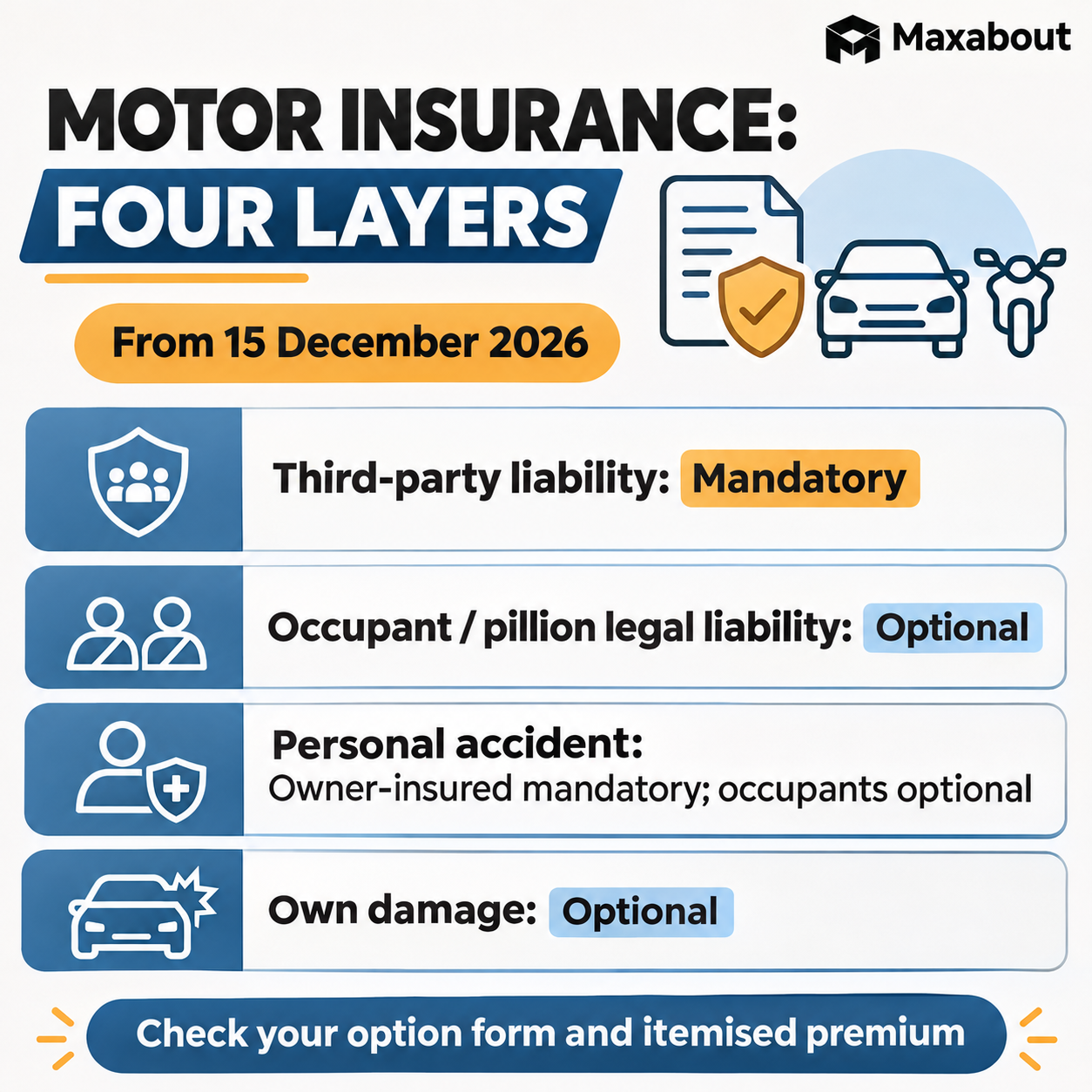
Buying or renewing insurance for a private car or two-wheeler will involve a clearer set of choices from 15 December 2026. The new four-layer motor insurance structure separates third-party liability, legal liability to occupants or a pillion rider, personal accident cover and own damage. It also requires a completed customer option form and a Customer Information Sheet at the point of sale. The key distinction for owners is that four sections do not mean four compulsory purchases: some protection is mandatory, while other cover remains optional.
What changes for car and bike owners?
- One clearer structure: policies issued from 15 December 2026 must use the prescribed four-layer structure and standard wordings.
- Itemised choices: the policy schedule must show the actual cover and the premium charged against each section.
- Written selection: the completed option form becomes part of the policy, alongside the required Customer Information Sheet.
- Existing policies: occupant or pillion legal-liability cover can be added mid-term through the insurer that issued the third-party policy, with an additional premium.
The four layers: mandatory and optional cover explained
The structure separates different risks so that owners can see what they are choosing. Personal accident cover has its own mandatory and optional elements; treating that entire section as either compulsory or optional would miss this distinction.
| Section | Cover | Requirement | What to check |
|---|---|---|---|
| I | Liability to third parties | Mandatory | Confirm the third-party policy and its period of cover. |
| II | Legal liability to occupants or a pillion rider, including employees of the insured | Optional | Confirm whether this section has been selected and what premium applies. |
| III | Personal accident | Owner-insured cover is mandatory; occupant, pillion-rider and other-driver cover is optional. | Check who is named or covered and the terms of the selected protection. |
| IV | Loss of or damage to the insured vehicle | Optional | Review the own-damage cover, exclusions, conditions and price offered. |
Why occupant liability and personal accident need separate attention
Legal liability to an occupant or pillion rider and personal accident cover sit in different sections of the structure. Owners should therefore check both selections rather than assume that choosing one automatically provides the other. The policy wording and schedule determine the actual protection purchased.
This is especially relevant when comparing two quotations. A lower total premium can reflect a different selection of optional cover. Compare the sections, people covered and terms before deciding that two offers provide equivalent protection.
Can you add cover to an existing policy?
Yes. The circular provides a mid-term route for Section II occupant or pillion legal-liability cover. An existing policyholder can obtain it from the insurer that issued the third-party policy by paying an additional premium. The existing motor third-party policy does not need to be cancelled to make that addition.
The extra protection starts at the date and time stated in the endorsement. Request that endorsement and check its effective time; asking for the cover is not the same as having it in force. This specific mid-term provision should not be read as an automatic addition of every optional section to every existing policy.
A practical checklist before paying the premium
- Check the policy issue date and the period of insurance.
- Read the option form and confirm that its selections match the cover you want.
- Compare the premium and coverage shown against each section in the schedule.
- Read the Customer Information Sheet and the relevant policy terms, including exclusions.
- For a mid-term Section II addition, use the third-party insurer and verify the endorsement's start date and time.
- Keep the completed option form, policy, schedule and any endorsement together.
Does the new structure guarantee cheaper insurance?
No automatic premium reduction has been announced in this circular. Insurers can continue to develop own-damage products and determine their pricing in line with market conditions. The immediate benefit is greater visibility into the cover selected and the premium charged, rather than a guaranteed saving.
Insurers have also been directed to complete integration with Bima Sugam alongside implementation so that these policies are available there from the same date. That is an implementation direction, not evidence that every insurer's listing is already live.
FAQs
Are all four insurance layers compulsory?
No. Third-party liability and owner-insured personal accident cover are mandatory under the structure. Occupant or pillion legal liability, occupant personal accident and own damage are optional choices.
Do existing owners need to cancel their third-party policy?
No cancellation is required to add Section II cover through the existing third-party insurer. An additional premium applies, and the endorsement sets the start of the added protection.
When does the four-layer structure take effect?
It applies to policies issued from 15 December 2026. The option form and Customer Information Sheet are central parts of the new purchase process.
The four-layer motor insurance change makes the selection of cover more explicit. For Indian car and bike owners, the useful next step is to compare the actual sections and paperwork carefully, rather than judging a policy by its total premium alone.
Explore the story
Related news

Share your view and join the discussion.
Earn reward points for every comment and get a chance to win ₹1,000 in our weekly lucky draw. Sign in with Google in one tap.
Start the conversation
No one has commented on this article yet. Be the first to share your view.
Want to read more automotive news?
Stay updated with the latest car launches, reviews, and industry insights.
Browse All News