
EV Sales Surge 75% in April: Tata Leads, Mahindra Beats MG
April's electric vehicle sales numbers just dropped, and they're hard to ignore. India's EV market posted a 75% year-on-year surge this April, making it the strongest April the segment has ever recorded. That's not a rounding error or a seasonal blip — something real is shifting in how Indian buyers...
Editorial Team
April's electric vehicle sales numbers just dropped, and they're hard to ignore. India's EV market posted a 75% year-on-year surge this April, making it the strongest April the segment has ever recorded. That's not a rounding error or a seasonal blip — something real is shifting in how Indian buyers are approaching the idea of going electric.
Tata Motors held its ground at the top, as expected. But the more interesting story is Mahindra quietly pushing past MG Motor in monthly rankings. From what industry reports suggest, that's a meaningful moment for a brand that only recently re-entered the EV space with serious intent.
Now, if you're someone still on the fence about buying an electric car, I think this data actually speaks to you more than it does to early adopters. A few things have changed in India's favour recently — fuel prices remain stubbornly high, charging infrastructure in larger cities has genuinely improved, and there are now more models across more price points than ever before.
This isn't about following a trend. It's about whether electric mobility is finally practical for everyday Indian conditions — the stop-and-go traffic of Bengaluru, the long highway stretches near Pune, the parking realities of Delhi. The numbers suggest more buyers think it is.
Breaking Down the April EV Sales Numbers: Who Sold What
The headline figure is striking — a 75% year-on-year surge in EV sales for April. But the more interesting story is in the details of who sold what, and how the competitive rankings actually shifted.
Tata Motors continues to anchor the entire segment. The Nexon EV remains the volume workhorse, consistently pulling buyers who want a proven, familiar nameplate with a decent real-world range. The Punch EV has added meaningful numbers at a slightly lower price point, bringing in first-time EV buyers who might have otherwise hesitated. The Tiago EV, while targeting the budget end, keeps Tata visible across multiple segments simultaneously. Together, these three models gave Tata a commanding lead in overall EV volumes this month.
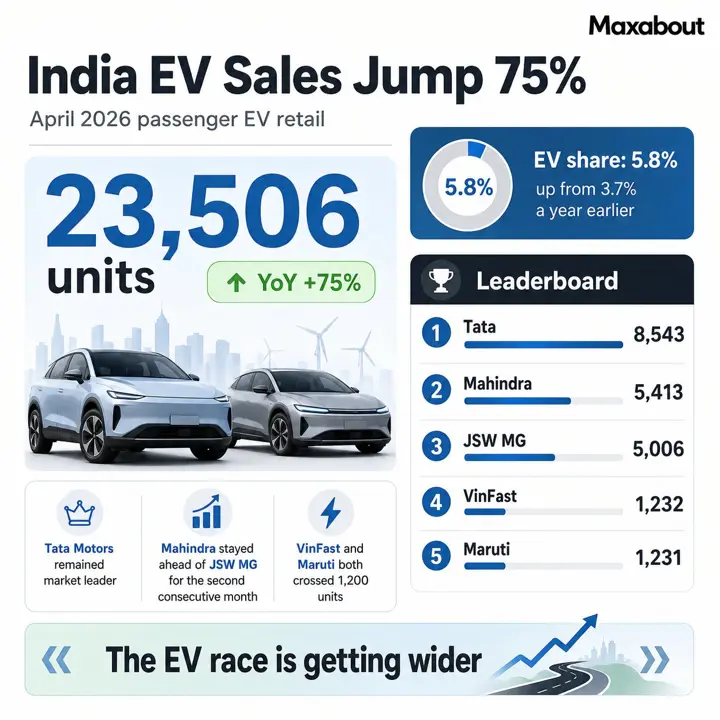 The genuinely surprising development, though, was Mahindra leapfrogging MG Motor in monthly rankings. The BE 6e and XEV 9e — both positioned as premium, technology-forward products — drove enough demand to push Mahindra past MG in unit sales. From what industry reports suggest, waiting periods on both Mahindra models remain substantial, which actually signals strong underlying demand rather than aggressive discounting.
MG had a reasonable month on its own terms, but the ZS EV's ageing positioning and questions around after-sales network depth may be limiting its ceiling. Hyundai's Creta Electric is building momentum steadily, BYD remains a niche premium player, and Ola Electric continues navigating its well-documented service challenges. The rankings today could look quite different by August.
Why Tata Motors Still Owns the Indian EV Street
There is something almost predictable about Tata sitting at the top of these monthly EV charts. And yet, predictable does not mean undeserved. The company has built something genuinely difficult to replicate — a layered product portfolio that meets buyers at almost every serious price point.
Start from the bottom. The Tiago EV remains the most accessible electric car from a mainstream brand in India, and that matters enormously in cities like Nagpur, Coimbatore, or Lucknow where buyers are cautious first-timers. Move up and the Punch EV fills the sweet spot that urban families actually shop in. Then the Nexon EV — still the segment reference point despite being around for years — and now the Curvv EV pushing Tata credibly into more aspirational territory. Very few manufacturers anywhere have executed this kind of staircase strategy this cleanly.
But the real advantage is less glamorous. Tata's service network reach into Tier 2 and Tier 3 cities is something newer EV entrants simply cannot match overnight. From what buyers and owners consistently report, knowing that a service centre exists within a reasonable distance is often the deciding factor — not the spec sheet.
That said, being honest matters here. Tata's older platforms carry legitimate concerns around real-world highway range, and increasing competition from better-specified rivals is applying genuine pressure. Dominance today does not guarantee dominance tomorrow.
Mahindra's EV Comeback: How the BE 6e and XEV 9e Changed the Game
If Tata's strength is trust built over time, Mahindra's recent surge is something different entirely — it's the confidence of a company that took a step back, rethought everything, and returned with something genuinely exciting. The BE 6e and XEV 9e are not cautious products. They are bold statements.
The INGLO platform underpins both vehicles, and it shows. Real-world range figures hovering around 450–500 km on the larger battery pack, combined with fast charging capability that gets you from near-empty to road-ready in under 30 minutes — these are numbers that actually matter to someone driving from Bengaluru to Mysuru and back without anxiety.
Then there's the design. Love it or question it, nobody calls these vehicles forgettable. The sharp, almost aggressive exterior language and a genuinely premium cabin experience have positioned these as aspirational purchases — not just practical ones. From what reviewers and early owners consistently describe, the interior quality feels like a meaningful step above what the Indian market typically offers at this price point.
The buyers gravitating toward these are largely urban professionals — tech-sector workers in Pune and Hyderabad, executives upgrading from mid-size ICE SUVs, buyers who want performance alongside purpose.
However, balance matters here. Wait times remain a real frustration, early delivery logistics were inconsistent, and the INGLO-specific service network is still catching up. At ₹18–26 lakh, the pricing is competitive but firmly premium — which narrows the audience somewhat.
MG Motor Falls Behind: A Temporary Blip or a Structural Problem?
MG's situation in April is worth examining carefully, because dismissing it as just a bad month would be too simplistic. The Windsor EV genuinely disrupted the segment when it launched — the battery-as-a-service model was clever, lowering the upfront cost barrier in a way no other manufacturer had attempted at scale in India. For a while, it was the conversation.
But Mahindra's newer platforms have clearly captured buyer attention now, and MG is feeling that shift. The question is whether this is seasonal softness, a supply constraint, or something deeper about where the brand stands in buyers' minds.
From what industry observers suggest, it's probably a combination. MG does face real perception challenges that go beyond product specs. Some Indian buyers — particularly those thinking about a five to seven year ownership horizon — still carry reservations about long-term service support and brand continuity. These concerns aren't irrational. They reflect a practical calculation about resale value and workshop availability in smaller cities.
MG has upcoming models in the pipeline, and their strategy of affordable, feature-rich cabins remains genuinely appealing. But that approach may need to evolve. Features alone won't sustain momentum when competitors are matching them on technology while adding stronger brand confidence to the equation.
What This EV Surge Tells Us About Indian Buyer Behavior in 2025
Step back from the brand numbers for a moment. A 75% surge isn't just a sales statistic — it's a signal that something fundamental has shifted in how Indian buyers think about electric vehicles.
Two years ago, EVs were a conversation starter. Today, they're a genuine first-choice consideration for a growing segment of urban buyers. The reasons are layered. Total cost of ownership has quietly become compelling. When fuel costs ₹105 per litre and your commute is 40 kilometres daily, the monthly savings from home charging are impossible to ignore. People are doing the math now in ways they simply weren't before.
Real-world range has also improved meaningfully. Newer models actually deliver closer to their claimed figures, which has rebuilt trust after early EV buyers shared disappointing experiences. And in cities like Bengaluru and Pune, home charging through apartment society approvals has become far more normalized than even 18 months ago.
There's also an honest social dimension here. In many urban circles, an EV parked outside is a quiet status marker. That motivation isn't trivial — it drives real purchasing decisions.
But mainstream adoption still faces genuine friction. Highway charging anxiety remains very real, particularly for buyers in cities like Nagpur or Hyderabad where long intercity drives are routine. Battery longevity concerns in extreme heat — Chennai summers are brutal on any battery chemistry — haven't fully been resolved in buyers' minds. And rural service availability remains a legitimate gap that no manufacturer has convincingly addressed yet.
Charging Infrastructure, Service Networks, and the Real-World EV Experience in India
Here's the honest truth about charging in India right now: it depends enormously on where you live. If you're in Bengaluru, Pune, or Delhi-NCR, the situation has genuinely improved. Public DC fast chargers are appearing in malls, IT parks, and fuel stations with reasonable frequency. Home charging, though, remains the real backbone for most owners — plug in overnight, wake up to a full battery. Simple, practical, cost-effective.
Step outside metro boundaries, and the picture changes. Tier 2 cities and highway corridors are still patchy. AC slow chargers exist in reasonable numbers, but a 6-8 hour charge time isn't useful mid-journey. DC fast charging on national highways is improving but remains inconsistent — finding one that's actually operational is a separate challenge.
Among the three brands, Tata has the broadest service footprint, simply because of its existing network scale. Mahindra's dedicated EV service infrastructure is still developing. MG has a reasonable urban presence but thinner coverage beyond major cities.
For buyers doing regular intercity travel — say, Mumbai to Pune is fine, but Mumbai to Nashpur is worth planning carefully — charging availability should be researched route-by-route before committing.
Should You Buy an EV Right Now? An Honest Take for Indian Buyers
Here is the straightforward answer: it depends on two things — where you charge and how far you typically drive. Get those two factors right, and an EV makes genuinely strong financial sense today.
If you live in a city apartment with dedicated parking and home charging access, the math already works in your favour. Daily commutes within Bengaluru, Hyderabad, or Pune — stop-and-go traffic included — are where EVs genuinely shine. Running costs drop significantly compared to petrol.
For frequent highway runners or buyers in smaller towns with limited public charging, a hybrid or fuel-efficient petrol car remains the more practical call. No point in range anxiety on every trip.
Across budgets, the current sweet spots look like this: the Tiago EV for entry-level buyers, the Punch EV or Nexon EV for the mid-range, and the Mahindra BE 6e or Creta Electric if you want premium features with serious range.
The 75% sales surge in April is not a one-month anomaly. It reflects a market that is genuinely maturing — better products, more charging options, growing buyer confidence. Waiting indefinitely might mean missing the best window for current incentives and widest model choice. The transition is already underway.
No comments yet
Be the first to share your thoughts!
Want to read more automotive news?
Stay updated with the latest car launches, reviews, and industry insights.
Browse All News