
EKA Opens Six Facilities: Pune–Pithampur Network and Capacity Explained
EKA's six-facility expansion explained: what each site does, how the group capacity figures should be read and what fleet buyers should watch.
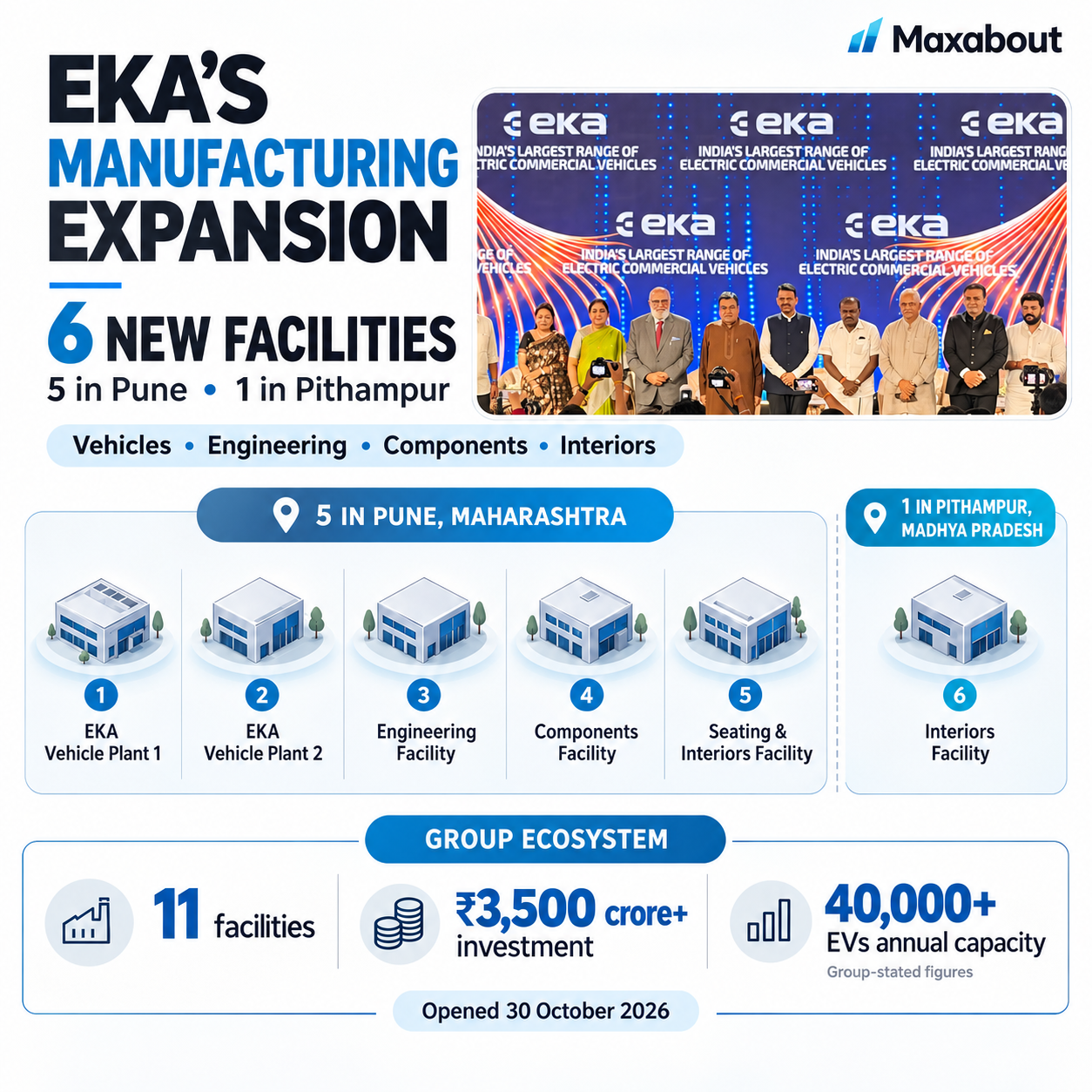
EKA Mobility and its group companies have inaugurated six manufacturing facilities across Pune and Pithampur, extending an ecosystem that combines electric commercial vehicles with engineering, components, seating and interiors. The openings form part of a group-reported investment exceeding ₹3,500 crore. For fleet operators, the useful distinction is that this is a broader manufacturing network: six new facilities does not mean six separate factories each producing complete electric vehicles.
Which facilities have opened?
Five sites are in Pune, Maharashtra, and one is in Pithampur, Madhya Pradesh. The inauguration took place on 30 October 2026. Their roles span finished-vehicle manufacturing and the engineering and components that support it.
| Facility | Location | Role described |
|---|---|---|
| EKA small commercial vehicle plant | Pune | Small commercial vehicle manufacturing. |
| EKA bus and truck plant | Pune | Bus and truck manufacturing. |
| VDL Pinnacle Engineering | Pune | Automotive engineering. |
| Instor India | Pune | Components and related manufacturing. |
| Pinnacle Seating and Interiors | Pune | Seating and interiors. |
| Pinnacle Interiors | Pithampur | Interiors. |
What the investment and capacity numbers cover
The group puts its wider network at 11 facilities across 120 acres, with annual capacity exceeding 40,000 electric vehicles. Its stated investment of more than ₹3,500 crore covers the integrated ecosystem. These are group-level figures, not a capacity allocation for each newly opened plant.
Capacity measures what a manufacturing system is designed to support. It should not be read as the number of vehicles already delivered, a guaranteed annual sales figure or evidence that every line is running at full utilisation.
Why the supporting facilities matter
Building a commercial vehicle involves more than final assembly. Seating, interiors, components and engineering must come together in a vehicle suitable for its route and operating duty. Bringing those functions into a coordinated network can support manufacturing execution, although the announcement does not quantify a resulting price reduction or delivery-time saving.
Indian fleet buyers still need to assess the vehicle offered to them: route suitability, charging arrangements, warranty coverage, service support and delivery commitments. A larger industrial footprint is useful context for that assessment, but it does not replace model-specific checks or an operating-cost comparison.
What to watch after the inauguration
The next meaningful indicators are production ramp-up, deliveries and deployment performance. Plant openings establish an infrastructure milestone; the commercial outcome depends on converting that infrastructure into vehicles and support that operators can use.
FAQs
Are all six new facilities complete-vehicle plants?
No. Two are identified as EKA vehicle plants; the others cover engineering, components, seating and interiors.
Does 40,000-plus capacity mean 40,000 vehicles have been sold?
No. The figure is the group's stated annual production capacity, which is different from sales or deliveries.
EKA's six-facility expansion broadens the manufacturing base behind its commercial-vehicle business. The key story is the combination of vehicle production and supporting functions, with actual ramp-up and fleet outcomes still the measures to follow.
Explore the story
Related news


Share your view and join the discussion.
Earn reward points for every comment and get a chance to win ₹1,000 in our weekly lucky draw. Sign in with Google in one tap.
Start the conversation
No one has commented on this article yet. Be the first to share your view.
Want to read more automotive news?
Stay updated with the latest car launches, reviews, and industry insights.
Browse All News