
E20 Petrol Debate: Unpublished ARAI Report Raises Questions for E10 Vehicles
A reported unpublished ARAI-linked study has added fresh questions to India's E20 petrol rollout, especially for vehicles originally designed around E10 fuel. The key point for owners is nuance: the reported concern focuses mainly on some rubber fuel-system components, while metallic parts and emiss...
Editorial Team
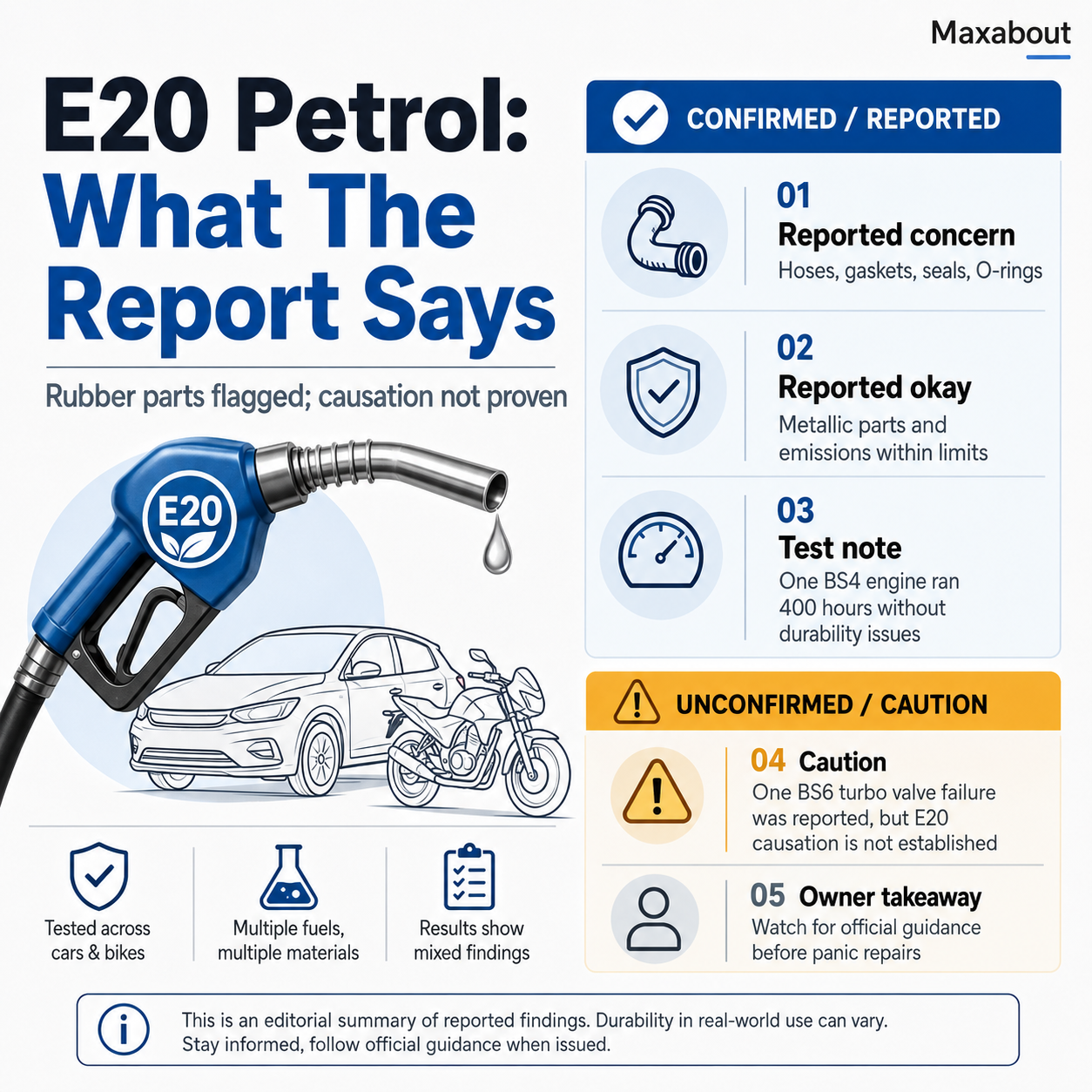
A reported unpublished ARAI-linked study has added fresh questions to India's E20 petrol rollout, especially for vehicles originally designed around E10 fuel. The key point for owners is nuance: the reported concern focuses mainly on some rubber fuel-system components, while metallic parts and emissions were reportedly within limits.
What The Reported E20 Findings Say
Reported concern: hoses, gaskets, seals and O-rings in E10-compatible vehicles may deteriorate with E20 exposure over time.
Reported okay: metallic fuel-system components were not said to show adverse impact.
Emissions: vehicles running on E20 reportedly stayed within prescribed legislative limits.
Important caveat: the ARAI study has not been publicly released.
Engine failure claim: one BS6 turbocharged engine reportedly suffered exhaust-valve failure after 265 hours, but direct E20 causation was not established.
Which Parts Are Being Discussed?
| Component group | Reported status | Owner meaning |
|---|---|---|
| Fuel hoses | Rubber part reportedly vulnerable | Watch for official service guidance, leaks or premature wear advisories. |
| Gaskets and seals | Rubber parts reportedly affected | Do not assume immediate failure; durability depends on material, age and usage. |
| O-rings | Reported as a possible replacement item | Relevant during inspection or fuel-system service. |
| Metallic fuel parts | No adverse impact reportedly observed | This reduces the scope of concern but does not close the full compatibility question. |
| Emissions | Reported within legislative limits | The durability discussion is separate from whether emissions limits were met. |
What Is Still Unconfirmed?
The biggest limitation is that the full ARAI study has not been made public. That means owners should avoid drawing brand-specific or model-specific conclusions unless official test data, OEM guidance or a public technical report confirms them.
The reported BS6 turbocharged engine exhaust-valve failure also needs careful handling. The available reporting says people familiar with the study cautioned against directly linking that failure to E20 because such failures can happen due to several engineering factors. In simple terms: reported failure is not the same as proven E20 causation.
What Owners Should Do Now
Check whether your vehicle is officially listed as E20-compatible by the manufacturer.
Follow the service schedule and do not skip fuel-system inspections on older vehicles.
Watch for official advisories before replacing parts pre-emptively.
If you notice fuel smell, leakage, rough running or unusual drivability changes, get the vehicle inspected.
Avoid panic repairs based only on unpublished or partial reporting.
Why It Matters For India
E20 is central to India's ethanol-blending and fuel-import-reduction push, but compatibility clarity matters for owners who plan to keep vehicles for many years. If older E10-compatible vehicles need rubber-part attention over time, the practical question becomes service guidance, part availability and transparent communication rather than panic.
FAQs
Does the reported ARAI study prove E20 petrol damages all older cars?
No. The study has not been publicly released, and the available reporting points to possible durability concerns for some rubber fuel-system parts in E10-compatible vehicles. It does not prove that all older cars will be damaged.
Which parts are reportedly affected by E20 petrol?
The reported concern includes rubber fuel-system components such as hoses, gaskets, seals and O-rings.
Did E20 petrol cause the reported BS6 engine failure?
That is not established. One BS6 turbocharged engine reportedly suffered exhaust-valve failure during durability testing, but the reporting also cautions that direct causation should not be assumed.
Should owners immediately replace fuel-system parts?
Not based on the reported study alone. Owners should wait for official manufacturer or regulatory guidance, follow regular service schedules and inspect the vehicle if symptoms appear.
The E20 petrol ARAI report story is best read as a compatibility and transparency issue. It raises valid owner questions, but the responsible takeaway is to separate reported component concerns from unproven claims and wait for public technical clarity.
Explore the story
Related news

Share your view and join the discussion.
Earn reward points for every comment and get a chance to win ₹1,000 in our weekly lucky draw. Sign in with Google in one tap.
Start the conversation
No one has commented on this article yet. Be the first to share your view.
Want to read more automotive news?
Stay updated with the latest car launches, reviews, and industry insights.
Browse All News