
E-Rickshaw Battery App Security Alert: Govt Reportedly Orders Removal of Risky BMS Apps
India's e-rickshaw battery app security issue has put a spotlight on a quiet but important risk in connected electric mobility: a weakly protected battery-management app can become a road-safety problem, not just a software problem.According to the reported update, the government has ordered the rem...
Editorial Team
India's e-rickshaw battery app security issue has put a spotlight on a quiet but important risk in connected electric mobility: a weakly protected battery-management app can become a road-safety problem, not just a software problem.
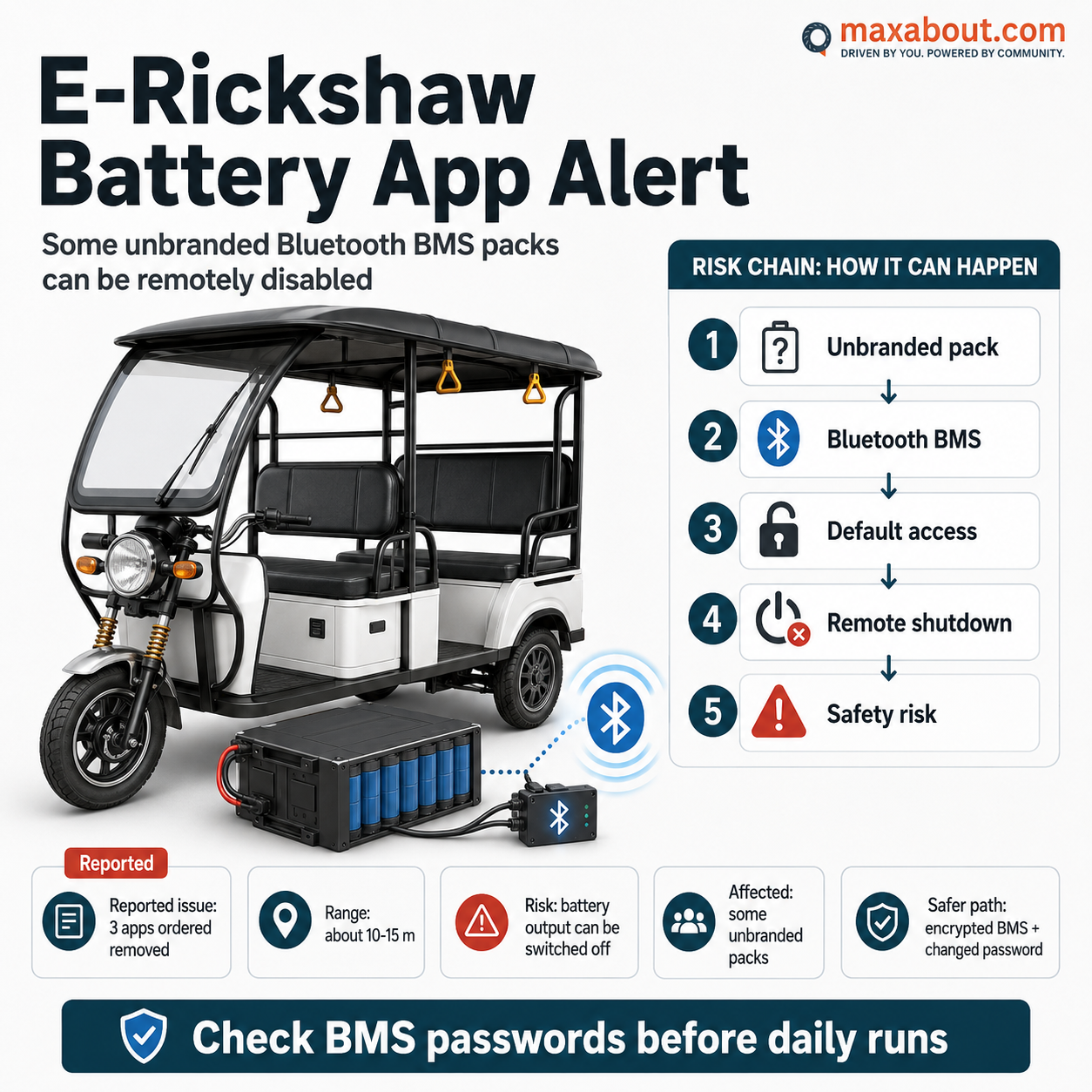
According to the reported update, the government has ordered the removal of three Chinese battery-management applications after videos showed certain e-rickshaws being remotely switched off. The risk is said to involve some low-cost, unbranded lithium battery packs that use Bluetooth-enabled battery management systems, or BMS units, with weak or default access protection.
What happened?
The reported concern is not that every electric rickshaw or every EV can be switched off remotely. The issue appears narrower: some battery packs allow a nearby phone to connect over Bluetooth to the BMS app, view battery information, and in vulnerable cases disable battery output.
Reported action: three battery-management apps were ordered removed.
Reported range: Bluetooth access is said to work from roughly 10 to 15 metres.
Affected area: certain unbranded lithium battery packs used in some e-rickshaws.
Main risk: a sudden battery-output shutdown could strand the vehicle or create a traffic hazard.
Why this matters for e-rickshaw owners
E-rickshaws are heavily used for last-mile passenger transport in Indian cities. Even a short loss of power can become serious if it happens in traffic, at an intersection, or while carrying passengers. That makes battery app security more than a convenience feature.
Battery-management apps are normally used to check data such as voltage, state of charge, battery health, and charging status. Those are useful features. The risk begins when the same access path also allows control over battery output and does not require strong authentication.
Affected vs lower-risk EVs
| Vehicle or battery type | Reported risk level | Reason |
|---|---|---|
| Some e-rickshaws with unbranded lithium battery packs | Higher concern | Bluetooth BMS access may use weak or default protection. |
| Established electric two-wheelers and passenger EVs | Lower for this specific issue | These generally use encrypted BMS authentication and tighter software controls. |
| Unknown replacement battery packs | Needs checking | Security depends on the supplier, BMS firmware, app access, and password policy. |
What owners and operators should check
If an e-rickshaw uses an aftermarket or unbranded lithium battery pack, the first step is to ask the battery supplier how the BMS app is protected. A default Bluetooth password should not remain unchanged after installation.
Confirm whether the battery pack uses a Bluetooth BMS app.
Change the default Bluetooth/BMS password where the system allows it.
Avoid installing unknown battery-management apps from unofficial links.
Ask the supplier whether battery-output control can be restricted or locked.
If the battery has been disabled, follow the supplier-approved reset process rather than repeatedly trying random apps.
The reported recovery process for affected users may involve switching the battery's main circuit breaker off and on, reconnecting to the BMS, and changing the default Bluetooth password. Owners should still follow their battery supplier's instructions because battery layouts and BMS software vary.
The bigger EV cybersecurity lesson
This incident is a reminder that EV safety is no longer only about cells, chargers, and wiring. Connected components also need secure software design. As India electrifies last-mile mobility, small suppliers and replacement battery makers need the same basic discipline that larger OEMs already use: encrypted authentication, sensible default settings, limited control access, and a clear update path.
For buyers, the takeaway is not to avoid e-rickshaws or EVs. The practical lesson is to treat the battery pack and BMS app as important safety components. A cheap battery with weak app security can create risks that are invisible during a normal test ride.
FAQ
Are all e-rickshaws affected?
No. The reported issue is linked to certain e-rickshaws using vulnerable unbranded battery packs with Bluetooth-enabled BMS access. It should not be treated as a blanket issue across all e-rickshaws.
Are electric cars and scooters vulnerable to the same problem?
The report says established electric two-wheelers, passenger cars, and other OEM EVs are generally less susceptible to this specific issue because they usually use encrypted BMS authentication.
What is the simplest safety check?
Check whether the battery pack uses a Bluetooth BMS app and whether the default password has been changed. If the supplier cannot explain the access control clearly, that is a warning sign.
The e-rickshaw segment is vital for affordable urban mobility. Strengthening battery app security now can help keep that transition safer as more connected EV components enter daily public use.
Explore the story
Related news



Share your view and join the discussion.
Earn reward points for every comment and get a chance to win ₹1,000 in our weekly lucky draw. Sign in with Google in one tap.
Start the conversation
No one has commented on this article yet. Be the first to share your view.
Want to read more automotive news?
Stay updated with the latest car launches, reviews, and industry insights.
Browse All News