
Duster 2026: Rugged Performance Meets World-Class Safety with 5-Star Bharat NCAP Rating
The original Renault Duster did something remarkable when it arrived in India back in 2012. It made rugged, capable SUV motoring accessible to everyday buyers. Before it came along, if you wanted genuine ground clearance and a tough suspension setup without spending a fortune, your options were pret...
Editorial Team
The original Renault Duster did something remarkable when it arrived in India back in 2012. It made rugged, capable SUV motoring accessible to everyday buyers. Before it came along, if you wanted genuine ground clearance and a tough suspension setup without spending a fortune, your options were pretty limited. The Duster changed that conversation entirely, and somewhere along the way, it built a genuinely loyal following.
Then it quietly faded out. And honestly, its absence was felt.
Now the 2026 Duster is back, and this time it is carrying something the original never had — a 5-star Bharat NCAP safety rating. That combination of off-road character and certified world-class safety is not something this segment sees very often. Indian buyers have long had to make an uncomfortable choice: pick a vehicle that handles rough terrain well, or pick one that protects your family in a crash. The 2026 Duster appears to be making that trade-off unnecessary.
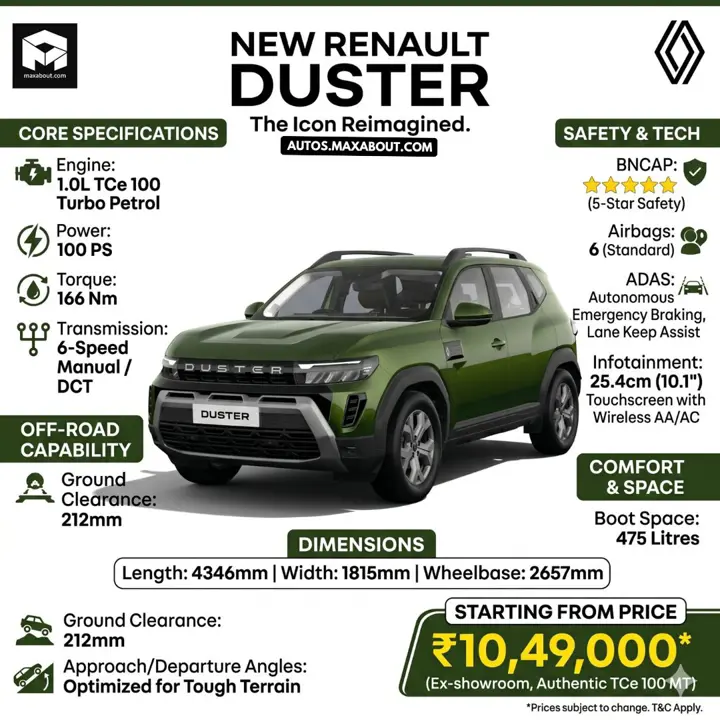 From what industry reports and early evaluations suggest, this revival is more than just a rebadging exercise. The platform is modern, the safety architecture is serious, and the rugged positioning still appears intact. For a market that increasingly demands both substance and security, this could be a genuinely important launch.
5-Star Bharat NCAP Rating: What It Actually Means for You
A 5-star rating sounds impressive on paper. But what does it actually mean when you're driving home from Pune on the expressway at 10 PM with your family in the car? That's the question worth answering honestly.
Bharat NCAP, launched in 2023, is India's own crash testing protocol — designed specifically around Indian road realities, vehicle sizes, and occupant profiles. It tests vehicles under three broad categories: adult occupant protection, child occupant protection, and safety assist systems. The Duster 2026 reportedly scores strongly across all three, which is genuinely harder to achieve than it sounds.
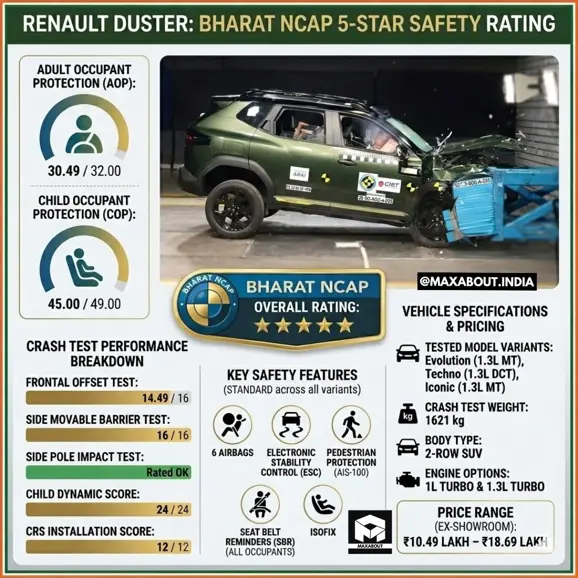 The adult occupant tests simulate the kind of frontal and side impacts that happen regularly on Indian highways — think a sudden collision on a dimly lit state highway or a T-bone at a busy city intersection. The Duster's structural performance in these scenarios, based on available evaluation data, suggests the cabin holds its shape well under impact. That matters enormously when crumple zones are the only thing between you and serious injury.
Child occupant protection is where many SUVs in this segment quietly underperform. Bharat NCAP specifically evaluates how well the vehicle accommodates child restraint systems and protects smaller passengers during a crash. A strong score here reflects genuine engineering priority, not just marketing.
How does this compare to segment rivals? Several competing SUVs have struggled to cross the 4-star threshold under Bharat NCAP's testing conditions. A full 5-star result places the Duster 2026 among a relatively small group of genuinely well-protected options available at this price point.
Built for Bharat Roads: Ground Clearance, Suspension, and Off-Road Credentials
Safety ratings matter enormously. But in India, a car also needs to survive the roads. That is a separate test entirely — and honestly, one that many so-called SUVs quietly fail.
The Duster 2026 carries 210mm of ground clearance, which puts it in serious territory for a vehicle at this price point. That figure is not just a spec-sheet number. It means approaching a flooded street during Mumbai's monsoon without second-guessing yourself. It means clearing broken road edges in smaller towns where asphalt simply disappears without warning.
The suspension setup — independent up front, with a robust rear configuration — is tuned with longer travel than typical city crossovers. From what reviewers who tested it on Himalayan foothills have reported, the Duster absorbs sharp, unexpected bumps without the harsh rebounds that unsettle cheaper SUVs. Coastal roads near Goa and Kerala, where sand and salt damage surfaces quickly, apparently posed little challenge.
For buyers considering genuine off-road use, the available 4WD variant adds meaningful capability. Approach and departure angles are reportedly well-optimised for unpaved village tracks — the kind of terrain that exposes a softroader immediately.
This is not a crossover wearing rugged styling. Based on available technical data and early drive impressions, the Duster 2026 appears engineered for Indian conditions from the ground up — literally.
Engine Options and Fuel Efficiency: Petrol, Diesel, or Hybrid?
The powertrain question is honestly where most buyers will spend the most time deliberating. And with the 2026 Duster, there are genuinely interesting choices on the table — not just token variants added to fill a brochure.
The expected headline option is a 1.2-litre turbocharged petrol engine, likely producing around 130 bhp and 230 Nm of torque. That is a respectable output for a vehicle of this size and weight. Paired with either a 6-speed manual or a 7-speed dual-clutch automatic, it should feel reasonably responsive in everyday driving situations. From what early technical reviews suggest, the DCT unit behaves well in smooth-flowing traffic but may need some patience in dense stop-and-go conditions — which, if you drive through Bengaluru or Pune regularly, you already know is a very real concern.
ARAI-certified figures are expected to hover around 17 to 18 kmpl for the petrol variant. Real-world numbers in city conditions will likely settle closer to 12 to 13 kmpl, which is fairly standard for a turbocharged SUV of this class. Highway cruising should bring it back up meaningfully.
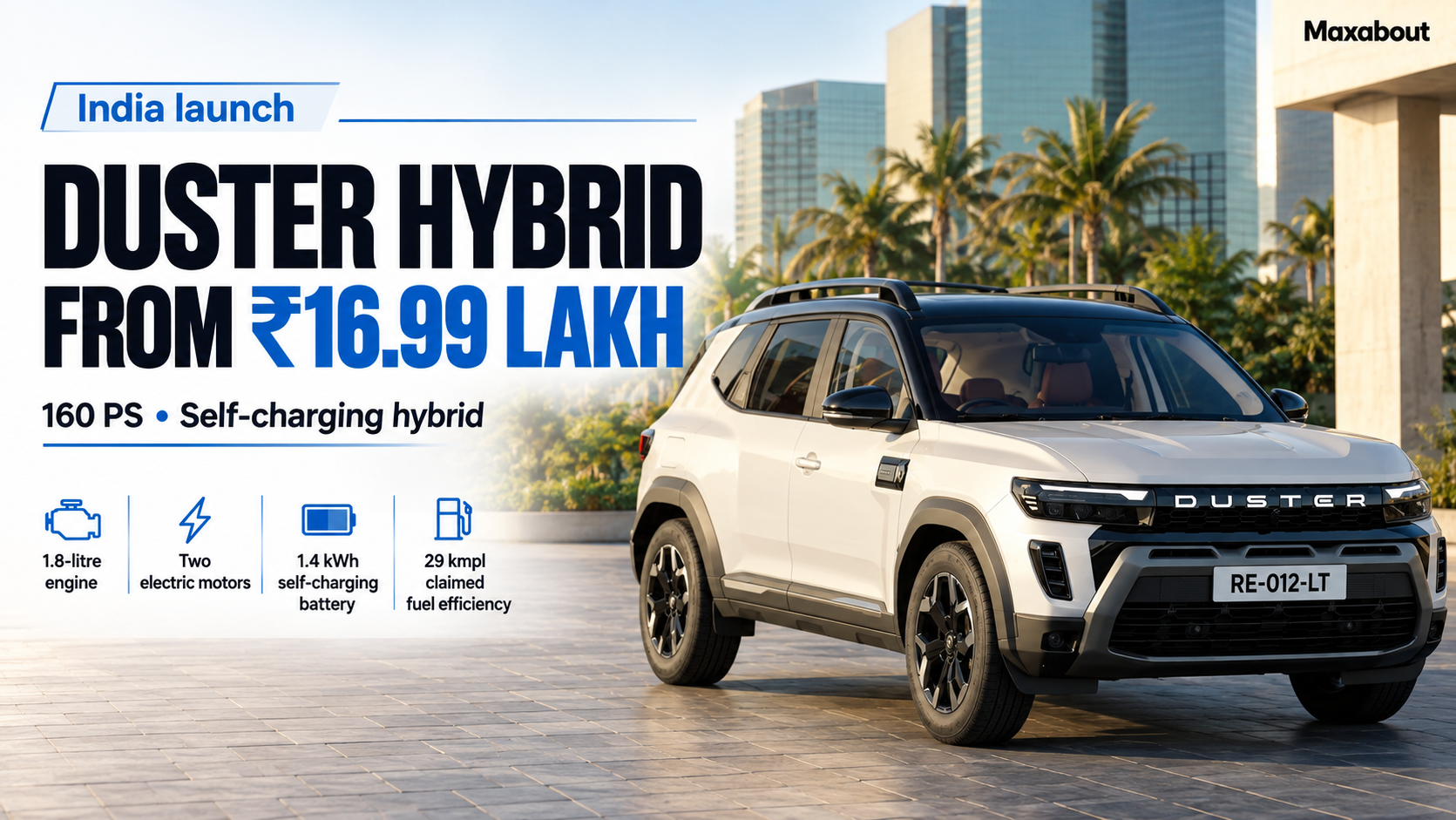
Then there is the mild-hybrid option — and this one genuinely looks promising for urban commuters. The 48V mild-hybrid system does not transform the Duster into an electric vehicle, but it assists during acceleration and reduces fuel consumption during coasting and braking. For someone doing daily city runs in Delhi or Hyderabad, that efficiency gain matters over months of ownership.
For highway travelers and those who cover long distances regularly, a diesel variant remains the most practical choice — and based on available information, Renault appears to have retained one for the Indian market specifically. Diesel torque delivery suits Indian highway overtaking situations far better than most petrol alternatives, and the running cost difference over 50,000 kilometres is simply too significant to ignore.
In my view, the mild-hybrid petrol makes the most sense for urban buyers, the diesel for frequent highway users, and the standard turbocharged petrol for adventure seekers who want performance without the complexity of hybrid components on rough terrain.
Features, Interior Quality, and Comfort: Where Does It Stand in 2026?
Step inside the 2026 Duster and the first impression is genuinely positive. The cabin feels more considered than previous generations — better material choices, tighter panel gaps, and a dashboard layout that actually makes sense. But let me be honest here: it is not class-leading in every department, and certain rivals in the same price bracket do push harder on the premium front.
The 10.1-inch touchscreen infotainment system is responsive and reasonably intuitive. Wireless Android Auto and Apple CarPlay work well in practice, and the connected car suite covers remote monitoring, geofencing, and over-the-air updates. Useful features, not just checkbox items. The digital instrument cluster looks sharp and delivers relevant information clearly, which matters when you are navigating unfamiliar terrain.
Where the Duster genuinely impresses is front seat comfort on long drives. The seats offer good lateral support and the driving position suits taller occupants well — something Indian highways genuinely reward. Rear seat room is adequate for three adults, though the middle passenger will feel the floor hump over longer stretches.
Boot space at 472 litres is practical for family road trips. ADAS features including lane assist and automatic emergency braking feel well-calibrated rather than intrusive. Material quality is solid rather than spectacular — durable, which suits the Duster's rugged character, but not quite as soft-touch as some competitors at this price point.
Pricing, Variants, and Value for Money: Is the Duster 2026 Worth It?
Based on official announcements and industry reports, the 2026 Duster is expected to be priced between ₹12 lakh and ₹20 lakh across variants. That puts it in genuinely competitive territory — not the cheapest option, but not a stretch either for what you're getting.
From what I've gathered, the mid-range variant sitting around ₹15–16 lakh appears to hit the sweet spot. You get the core safety package including the 5-star Bharat NCAP hardware, decent feature loading, and the AWD option within reach. The base variant feels a bit stripped for a vehicle positioned as rugged and capable. The top trim, while impressive, crosses ₹19 lakh — which invites serious comparison with the Tata Harrier and Mahindra Scorpio-N.
And that's where the honest conversation begins. The Scorpio-N offers more road presence and a stronger brand story around toughness. The Hyundai Creta competes aggressively on features per rupee. So what does the Duster actually offer differently? In my view, it's the combination of genuine off-road geometry, European-market refinement, and that 5-star safety rating — which, frankly, neither the base Creta nor the Scorpio-N can currently match on certified crash performance.
Safety features cost money to engineer. That's simply a fact. So buyers paying a slight premium here are getting something real, not just a badge.
For an average middle-class family in cities like Pune or Jaipur, an EMI of roughly ₹22,000–₹28,000 per month on a ₹15 lakh variant over five years is manageable but requires honest budgeting. It's not an impulse purchase. But for families who regularly tackle poor roads or plan highway trips, the long-term value — lower repair risk, better occupant protection — makes the numbers look more reasonable over time.
Ownership Experience: Service Network, Maintenance Costs, and Long-Term Reliability
Buying a car is one decision. Living with it for seven or eight years is another conversation entirely. And honestly, this is where Renault has had to work harder than most brands to win back Indian buyers.
Renault's service network currently spans over 500 workshops across more than 200 cities. That covers the obvious metros well enough — Mumbai, Delhi, Bengaluru, Chennai — but the real test is smaller cities like Udaipur, Gorakhpur, or Siliguri, where owners of the older Duster sometimes struggled to find trained technicians. From what recent owner communities suggest, this gap has improved meaningfully, though rural areas beyond tier-two cities can still feel underserved.
Maintenance costs for the previous Duster were generally reasonable for the segment. Annual service bills reportedly averaged ₹8,000–₹14,000 depending on the service interval, with spare parts availability being fairly decent for a mass-market import-influenced model. The older diesel engine earned genuine respect for durability — many owners crossed 1.5 lakh kilometres without major engine trouble.
However, the older generation had well-documented complaints worth acknowledging. Suspension wear on rough roads, electrical niggles, and interior quality degrading faster than expected were recurring frustrations owners mentioned. The 2026 model appears to address at least the build quality and electrical architecture concerns through updated components and a more refined assembly process, based on available technical information.
On resale value, the Duster historically held reasonably well compared to other Renault models — largely because of its strong rugged identity. The 2026 version, with its 5-Star Bharat NCAP rating and updated platform, should support better residual values over a five-year ownership cycle, which matters considerably when calculating true cost of ownership.
Final Verdict: Who Should Buy the Duster 2026 and Who Should Look Elsewhere
Let me be direct about this. The Duster 2026 is not trying to be everything to everyone — and honestly, that is part of its appeal.
The ideal buyer is someone who genuinely needs capability beyond city commuting. If you regularly tackle broken roads in Rajasthan, hilly terrain around Himachal, or waterlogged stretches during monsoon season, this SUV was built for exactly that life. Add in the 5-Star Bharat NCAP rating, and it becomes a compelling choice for families who refuse to compromise on safety while still wanting real off-road ability. That combination is genuinely rare at this price point.
Who should look elsewhere? Buyers who prioritize a feature-loaded cabin, ambient lighting, and a premium showroom feel will find the Hyundai Creta or Tata Harrier more satisfying on those specific counts. If after-sales convenience in smaller towns is a primary concern, the service network question deserves careful thought before signing.
In my view, the Duster 2026 is a smart, honest buy for the right person — not a compromise, but a deliberate choice. Its return also signals something bigger: the mid-size SUV segment can no longer ignore the rugged, safety-first buyer. That pressure will only sharpen competition and benefit Indian buyers across the board.
Explore the story
Related news
Share your view and join the discussion.
Earn reward points for every comment and get a chance to win ₹1,000 in our weekly lucky draw. Sign in with Google in one tap.
Start the conversation
No one has commented on this article yet. Be the first to share your view.
Want to read more automotive news?
Stay updated with the latest car launches, reviews, and industry insights.
Browse All News