
Ducati Panigale V4 Lamborghini Launched at ₹1 Crore in India
One crore rupees. Let that number sit for a moment. That is enough to buy a fully-loaded Mercedes-Benz GLE, a BMW 5 Series and still have change left over. It is enough to purchase a comfortable apartment in many Indian cities. And yet, Ducati has just launched a motorcycle at exactly that price — t...
Editorial Team
One crore rupees. Let that number sit for a moment. That is enough to buy a fully-loaded Mercedes-Benz GLE, a BMW 5 Series and still have change left over. It is enough to purchase a comfortable apartment in many Indian cities. And yet, Ducati has just launched a motorcycle at exactly that price — the Panigale V4 Lamborghini — and somehow, it does not feel absurd. It feels inevitable.
This machine is the result of two Italian legends finding common ground under the Volkswagen Group umbrella. Ducati and Lamborghini, brands that have spent decades building reputations on raw performance and visual drama, have collaborated to create something that exists entirely outside the boundaries of practical reasoning. This is not a commuter. It is not even a track-day toy for the weekend enthusiast. It is, quite simply, a rolling sculpture that happens to make around 230 horsepower.
In the Indian context, ₹1 crore for a motorcycle is a genuinely staggering statement. But here is the thing — for the specific buyer this targets, that comparison to cars is completely irrelevant. They already own the cars. What they are buying here is exclusivity, provenance, and a piece of automotive history where two of Italy's most storied names share the same bodywork.
What Makes This Collaboration Between Ducati and Lamborghini So Special
This is not a badge-engineering exercise. That point deserves emphasis upfront, because the moment you slap a famous name on something and charge a premium, cynicism is a natural response. But the Ducati-Lamborghini relationship has genuine structural roots that most people overlook.
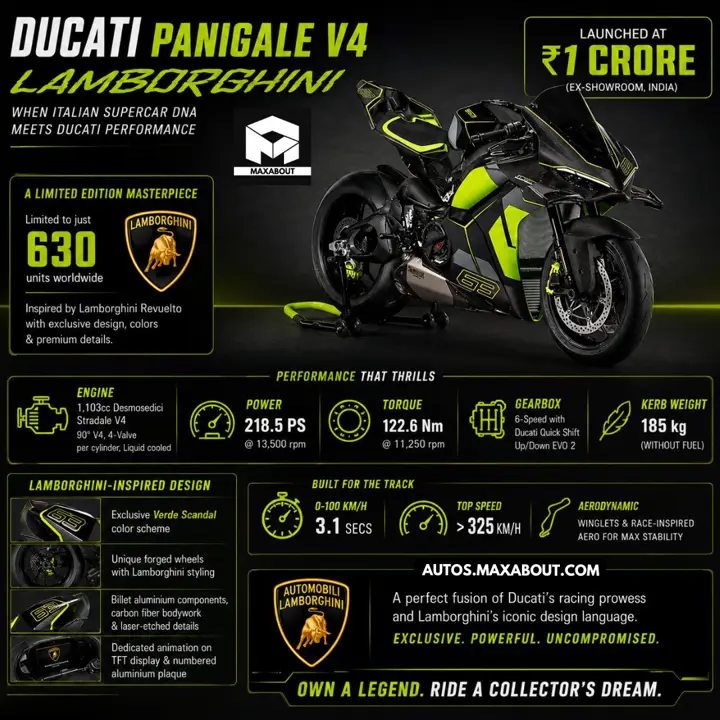 Both companies sit under the Volkswagen Group umbrella — Lamborghini through Audi AG, and Ducati equally under that same Audi ownership structure. These are not strangers collaborating for marketing optics. They share engineering conversations, design philosophy discussions, and crucially, access to each other's material expertise. That backstory matters when you are evaluating whether this partnership has substance.
The design language reportedly draws from Lamborghini's signature visual identity — sharp angular surfaces, the kind of aggressive stance that feels simultaneously functional and theatrical. The Verde-inspired livery is not simply a paint choice. From industry coverage, the finish quality and specific colorwork reflect Lamborghini's own paint processes and standards, which are genuinely distinct from standard Ducati production finishes.
The carbon fiber bodywork carries collaborative fingerprints too. Lamborghini has decades of advanced composites expertise — their supercars have long treated carbon fiber as a structural and aesthetic language, not decoration. That knowledge base visibly influences the execution here.
What emerges is something rare — a motorcycle that authentically represents two Italian houses rather than simply borrowing one's name.
Performance Credentials: What the Panigale V4 Base Platform Already Delivers
Before understanding what the Lamborghini edition adds, it helps to appreciate what it starts with. The foundation here is genuinely extraordinary.
The 1103cc Desmosedici Stradale V4 engine produces approximately 215-220 bhp — figures that belong in serious racing conversations, not showroom brochures. This engine is not a road motor adapted for performance. It flows in the opposite direction entirely. Ducati derived this architecture directly from their MotoGP program, then engineered it to meet road compliance. That distinction matters enormously.
The electronics package supporting all that power is equally serious. Cornering ABS, multiple traction control maps, wheelie control, engine brake control, and several riding modes — the Panigale V4 essentially carries racing-grade electronic intervention systems. The Öhlins suspension setup front and rear adds another layer of precision that most riders will honestly never fully explore.
Now consider what this means on actual Indian roads. Realistically — nowhere. Delhi's broken stretches, Bangalore's congested signal stops, Mumbai's pothole reality — none of these environments allow even a fraction of this motorcycle's capability to surface responsibly. This machine demands a closed circuit, proper leathers, and serious riding skill before its true character emerges. It is a track instrument first, with road registration as a secondary consideration.
The Lamborghini edition builds its identity on top of all this.
Who Actually Buys a ₹1 Crore Motorcycle in India?
The honest answer? Almost nobody buys this to ride it daily. And that is perfectly fine.
India's buyer profile for a motorcycle at this price point is extremely specific. Think established collectors in Mumbai and Delhi who already own three or four superbikes and are looking for something that anchors the collection. Think Bangalore-based tech entrepreneurs or Hyderabad's old-money business families who treat premium machinery the same way others treat art — as an asset with aesthetic and emotional value.
From what industry observers consistently note, India's superbike segment, while small, has grown steadily over the past decade. The customer base has matured. These are not first-time buyers. They understand what they are purchasing.
Import duty structures in India make this even more expensive than its global price — premium CBU motorcycles attract duties that can effectively double the landed cost. Buyers at this level are fully aware of that reality and factor it in without hesitation.
Is this a riding machine or a display piece? Probably both, depending on the owner. Some will trailer it to track days. Others will position it under gallery lighting in a climate-controlled garage. Neither use case is wrong. At ₹1 crore, the motorcycle earns its place simply by existing in your space.
The ₹1 Crore Question: Value, Exclusivity, and What Else You Could Buy
Let's be honest about what ₹1 crore buys you in India right now. A fully loaded BMW M3 Competition. A Mercedes-AMG C63 with room to spare. Possibly a base Porsche 911 with enough left over for a solid track day budget. These are extraordinary machines that seat four, handle monsoon-flooded roads in Mumbai, and won't attract a second glance from traffic police on the Outer Ring Road in Bangalore.
So why would someone still choose this motorcycle? Because none of those cars are a Ducati Panigale V4 Lamborghini. That sentence sounds circular, but exclusivity genuinely works that way at this level. When production numbers are deliberately constrained, the object stops being a vehicle and starts being a category of its own.
From what industry observers have noted, Ducati's limited special editions have historically held value remarkably well. Some have appreciated significantly over five to seven years. This isn't just a motorcycle purchase — it's closer to acquiring a numbered artwork that occasionally does 299 kmph.
The practical limitations are real, though, and worth stating plainly. Indian roads will never let this machine breathe properly. Insurance premiums on a ₹1 crore CBU motorcycle will be substantial. Servicing requires authorised Ducati technicians, and replacement parts carry significant lead times and costs.
Full potential? Almost certainly unreachable on public roads anywhere in India.
Owning and Maintaining a Ducati at This Level in India: The Practical Reality
Let's talk about what actually happens after the delivery ceremony ends and you're sitting with the keys to a ₹1 crore motorcycle.
Ducati's authorized service network in India is concentrated in Mumbai, Delhi, Bangalore, Chennai, Hyderabad, and Pune. That's essentially it. If you're based anywhere outside these cities, ownership becomes genuinely complicated — not impossible, but logistically demanding in ways that add to the already significant running costs.
Service intervals on the Panigale V4 are not forgiving on the wallet. Valve clearance checks, which this engine requires periodically, can run into substantial five-figure sums at authorized centers. Spare parts are largely imported, meaning lead times and pricing that reflect the CBU status of the motorcycle. Only authorized technicians should work on this machine — the engine architecture is complex enough that improvised servicing could cause serious damage.
Fuel quality matters too. This engine expects high-octane fuel consistently, and owners typically plan their routes around reliable pumps rather than roadside options.
From what serious owners report, track day memberships become almost essential. Circuits like Kari Motor Speedway near Coimbatore or BIC in Greater Noida are where this motorcycle finally finds room to operate at anything approaching its design intent.
Riding gear investment at this level should be proportionate — full leathers, a quality helmet, and back protectors are not optional considerations. Neither is proper covered storage.
These are real costs. For the target buyer, though, none of this is a dealbreaker — it's simply part of the ownership contract.
What This Launch Says About India's Ultra-Premium Appetite
The Ducati Panigale V4 Lamborghini arriving at ₹1 crore is not just a motorcycle launch. It is a signal. A clear one. India is no longer a market that global luxury and performance brands treat as an afterthought.
Look at the broader picture. Lamborghini reported record sales figures in India recently. Rolls-Royce has consistently noted India among its fastest-growing markets. Bentley, Porsche, and Ferrari are expanding their presence in cities like Mumbai, Delhi, and Bengaluru with genuine conviction. These are not vanity moves — they reflect real purchasing power and real demand from India's growing ultra-high-net-worth segment.
The motorcycle world is catching up to that same reality. Two-wheelers in India have historically been utility objects. Getting from one place to another, affordably and efficiently. That story is still true for most of the country. But alongside it, an entirely different story is being written — one where a motorcycle is a collectible, a statement, a piece of functional art with a numbered badge.
That cultural shift matters. When affluent buyers in India look at a limited-edition collaboration between Ducati and Lamborghini, they are not thinking about commuting. They are thinking about exclusivity, heritage, and belonging to a very small global club. That mindset now exists here in meaningful numbers.
Brands have noticed. Flagship launches are arriving in India simultaneously with global reveals — not months later.
Final Thoughts: Absurd, Brilliant, and Completely Justified on Its Own Terms
Let's be honest. For the overwhelming majority of motorcycle buyers in India, the Panigale V4 Lamborghini is completely irrelevant. And that is perfectly fine. Nobody buying a commuter or even a mid-range sports bike needs to think about this motorcycle for a single second.
But for the small group it targets? It delivers something genuinely unique — the combined design and engineering prestige of two Italian icons, unified on two wheels. No other motorcycle on the planet currently offers that specific combination. That matters to the buyer writing that cheque.
What excites me personally, even knowing I will never own one, is what launches like this represent for the broader conversation. They push motorcycles firmly into the territory of art and serious engineering achievement. That conversation deserves to happen here in India just as much as anywhere else.
And looking ahead — India's premium vehicle market over the next decade looks genuinely fascinating. As domestic wealth concentrates and global brands treat India as a first-tier market, expect these boundary-pushing collaborations to arrive here faster, and perhaps eventually, be designed with Indian buyers directly in mind.
Explore the story
Related news

Share your view and join the discussion.
Earn reward points for every comment and get a chance to win ₹1,000 in our weekly lucky draw. Sign in with Google in one tap.
Start the conversation
No one has commented on this article yet. Be the first to share your view.
Want to read more automotive news?
Stay updated with the latest car launches, reviews, and industry insights.
Browse All News