
BYD Sealion 6 Plug-In Hybrid Spied Testing in India: Launch Details & Expected Price
So this is interesting. The BYD Sealion 6 plug-in hybrid has reportedly been spotted on Indian roads during what appears to be testing runs. No official confirmation yet from BYD India, but the sighting itself says quite a bit.BYD has been moving fast in India. From a cautious entry to pushing multi...
Editorial Team
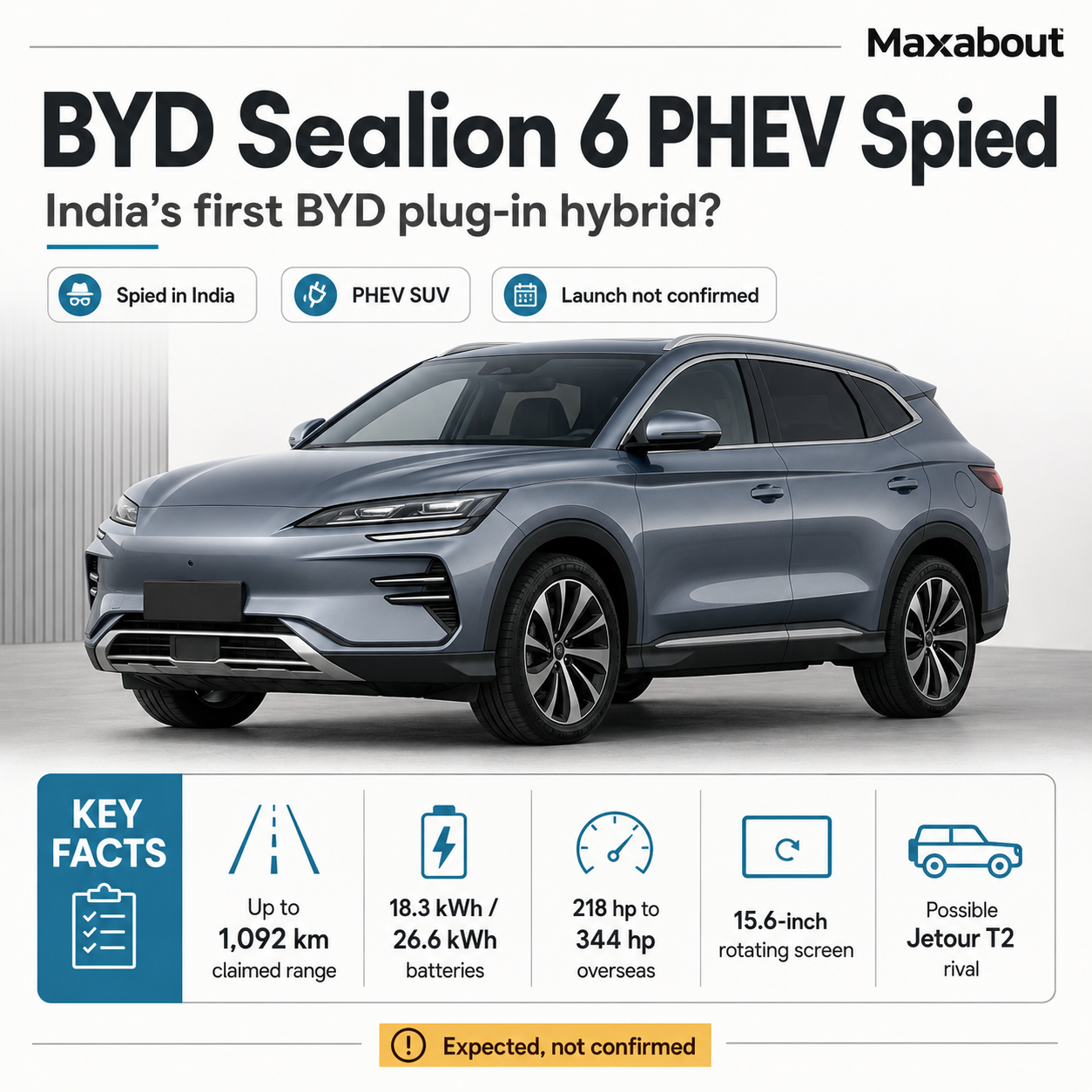
So this is interesting. The BYD Sealion 6 plug-in hybrid has reportedly been spotted on Indian roads during what appears to be testing runs. No official confirmation yet from BYD India, but the sighting itself says quite a bit.
BYD has been moving fast in India. From a cautious entry to pushing multiple electric models across segments, the brand clearly has long-term plans here. But here is the thing — their India story has been almost exclusively electric so far. A PHEV in the mix would mark a genuine shift in strategy.
And honestly, the timing makes sense. Pure electric adoption in India has been slower than many expected. Range anxiety is real, particularly for buyers outside the major metros. Charging infrastructure, while improving, remains patchy once you move beyond cities like Bengaluru, Pune, or Delhi. A plug-in hybrid addresses exactly that hesitation — you get electric efficiency for daily urban use, with a petrol engine as genuine backup for longer runs.
The Sealion 6 is already a reasonably well-regarded product in global markets. Seeing it tested on Indian roads suggests BYD is at least evaluating whether the local conditions, regulations, and buyer appetite support a launch. Whether it actually arrives is a separate question — but the fact that testing appears underway makes this worth watching closely.
BYD's Current India Lineup and Why a PHEV Makes Strategic Sense
BYD's India story so far has been entirely electric. The Atto 3, Seal, and eMax 7 are all pure battery electric vehicles — solid products, reasonably well-received among buyers who were already convinced about going electric. But that last part is the catch. The buyers who need convincing? BYD currently has nothing to offer them.
 Globally, that is not the case at all. BYD's DM (Dual Mode) plug-in hybrid technology is arguably its biggest commercial weapon. A significant portion of BYD's massive global sales volumes come from PHEV models, not pure EVs. India has, until now, been left out of that strategy entirely.
The reason that matters is straightforward. Charging infrastructure in India is improving, but the improvement is uneven. In Mumbai, Delhi, Bengaluru, and Hyderabad, public charging has become genuinely more accessible. Step outside those metros — smaller cities, highway stretches, tier-two towns — and range anxiety remains a real, practical concern for most buyers.
A PHEV fits that reality rather neatly. It does not demand the same infrastructure commitment that a pure EV requires. For a brand still building trust and awareness in India, that flexibility could open conversations with a much wider audience than BYD is currently reaching.
What Is the BYD Sealion 6 PHEV? Global Specs and Features Explained
So what exactly is the Sealion 6 PHEV? At its core, this is a mid-size SUV built on BYD's DM5 (Dual Mode 5th Generation) plug-in hybrid platform — the same system powering several of BYD's recent global launches. It pairs a 1.5-litre naturally aspirated petrol engine with an electric motor, producing a combined system output of around 215 horsepower, depending on the specific variant.
The battery pack sits at approximately 15.87 kWh, which global reports suggest delivers a pure electric range of roughly 100 kilometres under standard test conditions. Real-world figures will naturally be lower, but that number is still meaningful for daily urban commutes without touching the petrol engine at all.
Internationally, automotive media has described the driving experience as smooth and well-integrated, with transitions between electric and petrol power being largely imperceptible. That is a genuine engineering achievement, and one worth noting.
On features, the Sealion 6 makes a strong impression. It carries BYD's signature rotating central console, a large 15.6-inch rotating infotainment display, and a comprehensive suite of driver assistance systems including lane keeping, adaptive cruise control, and automatic emergency braking.
India-specific specifications have not been confirmed yet, so global variants serve only as a reference point here. Localisation often brings changes to battery size, feature trims, and powertrain tuning.
How the Sealion 6 PHEV Could Perform on Indian Roads
This is where things get genuinely interesting. A plug-in hybrid powertrain actually makes a strong argument for Indian driving conditions — arguably more than a pure electric vehicle does right now.
Think about a typical Delhi or Pune commuter. Most people covering under 50 km daily could theoretically run almost entirely on electric power, assuming the Sealion 6 arrives with a competitive EV-only range. Global variants offer around 80–100 km of electric range, which in real-world Indian city traffic — with all the crawling and idling — could translate to several days of commuting without touching the petrol engine at all. That is a meaningful saving on fuel costs.
Stop-and-go traffic, which is practically a way of life in cities like Bengaluru or Mumbai, actually works in a PHEV's favour. Regenerative braking recovers energy during those endless slow-downs, keeping the battery topped up through the day. On longer stretches like the Mumbai-Pune Expressway, the petrol engine seamlessly takes over, removing any range anxiety entirely.
Ground clearance, however, is a legitimate concern. From what existing BYD Atto 3 owners have reported, BYD has been reasonably thoughtful here — but potholed urban roads and unmarked speed breakers remain a real test. The Sealion 6's underbody battery placement will need careful engineering for India's rougher surfaces.
Monsoon performance is another factor worth watching closely.
Expected Price and Who This Car Is Really Aimed At
Pricing is where things get genuinely interesting. BYD's existing India lineup gives us some useful anchors — the Atto 3 sits around ₹24–25 lakh, and the Seal sedan pushes considerably higher. The Sealion 6 PHEV, being a more complex vehicle with dual powertrains, would almost certainly land above the Atto 3.
Based on BYD's import duty exposure and their historical pricing approach in India, a realistic estimate would place the Sealion 6 somewhere in the ₹28–35 lakh range. That is speculation, not confirmation — but it feels responsible given what we know.
At that price point, the target buyer becomes fairly clear. This is someone who regularly commutes in a city like Bengaluru or Pune, values fuel efficiency deeply, but genuinely cannot commit to a pure electric vehicle yet. The hybrid powertrain removes that mental barrier entirely.
Think of it this way — premium SUV expectations, hybrid running costs. That combination has real appeal for a certain kind of buyer who finds pure EVs slightly premature but finds conventional petrol SUVs increasingly expensive to run.
The segment competition at this price bracket is already fierce, with established names offering strong value. BYD will need compelling ownership economics to justify the ask.
The PHEV Advantage: Why Plug-in Hybrids Are Gaining Ground in India
So what exactly makes a PHEV different from a regular hybrid — and why does it matter for Indian buyers specifically? It is worth stepping back here, because there is genuine confusion around this.
A plug-in hybrid carries a significantly larger battery than a standard hybrid. You charge it deliberately, like an EV, and it runs purely on electricity for a meaningful distance — typically 50 to 80 kilometres depending on the model. For most city commuters in Bangalore, Pune, or Delhi, that covers an entire day of driving without burning a single drop of petrol. Then, on a highway run to your hometown, the petrol engine takes over seamlessly. No range anxiety. No detour hunting for a fast charger.
That dual nature is genuinely compelling in the Indian context, where charging infrastructure remains uneven outside major metros.
The charging requirement is also far less intimidating than people assume. A standard 15-amp home socket works perfectly overnight. No expensive wallbox installation needed. This is a meaningful practical advantage over pure EVs, particularly for buyers in older apartment buildings or independent houses with basic electrical setups.
Several states have also extended favourable tax treatment to strong hybrids and PHEVs, recognising their transition-friendly nature. From an ownership economics standpoint, the math works quietly but consistently — especially if your daily driving stays within that electric range.
Concerns and Challenges BYD Will Need to Address
The ownership economics look promising on paper, but there are genuine questions worth sitting with before getting excited about this vehicle.
Service network is the most pressing concern. BYD currently operates a relatively thin dealership footprint across India. If you're in Mumbai, Delhi, or Bengaluru, you're probably fine. But for someone in Jaipur, Lucknow, or Kochi, the nearest authorised service centre could be a real inconvenience — and that matters enormously when you've spent ₹25-30 lakh on a vehicle. A breakdown or even a routine service shouldn't require half-day travel planning.
Then there's the mechanical complexity of PHEVs themselves. Two powertrains — an electric motor and a petrol engine — mean more components, more potential failure points, and technicians who genuinely understand both systems. That's a higher bar than servicing a straightforward ICE car or even a pure EV.
Pricing is another real pressure point. BYD currently imports vehicles as CBUs, attracting heavy import duties that significantly inflate the final price. Local assembly could change this, but until that happens, cost competitiveness against established rivals remains a challenge.
Finally, the geopolitical dimension exists and shouldn't be dismissed. Regulatory scrutiny around Chinese automakers operating in India is an ongoing background reality. It hasn't blocked BYD so far, but it introduces an uncertainty that a cautious long-term buyer would reasonably factor in.
Launch Timeline and What Indian Buyers Should Watch For
Spotting a test mule on Indian roads typically signals somewhere between six to eighteen months before an official launch. That's a rough window, not a guarantee. BYD could accelerate things or quietly shelve plans depending on market conditions.
For now, watch three things closely: official BYD India announcements, upcoming auto shows like Bharat Mobility, and any regulatory or homologation filings that surface in industry reports. Those tend to be the most reliable early indicators before any showroom date gets confirmed.
My genuine advice — do not reorganize your finances around a vehicle that hasn't launched yet. Stay informed, but stay patient.
That said, I'll be honest. If BYD manages to price the Sealion 6 PHEV sensibly and backs it with a stronger service network than what exists today, this could genuinely be one of the more interesting launches this segment has seen in a while. The technology is compelling. The execution just needs to match.
What's your read on this? Would you seriously consider a PHEV from BYD, or do the uncertainties still feel like too much to overlook? Drop your thoughts below.
Explore the story
Related news
Share your view and join the discussion.
Earn reward points for every comment and get a chance to win ₹1,000 in our weekly lucky draw. Sign in with Google in one tap.
Start the conversation
No one has commented on this article yet. Be the first to share your view.
Want to read more automotive news?
Stay updated with the latest car launches, reviews, and industry insights.
Browse All News