
BYD Leopard 8 PHEV Patent in India: What It Means For Buyers
BYD Leopard 8 PHEV: What Does This Patent Mean for India?The automotive landscape in India is witnessing an interesting development with BYD's recent patent filing for the Leopard 8 PHEV. This Chinese automaker has been steadily expanding its footprint in our market, and this latest move suggests th...
Editorial Team
BYD Leopard 8 PHEV: What Does This Patent Mean for India?
The automotive landscape in India is witnessing an interesting development with BYD's recent patent filing for the Leopard 8 PHEV. This Chinese automaker has been steadily expanding its footprint in our market, and this latest move suggests they're planning to broaden their portfolio even further.
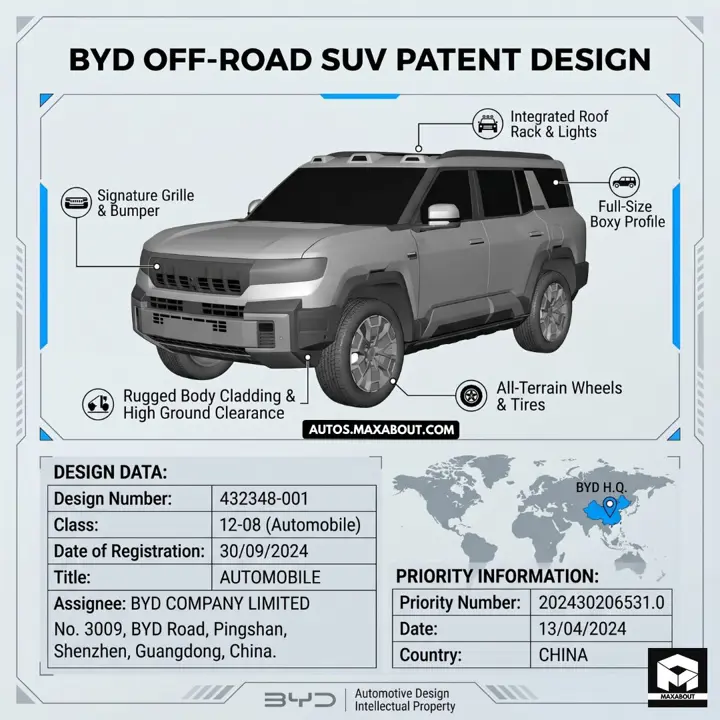 A patent filing, however, doesn't necessarily guarantee an imminent launch. It's more of a strategic move to protect intellectual property rights before potential market entry. That said, it does indicate BYD's serious intentions for the Indian market.
Currently, BYD offers models like the e6 MPV, Atto 3 SUV, and the recently launched Seal EV in India. The Leopard 8 PHEV would potentially add a plug-in hybrid option to their predominantly all-electric lineup, catering to customers who want electrification with range flexibility.
With growing interest in alternative fuel vehicles amid rising fuel prices and environmental concerns, the timing could be strategic for BYD's hybrid expansion in India.
Technical Specifications: What Makes the Leopard 8 Special?
Based on international specifications, the BYD Leopard 8 PHEV packs quite an impressive technical punch. It's expected to feature a 1.5L turbocharged engine working alongside electric motors, collectively generating around 550 HP. This powertrain setup should deliver a 0-100 km/h acceleration time of approximately 4.3 seconds - performance figures that would rival many luxury sports cars available in India.
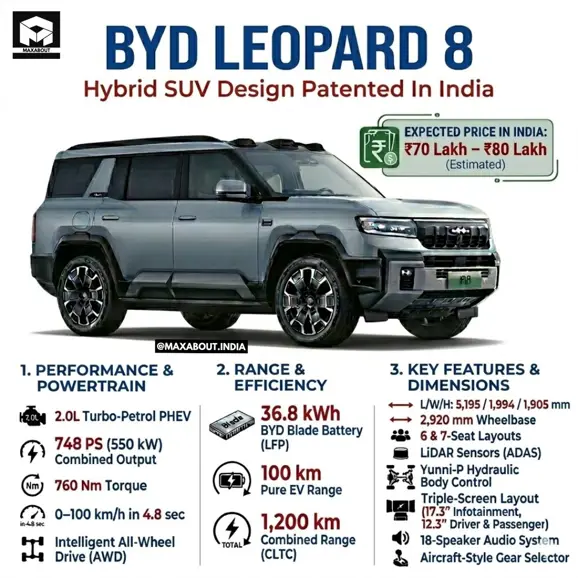 The Leopard 8 likely comes with a battery capacity of about 18.3 kWh, offering an electric-only range of 80-100 km. This is particularly relevant for Indian driving conditions, where the average daily commute in metros like Bangalore or Mumbai often falls within 40-50 km. Many owners could potentially complete their weekday driving without using any petrol.
Compared to other PHEVs in the Indian market like the Volvo XC60 Recharge (which offers about 45 km of electric range), the Leopard 8 would provide significantly more flexibility. Its fast-charging capability, estimated to support 0-80% charging in under 30 minutes, also addresses concerns about charging infrastructure limitations in many Indian cities.
Design and Features: A Closer Look at the Leopard 8
Based on patent images and BYD's design language, the Leopard 8 appears to embrace a sleek, modern aesthetic with a coupe-like silhouette despite being an SUV. I'm particularly impressed by its aggressive front fascia, which features sharp LED headlights and the signature "Dragon Face 3.0" design we've seen on newer BYD models.
Inside, expect premium materials throughout the cabin with a minimalist approach similar to the Seal. The centerpiece will likely be a rotating touchscreen display – a feature that has become BYD's distinctive touch. This would be complemented by a digital instrument cluster and possibly an augmented reality head-up display.
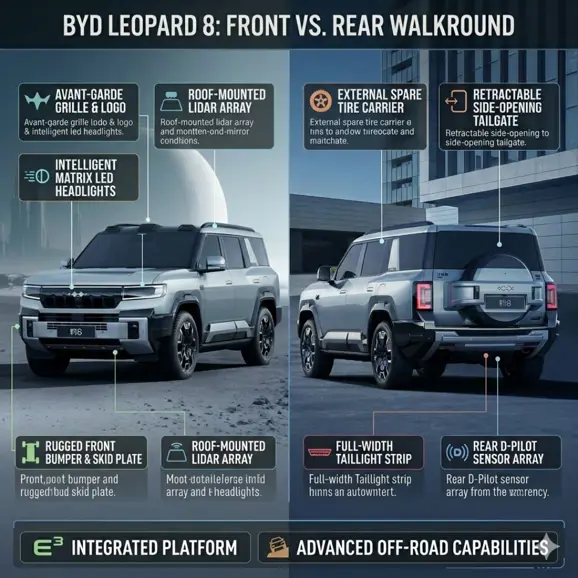 What intrigues me about the Leopard 8 is how it might be adapted for Indian conditions. With our notorious speed breakers and uneven road surfaces, I expect BYD will tune the suspension for greater ground clearance than its European specification. The panoramic glass roof shown in patent images would be a fantastic feature, though I wonder if it might require enhanced cooling capacity for our summer heat.
For premium buyers, the vehicle should offer ventilated seats, ambient lighting, and advanced driver assistance features – elements that are becoming expected in the ₹40+ lakh segment in India.
PHEV Technology: Is It Right for Indian Consumers?
Plug-in hybrid electric vehicles (PHEVs) occupy an interesting middle ground that might be particularly suited to India's evolving automotive landscape. These vehicles combine a conventional engine with a rechargeable battery pack, allowing for pure electric driving for shorter distances before switching to hybrid operation.
In metropolitan areas like Mumbai and Bengaluru where commutes can involve long periods in stop-and-go traffic, the electric-only mode could significantly reduce fuel consumption. Based on typical patterns, a PHEV with 50-60km electric range could handle most daily commutes without using any petrol.
The challenging part is charging infrastructure. While Delhi and Pune have made strides in public charging stations, tier-2 cities lag behind considerably. The beauty of PHEVs is that you're never stranded – the petrol engine ensures you can continue your journey even without charging access.
Compared to pure EVs, PHEVs eliminate range anxiety but carry more complexity in their dual powertrains. This raises questions about maintenance costs, especially after warranty periods expire. Will BYD establish sufficient service centers across India to support these sophisticated vehicles?
For those living in apartments without dedicated parking, the inability to charge regularly might diminish the PHEV advantage, making standard hybrids potentially more practical. That said, even with occasional charging, PHEVs still offer improved fuel efficiency over conventional vehicles – particularly valuable with fuel prices hovering around ₹100/liter in many states.
Expected Pricing and Market Positioning
Looking at BYD's current Indian lineup, I expect the Leopard 8 PHEV to be positioned as a premium offering. The Atto 3 starts at approximately ₹30 lakh, while the Seal sedan is priced around ₹41-53 lakh. Given the Leopard 8's larger size and PHEV technology, a price range of ₹70-80 lakh seems realistic.
At this price point, the Leopard 8 would compete with established luxury SUVs like the Jeep Meridian (₹30-37 lakh), MG Gloster (₹38-43 lakh), and Toyota Fortuner (₹33-50 lakh). The vehicle would also rival entry-level luxury SUVs from German manufacturers.
The value proposition would center around BYD's advanced battery technology and potential fuel savings. While import duties might inflate pricing, FAME-II subsidies (if applicable to PHEVs) could offset some costs. However, with limited PHEV options in India, BYD has an opportunity to establish itself in a relatively uncrowded segment.
Ultimately, the success will depend on whether luxury SUV buyers see sufficient value in the Leopard 8's technology to justify its premium over traditional diesel powerhouses that dominate this segment.
Challenges and Opportunities for BYD in India
Chinese auto brands still face perception challenges in India, with many consumers questioning long-term reliability and parts availability. BYD, however, is working hard to change this narrative through premium positioning and showcasing their technological prowess rather than competing on price alone.
The most significant hurdle for BYD is expanding their service network. With just about 24 dealerships across India currently, they're far behind established players. I believe they'll need at least triple that number to provide confidence to luxury buyers considering the Leopard 8.
The limited understanding of PHEVs among Indian consumers is another challenge. Most buyers here understand either conventional engines or full EVs, but the benefits of plug-in hybrids remain unclear to many.
On the positive side, the growing premium SUV segment presents a significant opportunity. Wealthy urban buyers increasingly value technological innovation and environmental credentials alongside luxury. The timing might be perfect as stricter emission norms push luxury buyers toward electrified options.
Competition will be fierce though, especially with Volvo, Mercedes, and BMW already offering electrified options. BYD's success will ultimately depend on establishing brand credibility in a market where European badges still command premium positioning.
What This Could Mean for India's EV Landscape
The potential arrival of the Leopard 8 could significantly reshape India's evolving EV landscape. PHEVs like this represent an important bridge technology as our infrastructure catches up with our EV ambitions. I think they offer a practical solution for consumers who want to embrace electrification but still harbor range anxiety on longer intercity trips.
This increased competition in the premium segment will likely accelerate innovation across the board. When manufacturers vie for market share, we typically see faster technology adoption and eventually more accessible pricing. The luxury segment often serves as a testing ground for features that eventually reach mass-market vehicles.
From a manufacturing perspective, if BYD commits to local production, it could strengthen our EV component ecosystem. Several states are already positioning themselves as EV manufacturing hubs, and foreign investment could accelerate this development.
Looking ahead, Indian consumers should watch for how government policy evolves around PHEVs versus pure EVs. The taxation structure will significantly influence adoption rates. I believe we're entering a fascinating period where traditional automotive hierarchies may be disrupted by new players with strong EV credentials.
Conclusion: Is the Leopard 8 Worth Waiting For?
The BYD Leopard 8's patent filing represents an intriguing development for the Indian automotive landscape. With its promised blend of performance, efficiency, and advanced technology, it could potentially fill a gap in our premium PHEV market. I think the vehicle might appeal particularly to tech-forward buyers who want electric capability without range anxiety.
That said, waiting for unannounced vehicles is always a gamble. We don't know the pricing strategy, service network expansion plans, or even if BYD will ultimately bring this model to India. For potential buyers, it's worth considering your current transportation needs against an uncertain timeline.
Will the Leopard 8 help transform how Indians view Chinese automotive brands? Only time will tell, but it certainly represents the rapidly evolving nature of our market where technology may soon trump traditional brand hierarchies.
No comments yet
Be the first to share your thoughts!
Want to read more automotive news?
Stay updated with the latest car launches, reviews, and industry insights.
Browse All News