
BYD Electric Car Price Hike In India From July 2026
Price hike announcements in the EV segment have a way of getting people's attention fast. And when the brand making that announcement is BYD, it gets even more interesting. The Chinese electric vehicle giant has confirmed that it will be increasing prices across its electric car lineup in India effe...
Editorial Team
Price hike announcements in the EV segment have a way of getting people's attention fast. And when the brand making that announcement is BYD, it gets even more interesting. The Chinese electric vehicle giant has confirmed that it will be increasing prices across its electric car lineup in India effective July 2026, and that news is already making buyers stop and think twice.
BYD is not a fringe player here. The company has quietly but steadily built a real presence in India's premium EV space. Models like the Atto 3, the sporty Seal, and the practical eMax 7 have found genuine takers among buyers who want something beyond the usual options. From what I have seen in owner communities and review discussions, BYD owners tend to be quite satisfied with the technology on offer, even if the brand is still building its service network across Indian cities.
So this price revision matters, and it matters to a specific kind of buyer. Someone sitting on the fence about the Seal or seriously considering the eMax 7 for family duties now has a real deadline to think about. This is not just another news update. Think of this as a practical guide to understanding what is changing, why it is happening, and whether acting before July 2026 actually makes financial sense for you.
Why Is BYD Increasing Electric Car Prices in India?
The short answer is: it is complicated. But let me break it down in a way that actually makes sense for someone trying to decide whether to buy now or wait.
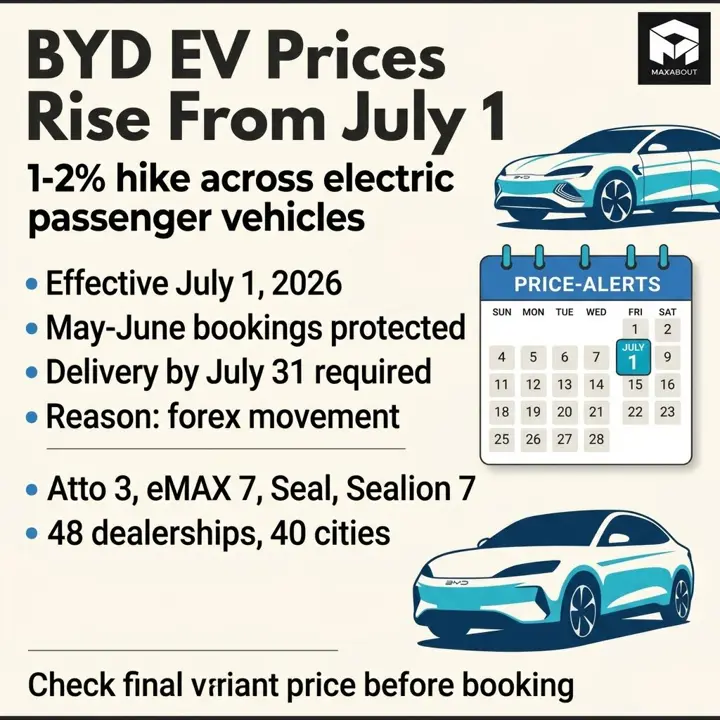 Import duties are the biggest piece of this puzzle. BYD currently sells its vehicles in India as CBUs — Completely Built Units — shipped directly from China. The customs duty on CBUs sits at a steep 100% for vehicles priced above a certain threshold. That is a massive cost burden that BYD has been partially absorbing to stay competitive. Industry reports suggest that absorbing those duties indefinitely simply is not sustainable at current volumes.
Then there is the raw material story. Lithium and cobalt — the core ingredients in EV batteries — have seen significant price volatility globally. While lithium prices dipped briefly, recent supply chain pressures have pushed costs back up, and battery packs remain the single most expensive component in any electric vehicle.
Currency movement adds another layer. The Chinese yuan's behaviour against the Indian rupee directly affects what BYD pays versus what it earns here. Even modest shifts over months can quietly erode profit margins on every unit sold.
Finally, BYD's own business strategy plays a role. As the brand matures in India and demand builds gradually, pricing corrections reflect a move toward long-term profitability rather than aggressive market-entry discounting.
How Much Could Prices Rise? A Look at BYD's Current India Lineup
To understand what a price revision actually means in practice, it helps to start with where BYD currently stands in India's premium EV space.
The BYD Atto 3 sits around ₹33–34 lakh (ex-showroom), positioning it squarely against established names in the mid-premium electric SUV segment. The BYD Seal, a genuinely impressive electric sedan, is priced closer to ₹41–45 lakh depending on the variant. Then there is the BYD eMax 7 MPV, which targets family buyers at roughly ₹26–27 lakh — arguably the most accessible entry point in BYD's India portfolio right now.
Now, even a 2 to 3 percent increase sounds modest on paper. But at these price points, the math tells a different story. A 3 percent hike on the Seal alone translates to somewhere between ₹1.2 to ₹1.5 lakh added to the sticker price. On the Atto 3, buyers could be looking at roughly ₹80,000 to ₹1 lakh extra. That is not pocket change for most buyers in this segment.
Based on how other premium EV brands have approached similar corrections — Kia, Volvo, and even BMW's electric range have all seen incremental revisions of 2 to 5 percent over recent years — a mid-range adjustment rather than a dramatic jump seems most likely. Industry patterns suggest BYD will probably avoid anything that looks aggressive, keeping the increase just enough to restore margin without alarming existing customers or dampening fresh inquiries.
Still, in absolute rupee terms, even a careful revision matters significantly at this price level.
Should You Rush to Buy a BYD EV Before the Price Hike?
The temptation is completely understandable. If a price revision is coming, buying now feels like the smart move. But I think it is worth slowing down before letting that logic drive a decision worth several lakhs.
First, the practical reality. BYD's dealership network in India remains relatively limited, concentrated mostly in metro cities like Mumbai, Delhi, Bengaluru, and Hyderabad. Waiting periods for popular variants — particularly the Seal and the Atto 3 in preferred colors — can stretch anywhere from a few weeks to over a month depending on your city. If the July 2026 deadline is firm, you actually have reasonable time. Rushing into a color or variant you did not originally want simply to beat a deadline rarely ends well.
On the financial side, the savings could be real but not necessarily dramatic. Based on the pattern of previous EV price revisions in India, a 2 to 4 percent increase on a vehicle priced between ₹30 lakh and ₹50 lakh translates to roughly ₹60,000 to ₹2 lakh. That is meaningful money, no question. But weighed against a poor variant choice or a financing arrangement you are not comfortable with, the math can quickly flip against you.
From what industry observers suggest, the smarter approach is to treat the deadline as useful motivation, not pressure. If you were already close to a decision — financing sorted, preferred variant identified, test drive done — then moving now makes genuine sense. But if you are still figuring out whether an EV fits your lifestyle, rushing could mean committing to a product category you are not fully ready for.
The price hike creates a window. Just make sure you are stepping through it for the right reasons.
BYD's Value Proposition in India: Does It Still Hold After a Price Increase?
This is the real question buyers need to sit with. A price hike changes the math, but does it change the answer?
Honestly, BYD's core strength has always been its battery technology. The Blade Battery is genuinely impressive — better thermal management, stronger longevity claims, and real-world range figures that hold up reasonably well even in stop-and-go Bengaluru or Delhi traffic. That part of the equation does not disappear after a price revision.
The feature-to-price ratio has also been a consistent talking point. Buyers get large panoramic roofs, rotating seats, advanced driver assistance systems, and substantial boot space at price points where most rivals are still offering considerably less equipment. After the hike, some of that gap will narrow — but it likely will not close entirely.
Where BYD still has genuine ground to cover is its service network. Compared to Tata or MG, the authorized touchpoints across smaller cities remain limited. For someone in Pune or Chennai, this is manageable. For buyers in Tier 2 cities, it is a legitimate concern worth factoring in.
From what industry observers and early owners have noted, the ownership experience has been largely positive — software updates, responsive customer support in metro areas, and strong resale conversations are emerging. But it is still a relatively young brand presence in India, and that carries some uncertainty.
At the revised price, BYD remains competitive. Just not as effortlessly as before.
Impact on India's EV Adoption: The Bigger Picture
Step back from the BYD conversation for a moment. This price hike is not happening in isolation — it is a signal worth reading carefully.
India's EV adoption is growing, but it remains deeply price-sensitive. The mass market is moving on the back of affordable options. The premium segment, where BYD sits, is still a relatively thin slice of the pie. When prices climb at this end, the ripple effects on buyer sentiment are real — even if the actual sales numbers do not collapse overnight.
The more immediate question is where a hesitant premium buyer turns next. Tata's lineup, MG's ZS EV and Windsor, and an increasingly confident set of upcoming players are all circling this space. None of them match BYD's technology depth right now, but they offer something equally important to the Indian buyer — familiarity, wider service reach, and pricing that does not require a second thought.
Then there is the policy angle. India's PLI schemes and high import duties were designed to push global manufacturers toward local manufacturing. In theory, that should bring costs down over time. In practice, brands like BYD are still navigating that transition, and the consumer ends up absorbing the pressure in the interim. The structure is working as intended in the long run — but the short-term cost lands on the buyer's doorstep.
If India is serious about its EV adoption targets, pricing friction at the premium end cannot be ignored forever.
Alternatives Worth Considering If BYD Prices Feel Too High
If the post-hike BYD numbers no longer sit comfortably within your budget, it genuinely makes sense to step back and reassess. The Indian EV market has matured enough that you are not left with poor options.
For buyers prioritizing service network reliability — especially in tier 2 and tier 3 cities — the Tata Nexon EV and Tata Punch EV remain hard to overlook. Tata's service reach across smaller towns is something most international brands simply cannot match right now. That matters more than most people admit when calculating real ownership costs.
If range is your primary concern, the MG ZS EV and the upcoming BYD competitors from Hyundai's electric lineup offer reasonable highway performance with growing fast-charger compatibility across major corridors like the Delhi-Jaipur and Mumbai-Pune stretches.
For those willing to spend closer to the premium segment, the Kia EV6 and Hyundai Ioniq 5 deserve a serious look. Charging infrastructure support and after-sales experience in metro cities have improved noticeably.
Total cost of ownership is what I would urge anyone to calculate honestly — insurance, charging costs, resale value trends, and service availability in your specific city. A slightly lower sticker price from a brand with stronger local roots can save you considerably over five years.
Final Thoughts: Is This a Dealbreaker or Just the Cost of Progress?
Honestly? It depends on where you stand right now in your buying journey.
Price increases are rarely welcome news, but they are not entirely surprising either. As BYD deepens its India footprint — localising components, expanding its dealer network, navigating import duty structures — some cost adjustment was always likely. That is just the reality of how automotive businesses scale in a market as complex as India.
That said, I completely understand the frustration. Many buyers have been waiting patiently for EVs to become more accessible, not less. A hike before July 2026 feels like the window closing just as you were reaching for it.
My honest takeaway for anyone actively considering a BYD right now — do not panic, but do not delay unnecessarily either. If the numbers work for you today, waiting purely on speculation rarely pays off.
Evaluate this as a long-term investment. BYD builds genuinely capable electric vehicles. But in a market where competition is intensifying rapidly, informed patience often beats reactive purchasing. Know your budget, do the total cost calculation, and decide with clarity — not urgency.
Explore the story
Related news
Share your view and join the discussion.
Earn reward points for every comment and get a chance to win ₹1,000 in our weekly lucky draw. Sign in with Google in one tap.
Start the conversation
No one has commented on this article yet. Be the first to share your view.
Want to read more automotive news?
Stay updated with the latest car launches, reviews, and industry insights.
Browse All News